It’s Official: March Was the 10th Straight Month to be Hottest on Record
And there’s only one reason for such a streak
Another month, another heat record for the planet.
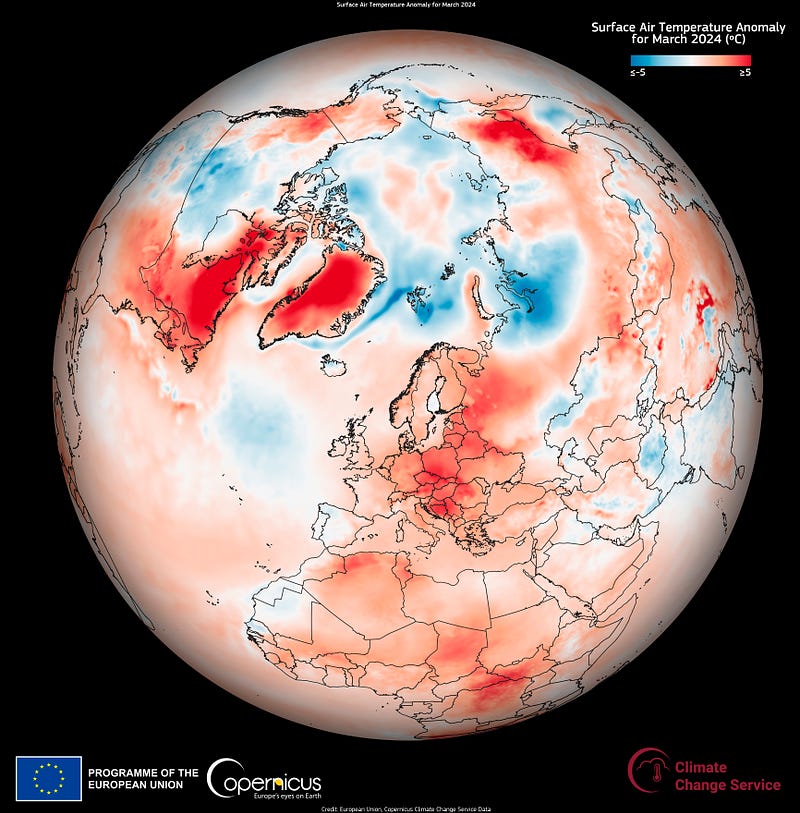
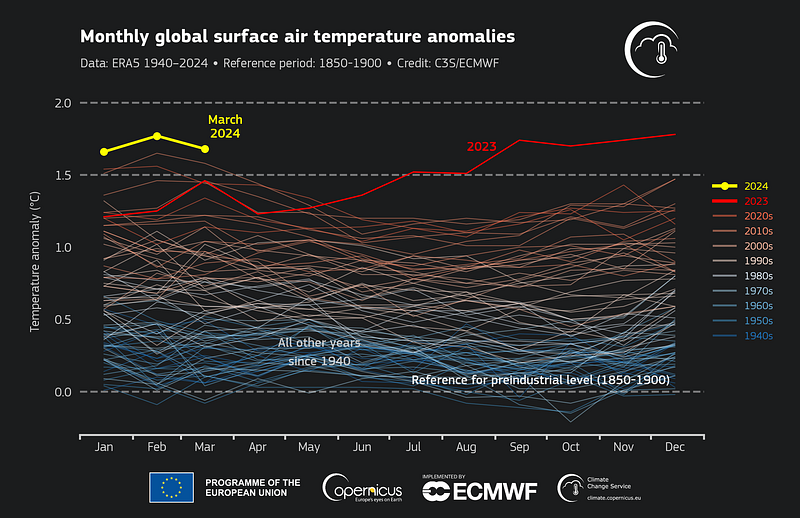
According to data released by the Copernicus Climate Change Service, March 2024 was warmer globally than any previous March in the data record by all standards:
- 0.10°C above the previous high set in March 2016
- 0.73°C above the 1991–2020 average
- 1.68°C warmer than the average pre-industrial March temperature
- Global sea surface temperature averaged 21.07 °C, the highest monthly value on record and slightly higher than what was recorded in February
- The most above-average country was Paraguay, at nearly +5°C (!)
This isn’t a one-off incident. For the 10th consecutive month, we’ve had record-breaking global heat. Both surface air and sea surface temperatures reached unprecedented levels. And over the past year, our global temperatures have been the highest ever recorded, 0.70°C above the 1991–2020 average and 1.58°C above the pre-industrial average. This situation even surpasses the 1.5°C limit set by the Paris climate agreement, albeit temporarily (the landmark deal won’t be considered breached until this trend persists for a decade).
This staggering reality has climate scientists questioning whether this is a late aftermath of El Niño or a terrifying indication of our planet’s deteriorating health.
Becuase El Niño is dwindling, and the temperatures should decrease. But “If the anomaly does not stabilize by August — a reasonable expectation based on previous El Niño events — then the world will be in uncharted territory. It could imply that a warming planet is already fundamentally altering how the climate system operates, much sooner than scientists had anticipated,” said Gavin Schmidt, the director of NASA’s Goddard Institute for Space Studies.
The facts speak for themselves.
No Place Can Escape The Heat
Copernicus is Europe-based so their information on the continent is thorough. My sharp friend Denis Gorbunov, anticipated what the reports brought: that the largest anomalies occurred over the central and eastern regions of the continent, with Germany recording its hottest March since 1881. The Netherlands experienced a frost-free March for only the second time. The Baltic countries were no exception. Other countries, including Croatia, Latvia, Moldova, Hungary, and Ukraine, smashed their March temperature records, soaring to new highs between +1.3°C and +4.2°C above the norm.
Beyond Europe, it’s the same alarming story. The month kicked off with record-low ice cover over the Great Lakes in Eastern North America; Greenland and eastern Russia reported much higher temperatures than normal.
Central America, where drought is crippling the Panama Canal, also reported unusually high temperatures. Cuba, for example, noted a +2.0°C anomaly. South America wasn’t spared either, especially Venezuela and parts of the continent’s central region, with Paraguay having the highest anomaly at almost +6°C. Africa, too, had no respite, with several regions hitting exceptionally high temperatures. Even April has begun with the worst heatwave in Sahel history. South Australia had its warmest March on record. Even Antarctica wasn’t exempt from the heat, particularly over Marie Byrd Land and east of the Antarctic Peninsula.
And my home country, Argentina? It experienced a March of extremes — a chilly South and a blisteringly hot North, with anomalies soaring up to +5.7°C near Paraguay.
So, there it is: no place on Earth is immune to these rising temperatures.
A Warming Acceleration Debate
The UK Met Office accurately predicted five years ago that global warming could temporarily hit 1.5°C above pre-industrial levels for the first time between then and 2023. But since monthly records started piling up last June, there has been a vibrant debate among scientists (and wannabes): is global warming accelerating faster than expected?
Yes, there is increasing evidence of an acceleration in the rate of warming over the past 15 years.
Dr. Zeke Hausfather’s latest analysis at Carbon Brief Fact Check confirms it. But here’s the kicker: this acceleration aligns with the latest climate models and the Intergovernmental Panel on Climate Change (IPCC)’s recent sixth assessment report. Their “assessed warming projections” anticipate a 26% faster warming rate up to 2050, compared to what we’ve seen since 1970. And the latest climate models have a prominent backup. Dr. James Hansen, a leading climate scientist, and his colleagues also estimated this acceleration in a notable 2023 paper.
Even though annual temperatures still remain well within the range of climate-model projections, there remain major questions regarding drivers of 2023’s record-breaking heat relative to 2022.
Gavin Schmidt, noted we’re breaking temperature records every month by up to 0.2C. “It’s humbling, and a bit worrying, to admit that no year has confounded climate scientists’ predictive capabilities more than 2023 has,” the successor to Dr. Jim Hansen wrote in a recent article for Nature.
Schmidt offers some potential causes: the El Niño effect, pollution control-induced reductions in sulfur dioxide particles, the fallout from the 2022 volcanic eruption in Tonga, and increased solar activity.
Yet, he admits these factors aren’t enough to explain the 0.2C spike. So, let’s give him a hint.
The One and Only Reason For Such a Streak
Scientists agree, with a near-unanimous 99.9% consensus, that human-triggered climate change is the principal cause of record-breaking global heat. And there’s no room for debate — fossil fuels are the core of the problem.
The only opposition to this view comes from the fossil fuel industry. These are the companies responsible for 80% of emissions and stand to lose trillions of dollars. On the 10th consecutive month with record-breaking global heat, Saudi Aramco’s CEO was insanely applauded for claiming that ‘We should abandon the fantasy of phasing out oil and gas.’ This was despite the fact that his country and others had agreed to move away from fossil fuels at the COP28 climate summit in Dubai just four months earlier.
The deeper problem is, as Vaclav Smil says, that our modern civilization is built upon four pillars: cement.), steel, plastics, and ammonia. These are the foundation of our lives and are involved in everything we do. The common denominator? They all require fossil fuels for their production.
And fossil fuels are absurdly cheap when you consider the environmental damage they cause. In 2020, they were subsidized to the tune of $5.9 trillion, or 6.8% of GDP, a figure set to rise to 7.4% by 2025. That’s $11 million per minute to support the industry that is destroying us. For every single dollar we invest in combating climate change, there are at least five at the very thing causing it.
The reality is paradoxical: our identity is built around consumption, and for that, we are fully dependent on fossil fuels, no matter if that’s bringing our planet toward the critical 1.5°C global warming threshold.
“We’ve had record-breaking months that have been even more unusual,” said Samantha Burgess, deputy director of Copernicus, pointing to February 2024 and September 2023. But the “trajectory is not in the right direction,” she added.
The bottom line is clear: the world is warming as fast as predicted — and that’s bad enough. April 2024 is already shaping up to be the warmest ever. This trajectory will not change until concentrations of greenhouse gases in the atmosphere stop rising.
Until then, expect more broken records.
Be loud.
Thank you for your thorough reading and support! Subscribe for immediate insights and join the 400+ Antarctic Sapiens community for weekly thought-provoking content.