
Cliff Notes on the 1619 Project
And the white supremacy behind “patriotic education”
I first heard of the 1619 Project when Senator Tom Cotton objected to it being taught in public schools. The Project investigates the impact that slavery had on the United States, and Cotton objected so strongly to its message that he suggested defunding any school that taught it. That was intriguing. So I looked it up.
Then I wrote a story about what I read, and shortly thereafter got the “15 minutes of fame” that Andy Warhol promised.
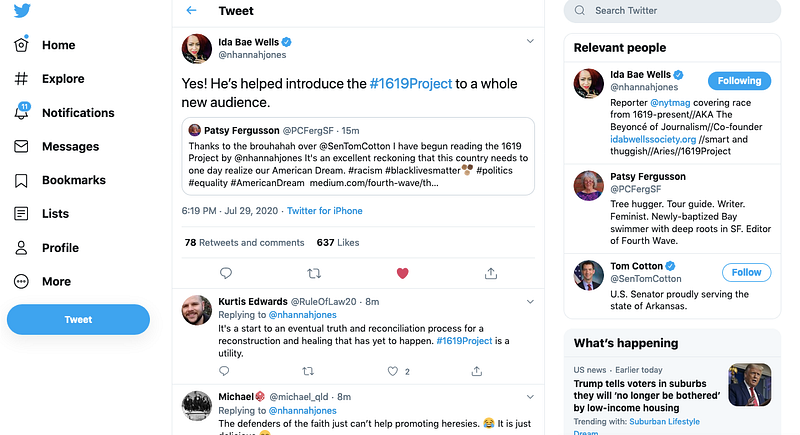
When I promoted the story on Twitter, Nikole Hannah-Jones — the New York Times journalist, 2017 MacArthur fellow, and Pulitzer Prize winner who conceived of the Project in the first place — retweeted me!
I felt well and truly blessed by the gods of Journalism.
Pumped by the mention and the consequent views and reads, I set out to read the 1619 Project in its entirety. But here’s the thing: It’s long. It’s complicated. It’s not one story, but 14 essays written by an array of historians on a variety of topics, plus a podcast. This was going to take time. This was going to take commitment. So I put it on the back burner…
Trump ups the ante
Then on Sept. 17, President Trump said he was establishing a commission to promote “patriotic education,” by which he means white-centered education that flatters our founders and glosses over our history of oppressing people of color.
Trump went so far as to call teaching curricula like the 1619 Project “child abuse.” He obviously hasn’t read it himself, or he’d know that the reading level of the essays places it at high school or beyond, when students are mature enough to appreciate the truth. And it’s not all ugly.
One important theme of the Project is that Blacks have fought to realize our American ideals. Why would we want to ignore that achievement?
It’s like Nikole Hannah-Jones says in her introduction to the Project: “Our democracy’s founding ideals were false when they were first written. Black Americans have fought to make them true.” Here’s how.
Probably the most famous line in the U.S. Constitution is that “all men are created equal.” But when it was written, it didn’t apply to women. It didn’t apply to Blacks, or indigenous people, or other people of color. And it didn’t apply to poor White men who didn’t own property or pay taxes. In fact, it only applied to about six percent of the population at the time.
We’ve since expanded the founders’ narrow vision to include all people. But how did that expansion happen? Much of it was though Black protests for Black rights. And it’s time to give credit where credit is (over)due.
The Union still isn’t perfect. We’re still working on it. But if people like Trump and Cotton have their way, some hard-won gains in equality will be reversed. Yet even if they prevail, we don’t have to allow the government to prescribe our education. As long as we live in a democracy (fingers crossed and ballot ready), we can educate ourselves.
So today I’m offering something for the lazy learner (like me): the first of what I plan to be 14 summaries of each essay in the 1619 Project. I hope this series will motivate me to read each essay in full. And I hope the little taste I provide will give you a better understanding of the Project in general, and maybe whet your appetite for more.
Essay #1 — The Idea of America
The first essay was written by the project’s originator, Nikole Hannah-Jones. She talks about how patriotic her father was, despite growing up in “an apartheid state that subjugated its near-majority black population through breathtaking acts of violence. White residents in Mississippi lynched more black people than those in any other state in the country, and the white people in my dad’s home county lynched more black residents than those in any other county in Mississippi.”
Even serving in the military did not grant her father fair treatment. Yet still, he always flew an American flag in their yard.
Hannah-Jones was embarrassed by his patriotism in her youth. Why did he love the country that mistreated him? At school, she was taught that “our history as a people began with enslavement and that we had contributed little to this great nation.”
But in fact, the 400,000 Africans who were kidnapped, enslaved, and brought to North America in chains beginning in 1619 transformed it into “some of the most successful colonies in the British Empire” with their “stolen labor.”
Yet the vast material wealth that Blacks created is not their greatest legacy, Hannah-Jones argues. Instead, it’s their passionate pursuit of American ideals. “More than any other group in this country’s history, we have served, generation after generation, in an overlooked but vital role: It is we who have been the perfecters of this democracy,” she writes. That was a new idea to me, and it made me sit up and take notice.
“Our democracy’s founding ideals were false when they were first written. Black Americans have fought to make them true.”
“Through centuries of black resistance and protest, we have helped the country live up to its founding ideals. And not only for ourselves — black rights struggles paved the way for every other rights struggle, including women’s and gay rights, immigrant and disability rights.
“Without the idealistic, strenuous and patriotic efforts of black Americans, our democracy today would most likely look very different — it might not be a democracy at all.”
So what about that flag flying in her father’s yard? Hannah-Jones says he understood a truth that she hadn’t yet grasped in her youth. “That black Americans, as much as those men cast in alabaster in the nation’s capital, are this nation’s true ‘founding fathers.’ And that no people has a greater claim to that flag than us.”
Her points are well taken, and make it clear that we must include Black experience in our history books via scholarly efforts like the 1619 Project. Ignoring the facts, glossing over them, only makes our students ignorant and deluded. And knowing the truth won’t make them ashamed of their country, but better equipped to pursue its highest goals. Imagine the healing that could be possible if we only gave credit where credit was due. Imagine the example we’d be setting if we resisted the urge to aggrandizement and insisted instead on Truth.
Read Nikole Hannah-Jones’ complete essay here.
For more of the good stuff, follow Fourth Wave, where we’re working to change the world for the better, one story at a time.
For further reading:
In honor of Black History and Women’s History Months…


