avatarPatsy Fergusson

Free AI web copilot to create summaries, insights and extended knowledge, download it at here

3370

Abstract

ass="link-block"> <a href="https://readmedium.com/why-u-s-capitalism-is-so-brutal-beec240c0d1e"> <div> <div> <h2>Why U.S. Capitalism is So Brutal</h2> <div><h3>Cliff Notes on the 1619 Project #2 — Capitalism</h3></div> <div><p>medium.com</p></div> </div> <div> <div style="background-image: url(https://miro.readmedium.com/v2/resize:fit:320/1*f_52jfb3dzI4bcI6TZ906Q.jpeg)"></div> </div> </div> </a> </div><h2 id="f1ad">How slavery’s legacy corrupted American healthcare</h2><p id="67b9">NYT Editorial Board member and magazine writer <a href="https://www.jeneeni.com/">Jeneen Interlandi</a> wrote the <a href="https://www.nytimes.com/interactive/2019/08/14/magazine/universal-health-care-racism.html">third essay</a>, which says the United States doesn’t have universal healthcare like <a href="https://en.wikipedia.org/wiki/List_of_countries_with_universal_health_care">all the other wealthy nations</a> because the country was built on slavery — a system that requires the belief that some humans are “more equal” than others.</p><p id="eb15">One example is the Smallpox Epidemic. After the Emancipation Proclamation, many formerly enslaved Black Americans lived together in makeshift camps across the South, where Small Pox began to spread. But rather than support a vigorous eradication effort, local politicians preferred to declare this result of poor sanitation and nutrition as evidence that Black people were better off enslaved.</p><blockquote id="77fe"><p>White legislators argued that free assistance of any kind would breed dependence and that when it came to black infirmity, hard labor was a better salve than white medicine. As the death toll rose, they developed a new theory: Blacks were so ill suited to freedom that the entire race was going extinct. “No charitable black scheme can wash out the color of the Negro, change his inferior nature or save him from his inevitable fate,” an Ohio congressman said.</p></blockquote><p id="1a18">After the Civil War, former slave states formed a powerful political bloc that passed laws that kept Black Americans oppressed for a century. When federal laws attempted to legislate equality, Southern Democrats invoked the charm of “state’s rights” to interpret them in ways that fortified white supremacy and excluded Black people from potentially empowering programs like the Fair Labor Standards Act, Aid to Families with Dependent Children, and the G.I. Bill. When it came to healthcare, it was more of the same.</p><blockquote id="c9ee"><p>Professional societies like the American Medical Association barred black doctors; medical schools excluded black students, and most hospitals and health clinics segregated black patients. Federal health care policy was designed, both implicitly and explicitly, to exclude black Americans. As a result, they faced an array of inequities — including statistically shorter, sicker lives than their white counterparts.</p></blockquote><p id="f5a1">Whether consciously racist or not, the American system that made paying for health care the responsibility of wealthy employers left behind “gig” farmworkers and domestic help, most of whom were people of color. And even when a predominantly Black gr

Options

oup like the Pullman Porters Union managed to bargain for employer-paid healthcare, they couldn’t access the better financed and equipped white hospitals.</p><p id="75c3">Over the years, Blacks have endeavored to make healthcare available to every American. In the 1950s, the primarily-Black National Medical Association pushed for a federal healthcare system. But the primarily-white American Medical Association fought back, calling the idea socialist and un-American, substanceless “name-calling” arguments that are still in use today.</p><p id="e74f">Reserving healthcare for the privileged few has consequences beyond lack of access to care for the poor and working class. <a href="https://www.nytimes.com/interactive/2019/08/14/magazine/racial-differences-doctors.html">Racist myths about Black bodies</a> (including that they are better able to tolerate pain) perpetuate in a white supremacist hierarchical system that locks Black leaders out.</p><h2 id="3f99">How we can use this knowledge to change</h2><p id="1c62">The more I read about systemic racism in America, the more I believe we need a complete do-over. Our political, financial, and healthcare systems should not be built on systems that prop up one group at the expense of others.</p><p id="063d">Do we hold our truths to be self evident? Are all people imbued with inalienable rights? Are all people entitled to life, liberty, and the pursuit of happiness? Or is it just white men?</p><p id="f705">I hope and believe the vast majority of Americans believe that ALL people are created equal, and deserve equal rights. Towards that end, I want us to make some changes.</p><p id="fdaa">I want universal healthcare. I want a tax structure that doesn’t favor the rich. I want policies that support the most vulnerable among us. I want the planet, and the people and animals and plants who live on it, to be valued more than money. And politically? I don’t want small groups of extremists, like the original Southern Democrats or the current GOP, to be able to distort or derail fair-minded policies meant to benefit everyone.</p><p id="200c">Is that too much to ask? Not at all. What’s more, now is the precise moment in America’s history — juxtaposed at the confluence of multiple national calamities — when vast changes like these are possible. So let’s get it done.</p><p id="1a15"><i>For more of the good stuff, follow <a href="https://medium.com/fourth-wave">Fourth Wave</a>, where we’re changing the world for the better, one story at a time. Got one of your own? <a href="https://readmedium.com/submit-to-the-wave-7c92f095e86f?source=friends_link&amp;sk=c6df1d6e65509aab783bdc7ea7332ab8">Submit to the Wave!</a></i></p><p id="371c"><i>P.S. Here’s how I heard about The 1619 Project in the first place:</i></p><div id="5a5f" class="link-block"> <a href="https://readmedium.com/thank-you-senator-cotton-53e827553adc"> <div> <div> <h2>Thank You, Senator Cotton</h2> <div><h3>For making me aware of the 1619 Project</h3></div> <div><p>medium.com</p></div> </div> <div> <div style="background-image: url(https://miro.readmedium.com/v2/resize:fit:320/1*kKyoWX3POrTgUCIogWYspg.jpeg)"></div> </div> </div> </a> </div></article></body>

Why the U.S. Healthcare System Sucks

Cliff Notes on The 1619 Project — Essay #3
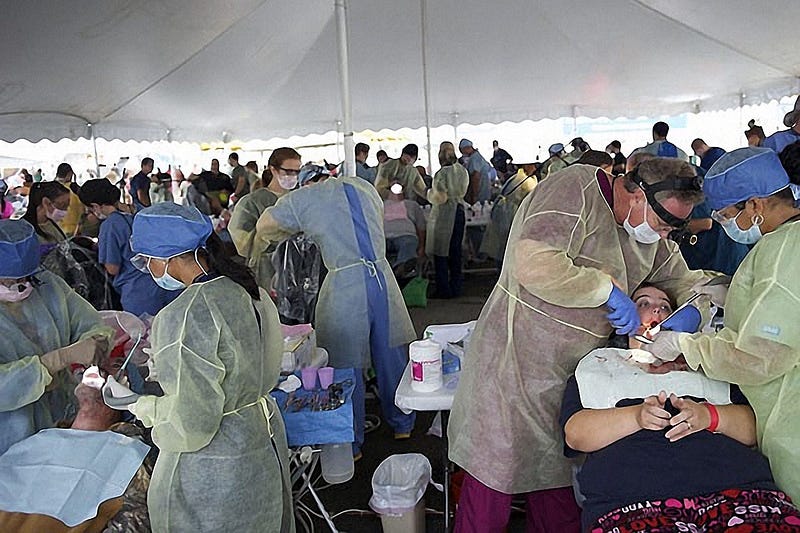
This image of people getting free healthcare in Appalachia is from this 2012 Reuter’s story by Mark Makela. When the clinic was set up by Remote Area Medical, a private charity, “People came from 14 states seeking care, and an estimated 1,700 patients were admitted for treatment the first day.”

This is the third in an intended series summarizing the collection of essays that drive The 1619 Project, a New York Times effort that asks journalists, scholars, historians, and artists to examine the history of slavery in the United States and express how it shaped and continues to affect the country.

How slavery’s legacy is still corrupting America

Project creator, NYT journalist, and Pulitzer Prize winner Nikole Hannah Jones wrote the introductory essay, which points out that the American ideal of “equality for all” wasn’t true when the founders wrote the Constitution. In fact, the “inalienable rights” enshrined in that document applied to only about 6 percent of the population at the time. But don’t despair. Black people have America’s back. They’ve been fighting to realize that ideal since the country was founded. Here’s my summary of the first essay:

How slavery’s legacy corrupted American capitalism

Princeton professor Matthew Desmond wrote the second essay, which posits that America’s particularly brutal form of winner-take-all capitalism was modeled on the plantation system and informed by “our nation’s unflinching willingness to use violence on nonwhite people and to exert its will on seemingly endless supplies of land and labor.” If we want to change that, we must first admit it. It’s not too late to amend America’s financial systems to more equitably distribute the wealth of the nation. Here’s my summary:

How slavery’s legacy corrupted American healthcare

NYT Editorial Board member and magazine writer Jeneen Interlandi wrote the third essay, which says the United States doesn’t have universal healthcare like all the other wealthy nations because the country was built on slavery — a system that requires the belief that some humans are “more equal” than others.

One example is the Smallpox Epidemic. After the Emancipation Proclamation, many formerly enslaved Black Americans lived together in makeshift camps across the South, where Small Pox began to spread. But rather than support a vigorous eradication effort, local politicians preferred to declare this result of poor sanitation and nutrition as evidence that Black people were better off enslaved.

White legislators argued that free assistance of any kind would breed dependence and that when it came to black infirmity, hard labor was a better salve than white medicine. As the death toll rose, they developed a new theory: Blacks were so ill suited to freedom that the entire race was going extinct. “No charitable black scheme can wash out the color of the Negro, change his inferior nature or save him from his inevitable fate,” an Ohio congressman said.

After the Civil War, former slave states formed a powerful political bloc that passed laws that kept Black Americans oppressed for a century. When federal laws attempted to legislate equality, Southern Democrats invoked the charm of “state’s rights” to interpret them in ways that fortified white supremacy and excluded Black people from potentially empowering programs like the Fair Labor Standards Act, Aid to Families with Dependent Children, and the G.I. Bill. When it came to healthcare, it was more of the same.

Professional societies like the American Medical Association barred black doctors; medical schools excluded black students, and most hospitals and health clinics segregated black patients. Federal health care policy was designed, both implicitly and explicitly, to exclude black Americans. As a result, they faced an array of inequities — including statistically shorter, sicker lives than their white counterparts.

Whether consciously racist or not, the American system that made paying for health care the responsibility of wealthy employers left behind “gig” farmworkers and domestic help, most of whom were people of color. And even when a predominantly Black group like the Pullman Porters Union managed to bargain for employer-paid healthcare, they couldn’t access the better financed and equipped white hospitals.

Over the years, Blacks have endeavored to make healthcare available to every American. In the 1950s, the primarily-Black National Medical Association pushed for a federal healthcare system. But the primarily-white American Medical Association fought back, calling the idea socialist and un-American, substanceless “name-calling” arguments that are still in use today.

Reserving healthcare for the privileged few has consequences beyond lack of access to care for the poor and working class. Racist myths about Black bodies (including that they are better able to tolerate pain) perpetuate in a white supremacist hierarchical system that locks Black leaders out.

How we can use this knowledge to change

The more I read about systemic racism in America, the more I believe we need a complete do-over. Our political, financial, and healthcare systems should not be built on systems that prop up one group at the expense of others.

Do we hold our truths to be self evident? Are all people imbued with inalienable rights? Are all people entitled to life, liberty, and the pursuit of happiness? Or is it just white men?

I hope and believe the vast majority of Americans believe that ALL people are created equal, and deserve equal rights. Towards that end, I want us to make some changes.

I want universal healthcare. I want a tax structure that doesn’t favor the rich. I want policies that support the most vulnerable among us. I want the planet, and the people and animals and plants who live on it, to be valued more than money. And politically? I don’t want small groups of extremists, like the original Southern Democrats or the current GOP, to be able to distort or derail fair-minded policies meant to benefit everyone.

Is that too much to ask? Not at all. What’s more, now is the precise moment in America’s history — juxtaposed at the confluence of multiple national calamities — when vast changes like these are possible. So let’s get it done.

For more of the good stuff, follow Fourth Wave, where we’re changing the world for the better, one story at a time. Got one of your own? Submit to the Wave!

P.S. Here’s how I heard about The 1619 Project in the first place:

Racism
Politics
American History
1619 Project
Health
Recommended from ReadMedium