
ENVIRONMENT | OKAVANGO DELTA | OIL AND GAS
It Is Ludicrous That a Canadian Oil Company Wants To Drill For Oil Near the Okavango Delta
Will the insanity never end?
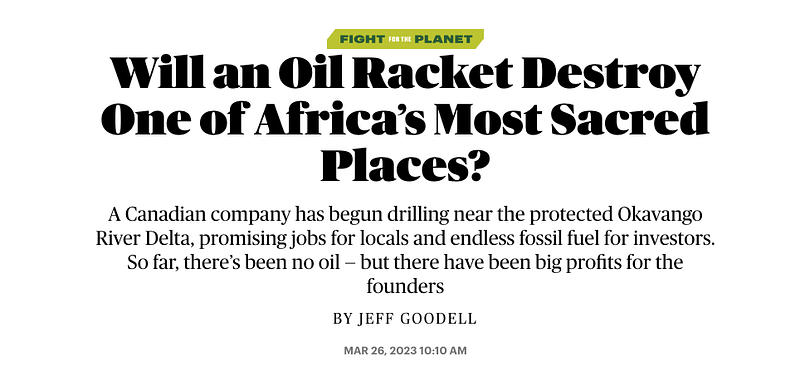
This morning an article in Rolling Stone Magazine, Will an Oil Racket Destroy One of Africa’s Most Sacred Places?, crossed my feed. It immediately caught my eye because it was written about an issue that has caused me great sorrow.
In 2021 my partner and I housesat in Maun, Botswana, a city located just outside the southern end of the Okavango Delta, for six weeks.
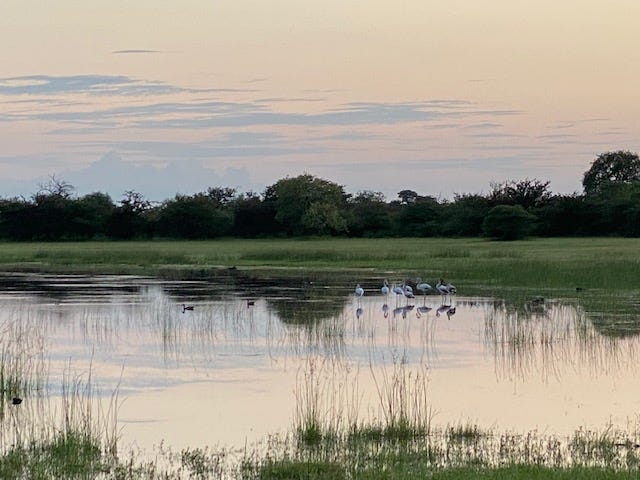
Known as the largest inland river delta in the world, the Okavango Delta is one of our planet's most biologically rich areas. Each year the rains from Angola tumble down the mountains and fill in an inland area of approximately 15 000 sq. km (5791 sq. miles).
This water feeds millions of creatures and habitats whos lives depend on this yearly cycle.
We had plans to go out into the delta the day after we finished our housesit but then we met Mike. Mike was heading out to his safari lodge, a 2-hour drive away, and invited us to come with him as his guests for a weekend.
Because we were finished with the housesit, we packed up all of our stuff and headed off. As full-time travelers, we knew that from there we would figure out where to go next.
We were a bit sad to turn our backs on visiting the delta, but we were also told that it wasn’t the best time of year to go out on it. At that point we had plans to return to housesit later in the year, so we figured we would see it then.
The lodge wasn’t very busy because of Covid, so along with the staff, we almost had the place to ourselves. As darkness arrived, our friend lit a fire in the fire pit.
“We’re gonna have ourselves a braai!” He exclaimed.
We had heard of braai’s since we had arrived in Botswana, but we hadn’t officially experienced one. I assumed it was just another type of BarBQue, but we would learn that a braai is a bit different. This time, instead of cooking on a grill, the mass amount of meat would be cooked right on the fire.
While researching the technical definition of what a Braai is, I found this helpful article that explains the difference between a Braai and a BBQ. It’s quite hilarious, really, and I laughed hard at this passage:
At a BBQ the alcohol consumption is monitored, lest you start disturbing the neighbours or risk being punished by the authorities for driving under the influence. This isn’t a concern at a braai. In fact, those invited have most likely already consumed a six-pack or a bottle of plonk while getting ready……and amazingly arrive looking as fresh as a priest on a Sunday morning.
One thing is for sure, Botswanans know how to drink!
Predictably, many others from the nearby village showed up and a party ensued.
At some point, a young lady came and sat next to me. We chatted about this and that and she asked us about how we came to be in Botswana. Of course, she asked us where we were from, to which I answered Canada.
It was then that she told me that she was part of a protest group that was trying to stop a Canadian Oil company from drilling for oil near the delta.
My eyes were wide as I said “WHAT? They can’t drill for oil there. It could be a disaster!”
I can’t really explain the pain I felt in my heart upon hearing this news. It truly felt like it sunk in my chest. Along with this, I went through a range of emotions.
First I felt shame because of my Canadian background, then there was disgust with how humans disregard the fragile ecosystems of our planet. Disbelief was next as I tried to process this disturbing information.
We chatted for a while about their attempts to stop this process, and all the while I felt helpless and sad. I was sad not only for the people that are trying to protect the beautiful place they call home, or for the locals that will have their lives disrupted because of this but will never benefit from it. Most importantly, I felt sad for the animals and the environment that depends on the clean rainwater that runs down the mountains.
Heaven forbid if an accident happened and oil found its way into the delicate balance that is the Okavango Delta.
When does the insanity end?
Jeff Goodell, the author of the Rolling Stones article, says this about the delta:
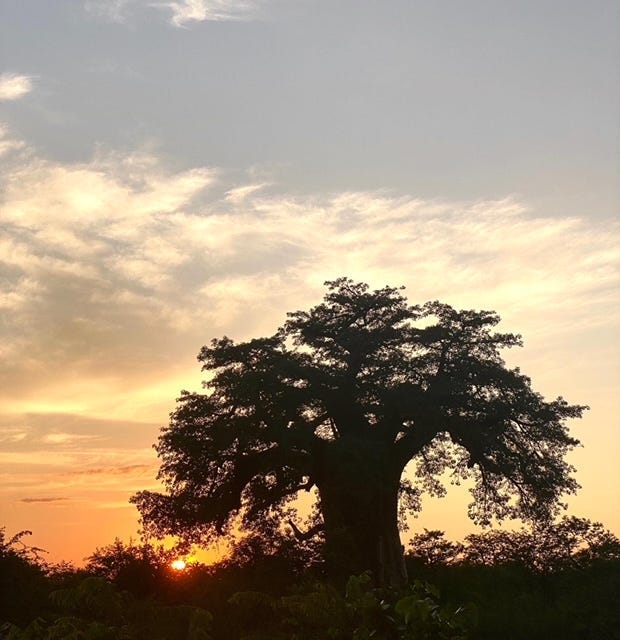
The water in the delta is beautiful and clear, unpolluted by chemicals or sediments. For wildlife, this water is a lifeline, a paradise, a refuge. Hippos and crocodiles thrive in the shallow channels and pools. More than 500 species of birds flash through the skies. It is a landscape of ancient baobab trees (one baobab in Namibia is estimated to be 2,100 years old) and riverbanks of papyrus, the plant from which Egyptians learned to make paper 4,000 years ago. It is an unfenced, undomesticated place that still moves to the rhythms of nature, where the big animals that populated your childhood imagination live and hunt and die without human interference.
I get it. Money dictates our lives. It is what keeps our economy going. We all need money to survive, and I don’t want to undercut the economic benefits that this may bring to these Southern African countries (not getting into the fact that it will only make the rich richer). But we REALLY have to start thinking about the environment that supports us.
If we don’t have a healthy environment, we can’t survive. When that happens, money will mean nothing and the economy will become a fart in the wind.
I’m currently back in Canada and my home province of Alberta. Alberta is the oil and gas capital of Canada and many of my childhood friends have found employment in the industry and have carved out nice lives for themselves. While I don’t support the further extraction of fossil fuels, I do respect that they have been an important part of our human development.
But when is enough?
When I told one of my childhood friends about this, a friend that has been working in the oil and gas industry for nearly 30 years, his response was, “There is enough oil in other parts of the world. They don’t need to bother with those sensitive areas.”
But how much oil is there?
According to Jeff’s research, his article claims that there is 120 BILLION barrels of oil waiting to be extracted. Of course, nobody can be 100% certain with these numbers. And it’s interesting to note that the man who made this claim, is not working for this company anymore.
But later in the article we hear from another geologist who claims that the area where they think all of this oil is, isn’t as deep as they think and he believes that the Earth's geological evolution long ago cooked off the oil. In fact, when asked if he thinks there is any oil there at all, his response is simply, “Extremely unlikely.”
And the truth is, not one drop of oil has come out of the ground yet and many wonder if any actually exists. But, as Jeff states, one thing is for sure:
If ReconAfrica is right and there is a lot of oil and gas below the Okavango Delta, somebody is going to try to go after it, no matter what damage it causes to the climate or the ecosystem of the delta. And in a battle between Big Oil and big elephants, you know who is going to win.
Disaster for the tourism economy
Okay, so big oil wins, they go in looking for oil, and they find it. So now the delta's ecosystem is screwed, but not only that, so is a nice industry that has been built up for the local population.
In the article, Jeff claims that “About 40 percent of people in the delta region are employed directly or indirectly by wildlife tourism.” Tourism which brings in around 100 000 tourists per year.
So what happens to this segment of the population when oil seeps into the delta and destroys everything? Oh right, the rich get richer, and the locals get nothing.
Seems to be the typical tale these days.
Sub-Saharan Africa brings in roughly $108 billion in revenue through tourism. And I know, some claim that Africa would be best left alone without tourists at all, but one can’t deny that much of the continent's economy depends on this income.
But without the wildlife and beautiful nature, the tourists won’t bother coming. They don’t want to see some hellscape like what occurred in Nigeria as Jeff also fills us in on:
One oil spill or rig blowout and this entire ecosystem would never recover. Why take the risk? To see what oil-and-gas development means for a place like this, just look at what has happened to the Niger Delta in Nigeria, where oil-and-gas drilling has been going on since the 1950s. It is now one of the most polluted regions on the planet. Even in the most optimistic scenario, drilling near the Okavango Delta means roads, tree cutting, water pumping, big trucks, big drilling rigs — all the industrial chaos that goes with fossil-fuel development.
Why take the risk?
Thankfully Jeff actually traveled to Africa to research his article. He saw firsthand what is at stake. Without wanting to quote his writing too much in this article, I couldn’t help but share this passage. I could never form words to describe this place, better than he could, especially since we didn’t actually get out into the delta ourselves.
I spent the next five days at three different safari camps (the company that hosted me, Kwando Safaris, agreed to show me around because they wanted to help communicate what is at stake by drilling for oil and gas near the delta). We went on two game drives a day, one in the morning, one in the evening. I saw an elephant sleeping cross-legged in the shade of a kait tree, and a leopard sitting on a rock, and an Angolan tree frog clinging to a reed. Another day, a herd of elephants surrounded our vehicle. On a boat ride in the delta, we were attacked by a very angry hippo (we dodged it). Nights in the delta were noisy and alive. Lions roared. Baboons huffed and puffed.
The wildness of the delta feels like the remains of another world. And in some ways, it is. Less than four percent of the Earth’s land is considered to be ecologically intact anymore, and what’s left is threatened. According to the World Wildlife Fund for Nature’s Living Planet Report, vertebrate populations have declined on average by 69 percent since just 1970. As many as a million animal and plant species face the threat of extinction — a figure that translates to about 13 percent of bird species and 25 percent of mammals.
So why? Why do we humans have to continuously poke our noses into these fragile places that can be ruined forever?
F-O-R-E-V-E-R!
This planet was not put here for us to use as our garbage dump. Nor was it put here for us to bleed it dry of every resource that exists. It was put here for us to enjoy, and to live a happy and prosperous life. And a happy and prosperous life doesn’t necessarily equate to having mountains of money.
The Earth is a living and breathing organism, and if we continue choking it off, we will die with it.
Plain and simple.
But what can we do?
I don’t pretend to have any answers on how to solve this or other problems like it, but I do know that if more people are informed, then change might have the ability to happen.
I’m sure many in the West have no idea that this is even happening at all. So, I see it as my duty to share this information. We MUST all do what we can, and what is within our sphere of influence, to aid in changing our direction in the world. Sharing my story and my connection to this important issue is how I hope to achieve change.
But what can you do about this? I don’t know what your sphere of influence is, so I really can’t make suggestions for you. But I do think that by reading Jeff’s article, and by becoming informed about the issues that are actually important in this world (and not the BS that the mainstream media continues to feed us), we will all rise up together to stop the insanity of these actions.
Because trying to drill for oil near one of the world's most fragile and diverse ecosystems is not only ludicrous, it is suicidal.
Sources:
Barbecue vs. Braai — Do You Know the Difference?
Will An Oil Racket Destroy One of Africa’s Most Sacred Places?

If you like my writing and want to read more, subscribe to Medium through my referral link (I will earn a small commission) to get full access! Plus sign up here to get my articles by email. We would also be happy if you considered leaving us a tip using the link below:)
We have been nomadic since 2017! Join our journey by hitting these links:
Website | Instagram | Facebook | LinkedIn| Patreon| YouTube | Medium


