
Sargassum | Florida | Environment | Compost
Sargassum Seaweed Might Not Be a Problem But a Solution
If only we decide to look in the right direction.
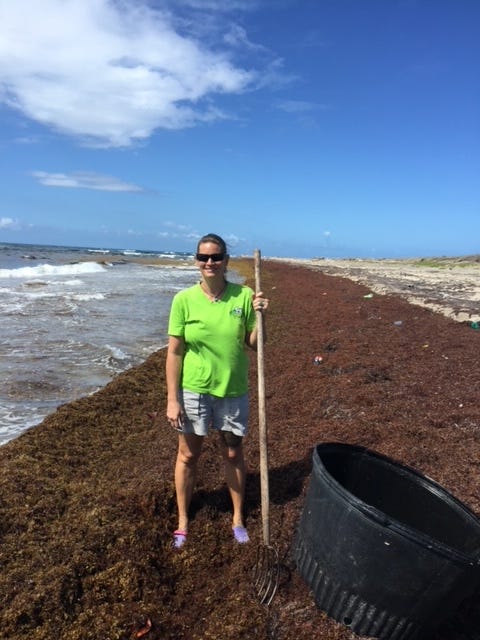
Many of you may have heard of the sargassum seaweed that is making its way through the Caribbean and all the way up to Florida. Some are calling it a ‘blob’. In fact, CNN claims that the ‘blob’ is twice the width of the US.
Talk about a dramatic headline!
The truth is that it is not a ‘blob’ at all. It is an ever-evolving and growing bunch of seaweed that keeps increasing in size as it encounters the perfect environment for growth and reproduction. It floats on a current that carries it from Africa and along the northeast coast of South America. It then moves up into the Caribbean, where it gets into the Gulf Stream and is carried up to Florida.
This is not a new phenomenon. Yearly visitors to Cancun, Tulum and Playa del Carmen have watched it roll into shore since the early 2010s.
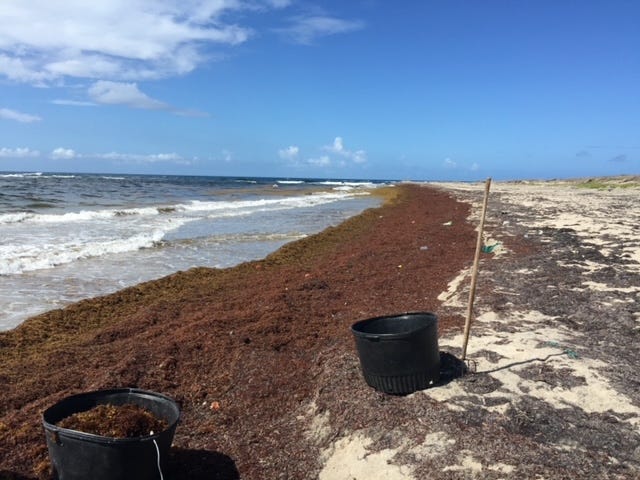
Beaches in the Caribbean have been shoveling it off for years and piling it up so that beach lovers still have sand to sit on.
But reports that I have heard lately are saying that there is now more than ever, and every year they have a much bigger job of containing it than the year before.
But what is Sargassum and where is it coming from?
Sargassum is a naturally occurring plant that blooms off the west coast of Africa. Though it is commonly called ‘seaweed’, it actually does not fall into the typical seaweed category as it is not attached to the ground.
Unlike kelp or eelgrass, which are types of seaweed fixed by their roots firmly to the seafloor, sargassum is a form of free-floating seaweed that is most highly concentrated in the Sargasso Sea. — Article link here.
Currents in the ocean bring it across to Central and South America. Usually, there is a balance to how much is produced, but because of human intervention in places like the Amazon rainforest, the weed is getting a ton of extra nutrients from runoff in the Amazon River.
There are a couple of reasons why this occurs:
- With more deforestation happening, more nutrients from the soil are simply slipping into the river when it rains. The trees aren’t there to suck them up and stop them from entering the waterways as the river banks erode.
- Fertilizers are sprayed on croplands and places where mass agriculture happens. These fertilizers are running down into the Amazon River and this also adds to the nutrient density in the water.
Combine these extra nutrients with a small rise in ocean temperature, and you have the perfect recipe for this plant to explode.
Sargassum seaweed is quite simply a human-caused problem.
And now we are crying the blues about it. Not surprising, really.
What are the biological impacts of sargassum?
In limited amounts, sargassum brings to shore important nutrients that feed the coastal marine life. Nutrients like carbon, nitrogen and phosphorous feed millions of critters near the shoreline.
But when it is too much, there are problems.
As the sargassum bobs in the water and decomposes, it uses up vast amounts of oxygen. If the plants use up too much oxygen from the water, fish and other marine life near the shore will suffocate and die. It also chokes off the light source for numerous critical seagrasses, plus it entangles turtles and other large ocean creatures as well.
Many creatures simply can’t survive under its heavy blanket.
Of course, sargassum also affects not only marine life but human lives as well.
When it decomposes, it gives off hydrogen sulfide gas. While sargassum is generally not toxic to humans, its decomposition gas can cause respiratory issues and more.
Wikipedia has this to say about a sargassum inundation event in 2018:
During the sargassum inundation event in 2018, 11,000 Acute Sargassum Toxicity cases were reported in an 8-month span on just the Caribbean islands of Guadalupe and Martinique.
Suddenly we can’t enjoy our favorite beaches, our boats get it wrapped around their propellers, and most importantly, our food chain is also threatened.
The trickle-down effects of something like this could lead to further depletion of our ocean life. Which, of course, also affects us.
But are there solutions?
While it’s impossible to physically stop an ever-increasing amount of sargassum floating up to shore each day, there are ways that we can put it to use so that it benefits humanity down the road.
We have had one experience with sargassum that I think has valuable information that others may learn from.
We first encountered large amounts of sargassum while volunteering at a Botanical Garden on the island of Nevis. Nevis is part of the island nation St. Kitts & Nevis. Some may have heard of it because it is a popular offshore banking location.
One day, after being on the island for about a month, we visited a particular beach and saw the huge amount of seaweed that had come ashore. Of course, at that time, we didn’t know anything about it and were surprised to see so much.
Obviously, we had no desire to swim in the water or sit on the beach, but as permaculturists and environmentalists, it sparked our interest. We saw it as something that could bring benefit to the land. We knew that we could compost it and make healthy and nutrient-dense soil out of it.
Something that the garden where we were volunteering desperately needed.
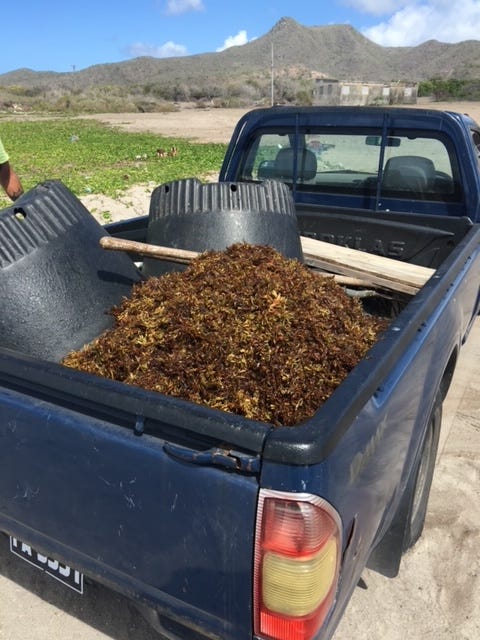
Despite the owner of the garden not showing much interest, one day we took our work truck down to the beach and loaded up the back. We then took it back to the garden and created a compost pile.
Each morning, we were already raking up dead leaves from the trees that fell over the pathways at night. We had wanted to try composting them back when we first arrived a month earlier, but we didn’t have a strong nitrogen plant to mix with them to help break them down quickly.
High in nitrogen, the Sargassum is exactly the plant we needed to aid in the process.
We made a heaping pile of the mixture, and every four days, we would soak it down with a hose, then rotate it. We did this for about 6 weeks.
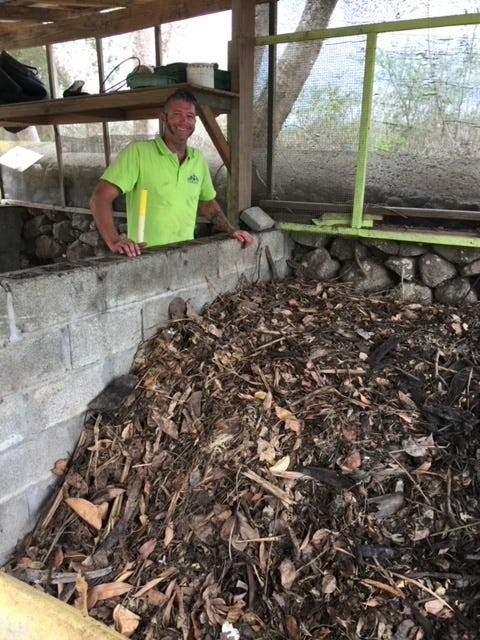
One day my partner Chris announced, “I think the soil is finished.”
In just six weeks — from dead leaves, sargassum, chopped banana stalks, grass clippings and some algae from the garden pond — we created this black and rich soil.
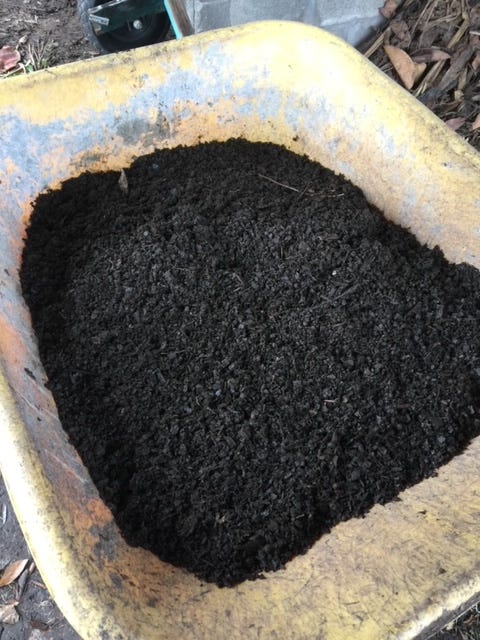
The head gardener was over the moon ecstatic with what we had shown him and quickly took wheelbarrow loads of the ‘black gold’ around to topdress some of the plants.
The owner of the garden was also impressed. She had doubted that we could achieve what we said we could in such a short amount of time, and I think she was surprised by how easily it was accomplished.
In a time when the land of our planet is suffering from a lack of nutrients, I believe that by composting sargassum, we can create a natural solution to improve the quality of our soils.
There may be other solutions as well
I have also heard of others' thoughts on what sargassum could be used for. One article in particular claims that alternative uses are being explored:
It is important to mention that some companies are interested in harvesting the seaweed for alternative purposes like the elaboration of paper, biodegradable food containers and plates. If authorities clear the legal aspects of this collaboration, this could bring hope for this problematic situation. — TheHill.com
Unfortunately, I have not found information that supports the above claim, but with enough creative thinking, I’m sure scientists could come up with a way to have sargassum benefit us.
Looking for answers
I think far too often these days, we tend to stare at problems and forget that we have the power to fix them. Of course, we can’t stop the sargassum from coming, but we do have the ability to put it to good use.
All it takes is some forward thinking and ingenuity, and the sargassum may become less of a problem and more of a solution.
Article Sources:
How An Algae Bloom Could Put Florida’s Spring Break At Risk

If you like my writing and want to read more, subscribe to Medium through my referral link (I will earn a small commission) to get full access! Plus sign up here to get my articles by email!
We have been nomadic since 2017! Join our journey by hitting the links below!
Website | Instagram | Facebook | LinkedIn| Patreon| YouTube | Medium


