
Is Vanity Bad if It Keeps You Fit?
Obesity is incredibly unhealthy regardless of your body image
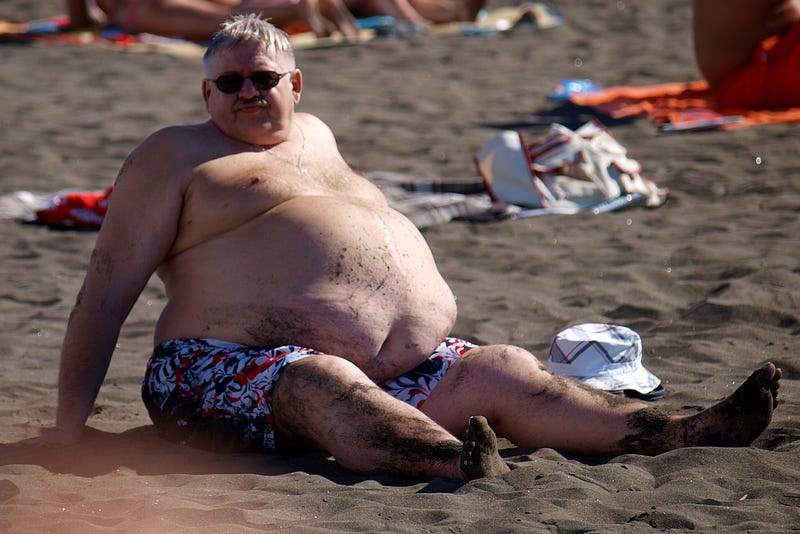

It’s modern, industrial society’s dirty, open secret. Everyone has gotten fat.
It’s a fact as plain as day. Look around anywhere and it’s readily, unavoidably apparent. Yet no one wants to talk about it. Or if they do, they want to paper it over and adorn it with ribbons.
To someone slim and trim, someone who values being so and who works hard to ensure I remain so, this feels like crazy town. It feels like a society that has fully thrown in the towel, a society that has shamelessly made its peace with utter defeat. And the fatter everyone else becomes, the more being thin feels like being the sole sane inmate in the asylum.
How did it come to this?
There’s a brief section in Jon Stewart’s nineteen-year-old tome America (The Book) titled “Obeausity,” where it shows a picture of an enormously obese woman with the caption, “In the future, you will want to ‘tap’ this.”
The accompanying text reads:
Around 2015, Americans will realize it would be much easier to change their standard of beauty than to lose weight. From that point on, we will embrace our indulgent lifestyles. Gyms will close, fad binge books will rule the best-seller lists, and singles ads will end with the phrase “Yes fatties.”
Mind you, this is a book of comedy, full of things that are intended to be patently ridiculous. Elsewhere, it states in a tongue-in-cheek chronology of world history (and remember, it’s by a Jewish author), “4000 B.C. Jews make covenant with God. Nothing bad ever happens to them again.” You get the gist.
But unlike the other jokes strewn throughout every page, this one about the faux sexual appeal of bigguns is no longer funny in this third decade of the 21st century. And no, not because the wokeists got to it, not because of the machinations of the dreaded sensitivity readers, but simply because it’s no longer satire. It’s not funny because it’s true. It’s become an everyday, banal reality.
Welcome to the world of plus-sized fashion models, of anti-fatphobia seminars. Welcome to a world where two thirds of Americans are not just overweight, but clinically obese. A world where diabetes and heart disease kill millions of people a year and cost the economy billions of dollars, in addition to putting severe strains on an already overburdened healthcare system. A world where three out of five military-age youth are ineligible for service based on their BMI.
The joke is on society, and it’s decidedly not funny.
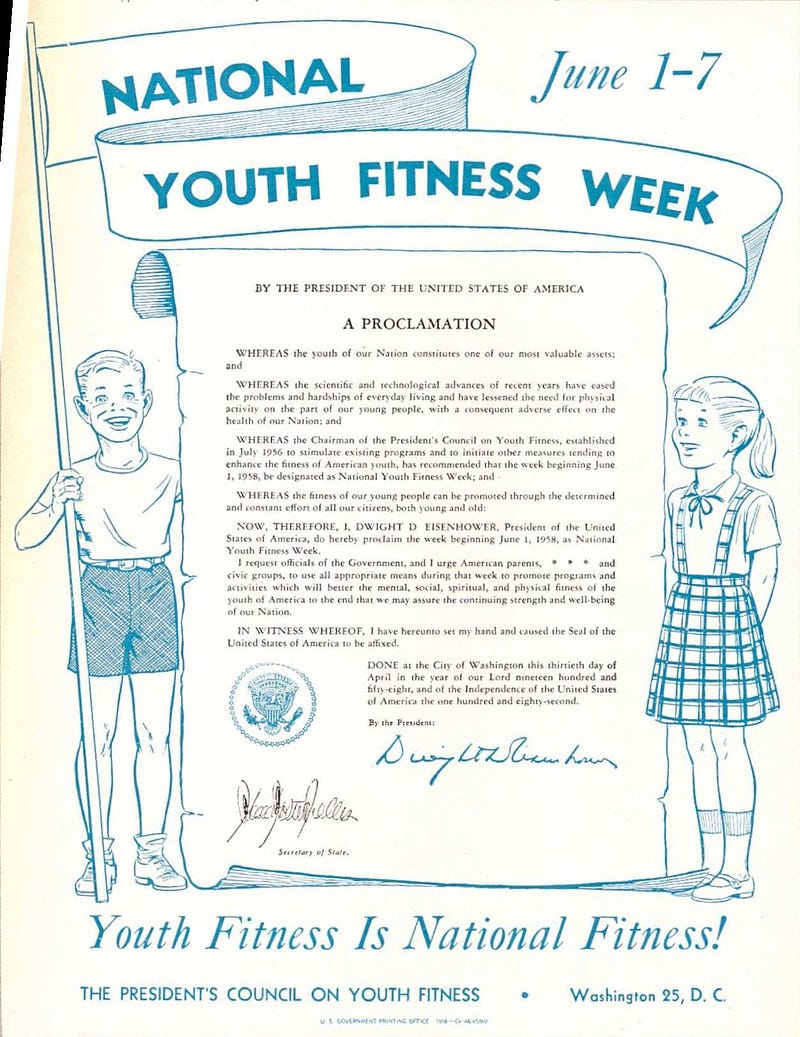

Now, setting all spiteful envy aside if you’re able to, imagine what it’s like to live in this world and to have watched it change before your eyes, yet to have yourself remained unchanged all the while. To have been blessed with a remarkable metabolism (coupled with healthy eating and an active lifestyle) such that you still wear exactly the same size shirts and jeans at forty-five as you did at fifteen.
“First of all, fuck you. I hate you. And second of all, where do I sign up?”
I know, I know. I hear it all the time.
And yet, irrespective of its fairness or glaring lack thereof, it’s nevertheless true. And for one living it, it’s bizarro world. Take, for instance, the gaslighting factor.
As just stated, I haven’t physically changed size or shape in over twenty-five years. And in my late teens, I always wore a size Large in tee-shirts. (I still have the shirts to prove it.) Perhaps I liked them a touch baggier then, but I’m tall, and that’s what fit me.
But then, at some point, starting probably fifteen years ago, size Large became ridiculously too big for me. The size I’d worn for years suddenly looked foolish on me. It made me look like an imp in an oversized imposter’s clothing. And I hadn’t changed a bit. If anything, I was a bit buffer than before.
It turns out that this isn’t some Mandela Effect ripple in the spacetime continuum. Nor is it me losing my mind.
The truth is, as Americans slowly got fatter and fatter, rather than allow people to feel bad about themselves for no longer fitting their old clothes, the clothing manufacturers (being dutiful capitalists and not wishing to upset their customers) simply realigned the labeling spectrum.
What used to be a Large is now a Medium (which I now wear). What used to be Extra Large is now Large.
How sweet of them. How caring. How Oceania was never at war with Eastasia of them.
But back to our Supersize Me, Fast Food Nation. Try the following Internet experiment. First, google the term “fat shaming.” Then go to the obesity section of the Centers for Disease Control and Prevention website. Here’s a snapshot of both:
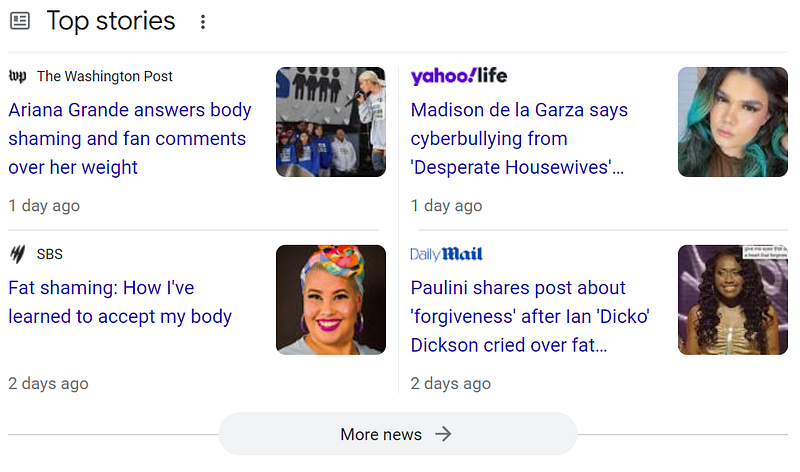
This first one is essentially all about feelings. It’s all about validation and rationalization. In other words, it’s all about excuses.
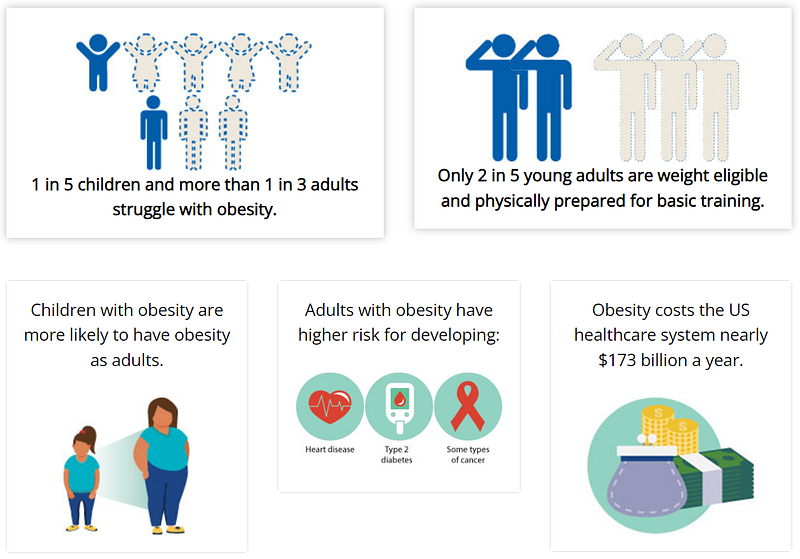
Meanwhile, this second one is nothing but cold, hard facts. Remember those? Or are we so far down the double-punch rabbit hole of political correctness and Trumpian “alternative facts” that the actual facts must step aside and make way for the new hybrid paradigm? And if so, at what cost?
Approaching the matter from another angle, here’s a question: What’s wrong with esthetics? What’s wrong with elegance, harmony, balance, and proportion? What’s wrong with the golden mean and the golden ratio? And what’s wrong with incorporating such lofty yet hardwired principles into the foundations of your society, as the ancient Greeks did?
It’s not all that long ago that we Americans did too. Back when people had to stay active to make a living. Back when you had to be fit just to go about your day. Back before cubicles and Barcaloungers and DoorDash.
We still maintain vestiges of this time. After all, we still appreciate esthetics in art and in architecture. We still appreciate fashion and interior design. We still enjoy the sleek, futuristic look of an iPhone or the sparkling symmetry of a Starship. Why, then, have we cast it aside when it comes to people?
And what does that mean for those of us who haven’t callously or lazily cast it aside? More practically, how does the pursuit of a “body esthetic,” of maintaining physical physique purely for the sake of beauty present itself? What virtue or what vice polices it?
Strangely enough, as it turns out, the answer falls among the vice category. We call it vanity. But if vanity exists or is applied in such a way to ensure virtue, then is it truly a vice?
I can’t claim to speak for others, but personally, I intend to go to my grave still rocking a six-pack. (Hopefully, as an old, old man. But either way.) It’s a sacred vow I’ve made to myself, for myself. It’s important to me on many levels. And I see no reasonable reason, barring the onset of some horrid ailment or a complete lapse of self-control and self-respect, that it shouldn’t come to pass.
“But why?” you might ask. Is this vow of mine for health reasons? Well, partly, sure. But not primarily.
I’m not one bit ashamed to admit the actual priority that’s driving it — I want to look good. I want to roll into my next high school reunion and be the guy who looks like he accidently stumbled into a thirty-year en route to a ten. The health benefits are merely a side bonus.
Is that so wrong of me?
I don’t think so in the slightest. In fact, I’d argue that it’s admirable. I think it’s commendable, something to be strived for by all.
And in a world itself commendable, it would be. In a world defined by values and self-discipline, certainly. But alas, such a world is a world other than our own.
Because in our world, the skinny guy is fast becoming a freak, an aberration. (Ironically, while every other former “aberration” is loudly demanding and gaining total acceptance.)
Now, I’m not saying the fit have life tougher — far from it. Obviously. There’s no contest there. There’s no, “Boo hoo, its hard being slim.”
And yet, despite its inherent and ongoing advantages, being fit is no longer quite the Greek ideal that all aspire to. At best, it’s a distant hope that’s all but forgotten.
In fairness, I suppose, like the Horatio Alger myth, the further an ideal drifts from attainable, the less it becomes an ideal to strive for. In fact, it soon becomes something to resent, or even disparage. (Say hello to the newly contrived crime of “lookism.”) It’s not hard to imagine that in the near future, athletes will be considered grotesque.
But why, after thousands of years of civilization, has this longstanding ideal suddenly become so unattainable? Is it genetic? Is it environmental? Or is it simply societal? Or, more likely, is it some mixture of all of the above?
Such questions are complex, and answers to them are still unclear (and vehemently disputed by various camps). As such, their exploration is far beyond the scope of this essay.
But nor is it of great import to its thesis. For the relevant question remains: Should we, as a society, continue to value the idea of physical fitness (even if increasingly few attain it)? Or should we instead write it off as yet one more entry in an endless list of “privilege,” something to be shunned and dismissed as inegalitarian?
And if the latter, what of all those medical realities that remain perennially indifferent to hurt feelings and shifting notions of politeness? Do we just accept “lifestyle diseases” as we’ve apparently come to accept mass shootings, bald-faced political lies, rampant litter and graffiti and property crime, or any number of detrimental signs of the decay of our once grand civilization?
,_NGA_45044.jpg)
I don’t know the answer. But I do know what I like. And I do know how I choose to roll and the direction I’ll steer my children. And regardless of anyone else’s opinion, I know which way I’m swiping and why. Call it vanity, call it shallowness, call it what you will, but there’s nothing I can imagine that will persuade me otherwise.
So yeah, that’s gonna be a pass on seconds and a hard “no” on dessert. Because the beach is calling, and Brendan Fraser aside, I prefer my whales to be cetaceans, freely swimming in the sea where they belong.

Colby Hess is a freelance writer and photographer from Seattle, and author of the freethinker children’s book The Stranger of Wigglesworth.
If you enjoy my writing and would like to receive stories by email whenever I publish, please click here.