


THE MEGADROUGHT SERIES
Is The Megadrought Over Or Just On Hiatus?
One good winter changed everything. Will there be a follow-up?
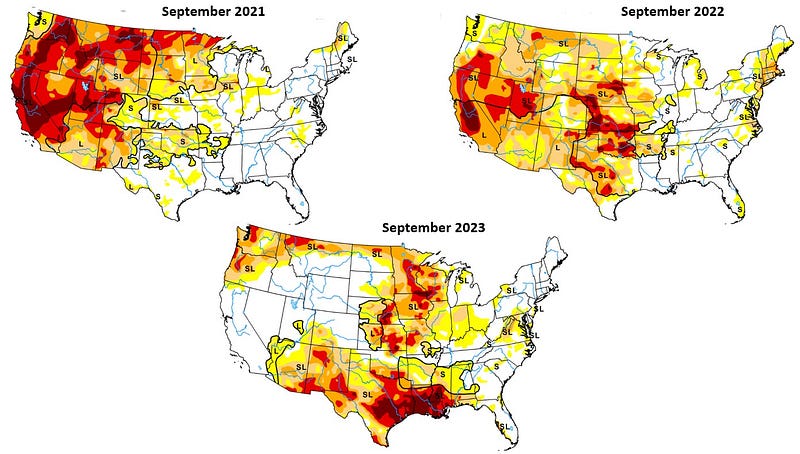
Is Water the New Gold Standard in the West?
I’ve written about the megadrought in the Southwest for three years. Hydrology is a subject I never thought I’d become enthralled with. Yet here we are, 24 articles later.
I never intended these stories to be from a global perspective. Instead, I have focused my interest in climate change on my own backyard — the Southwest, and specifically its lifeline: the Colorado River.
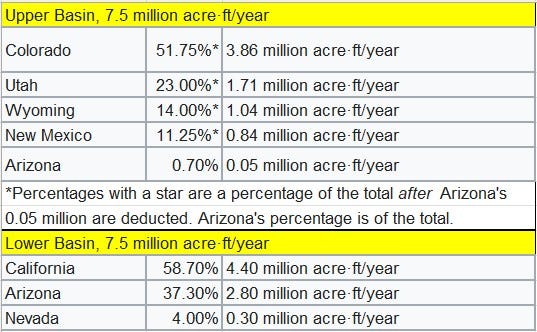
Most of the water in my home state of New Mexico drains into the Rio Grande and the Gulf of Mexico. But the continental divide jig-jags its way from the top to the bottom of the state’s Western side. Water to the West drains into the Colorado, so we’re entitled to a share of the river’s water. Our contribution is the San Juan River in northern New Mexico and the Gila River in the Southwest part of the state.
The river directly impacts seven Colorado Basin River states that comprise more than 21% of the U.S. landmass. (Northern California and Nevada receive their water from other sources.) Lake Powell generates power for all these states, even the non-basin state of Nebraska.
(It’s been a while, so let me refresh your memory: the Upper Colorado River Basin includes Wyoming, Colorado, Utah, and New Mexico. The lower basin is Arizona, Nevada, and California.)
Water wars have been occurring in the West since settlement began. The first was William Mulholland’s plan to move water from the Owens Valley to the steadily growing Los Angeles area via an aqueduct built between 1908 and 1913. Secretly, he also bought the water rights from many of the farmers along the river, leaving them high and dry. They fought back, but progress won. The Owens Valley, including Mono Lake, once a verdant agricultural area, now more closely resembles a desert.
The Colorado River is managed and operated under numerous compacts, federal laws, an international treaty, court decisions and decrees, contracts, and regulatory guidelines collectively known as “the Law of the River.” The agreement was signed in 1922, but Arizona did not ratify the Compact until 1944 due to the water wars between California and Arizona, which climaxed in an 11-year Supreme Court case.
So, is the megadrought over?
My go-to newspaper for world and national news is The Los Angeles Times. I like it for its anti-Trump stance, its reporting on the Colorado River, and its effect on the Southwest. Last year, you could count on a front-page story about it every day. Lately? Crickets.
These are the days when deniers’ screams sound even louder.
California now seems to have all the water it needs. (It doesn’t.)
Lakes Mead and Powell will likely be fifty feet higher than last year. Are they out of danger? No. Both are at less than 40% capacity.
The United Nations has warned of climate danger if the global average temperature exceeds 1.5°C above pre-industrial levels. On November 17, the Earth briefly experienced an average temperature that was 2.06°C higher.
“Humanity has just lived through the hottest 12-month period in at least 125,000 years,” according to David Reay of the Edinburgh Climate Change Institute.
“2023 is ‘virtually certain’ to be the hottest year on record.” ~The European Union’s Copernicus Climate Change Service (C3S)
The World
June was the hottest month the world had ever recorded until July came along. According to a United Nations report, July became the hottest month ever, not only in recorded history but in 125,000 years—Ditto for August. September was the hottest September, and October was the hottest October. Shall I go on? This year will easily be the warmest year on record. Ever. Infinity!
Another factor involving these records is sea temperatures. Worldwide, on July 31, the average sea temperature was 69.73°F, a new world record. Sea temperatures over 100° were typical off the Florida coast in June and July, which is so highly uncommon it’s almost unfathomable. Around the world, high sea temperatures are causing coral reefs to die. Besides their abundance of wildlife, reefs save coastlines. Combined with higher sea levels due to ice melting in the polar regions, it is another tragedy waiting to happen.
The Colorado River
The only real solution for the Colorado River is to use less of it. However, agriculture uses about 75% of the water drained from the river in California and Arizona. Where do we grow our food? And what about alfalfa, which feeds cattle and other livestock which consumes most of that water? You’ll see continued increases in the price of beef unless we stop eating it.
Beef is so rife with climate-related issues that I will not tackle it here!
Are the Colorado River’s water woes over? No, not by a long shot. Even with snowpack in the Rockies at 160% of normal last winter, the river’s flow will still be about 20% less than it once was. Soils are still dry, and evaporation from a warmer world will soak up some of the runoff. And those 40 million people who depend on the river aren’t going anywhere fast.
“I think doomsday may get pushed off another year, and gives us some time to craft some solutions that can be implemented and more reasonable.” ~ Camille Touton, U.S. Bureau of Reclamation Comissioner
El Niño
Right after I finished six years of college (yes, six), I moved to Santa Fe, New Mexico. Not a great place to start a career, but I grew weary of Nebraska. In 1982, a powerful El Niño was in place. It’s normal in the Southwest to receive monsoonal rains after June 15, and boy, did we! But the precipitation started well earlier that year and held the temperatures down all summer.
Well, El Niño, “The Boy,” has arrived. Will it behave as it usually does, or has the world climate changed to the extent that it will morph into something even more powerful?
Officially known as El Niño-Southern Oscillation, or ENSO, an El Niño occurs when warm water develops in the central and eastern Pacific, roughly along the equator. It typically produces more precipitation along the southern U.S. with normal to cooler temperatures and the opposite along the northern border.
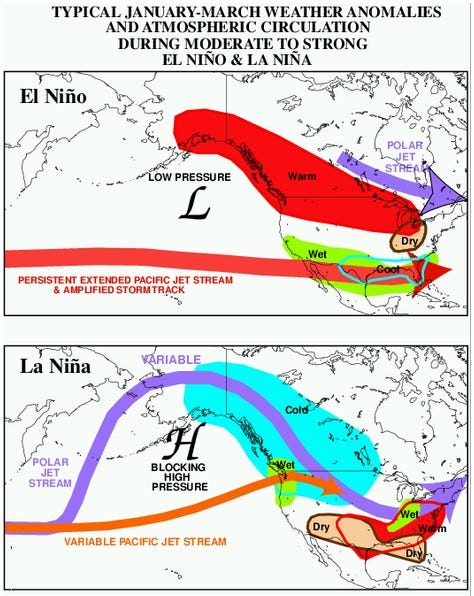
On average, El Niño conditions occur every two to seven years. The current one is forecasted to be stronger than most, with more precipitation falling south of the Mason-Dixon line.
The “La Niña” phase of ENSO occurs when the equatorial waters of the eastern Pacific are cooler than normal. It produced some of the worst drought conditions the Southwest has ever experienced during the last three years. And in the South, it brought about the dry conditions that started the drought in Louisiana.
La Niña lived up to its promises, but El Niño is doing the same thing from a temperature perspective. They’ve been above average for most of the Southwest, and with the transition to El Niño, it’s still warmer than average.
During the past winter of 2022–23, the ENSO was transitioning to El Niño, which could explain the West’s extraordinary rain and snow events. Most climate experts say the winter of 2022–2023 was an anomaly, and because of man-made climate change, hot and dry conditions will prevail over cool and wet ones.
The summer of 2023 was anything but ordinary. June and July were atypically hot. Phoenix recorded 31 days of temperatures above 110°, a new record. Albuquerque recorded 17 days at or above 100° when the normal is 0–5. According to the report, Houston experienced the longest extreme heat streak of any major city on Earth, with 22 consecutive days of extreme heat between July and August. I’ve watched New Mexico burn, bake, and brown in my five years here.
While the southern portions of Arizona and New Mexico saw some monsoonal rainfall, the northern half of New Mexico saw a nonsoon. There were 77 consecutive days during the monsoon season when it did not rain in Albuquerque.
The remnants of Hurricane Hilary gave the Western part of the Southwest abundant rain during a season when it usually doesn’t. At 2.2 inches, Death Valley National Park recorded its wettest day in history, which produced terrain-changing landslides. Many of its roads were damaged, and a portion of the park shut down altogether for over two months. Badwater Basin, the lowest point in the United States, received the runoff, and this ancient dry lake came to life again — at least for a short period.
“El Niño is really going to bite next year and that’s going to lead to even more warming as we head into 2024.” ~Andrew Pershing, President of Science for Climate Central
Mississippi River
I don’t usually cover areas this far east, but weather travels from west to east in the northern hemisphere, so as we suffer in the West, so do those in portions of the Midwest and East.
As this is turning out to be an extreme El Niño, it doesn’t bode well for the Mississippi River watershed. The Ohio Valley and the Mississippi and Missouri headwater areas expect below-normal precipitation this winter. (FUN FACT: The Missouri River is just slightly longer than the Mississippi, making it the longest river in the country.)
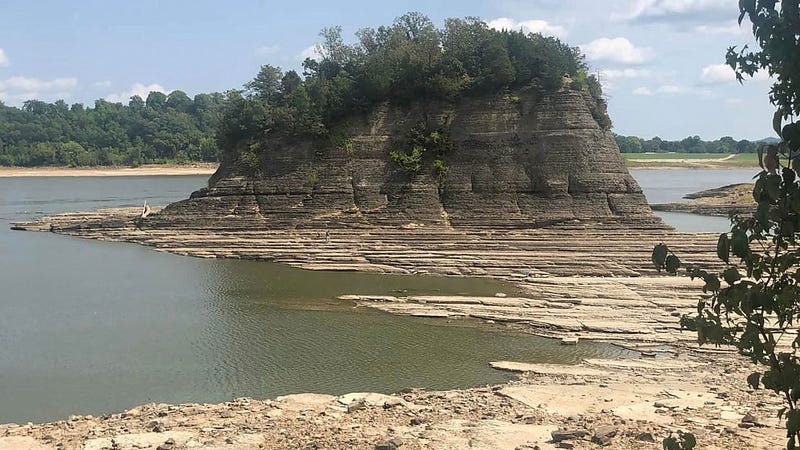
For the second year in a row, Tower Rock, a stone monolith sticking out of the Mississippi River South of St. Louis, is accessible by foot. It is usually an island. Extreme drought throughout the Midwest has caused this condition, and all of the “Mighty Mississippi’s” tributaries ran low. The flow in 2023 was less than the record low set in the previous year.
Louisiana has been one of the hardest-hit states this year, with most of it being in some stage of drought. About 50% of it is in “exceptional drought,” the worst case in the spectrum.
The Mississippi River cargo system carries 60% of all grains produced in the U.S., mainly corn, wheat, and hay. Coinciding with the harvest season, the drought halted barge movements while the main channel could be dredged. The width of a river is an issue, too. The river must be 9 feet deep and 300 feet wide to accommodate two-way barge traffic.
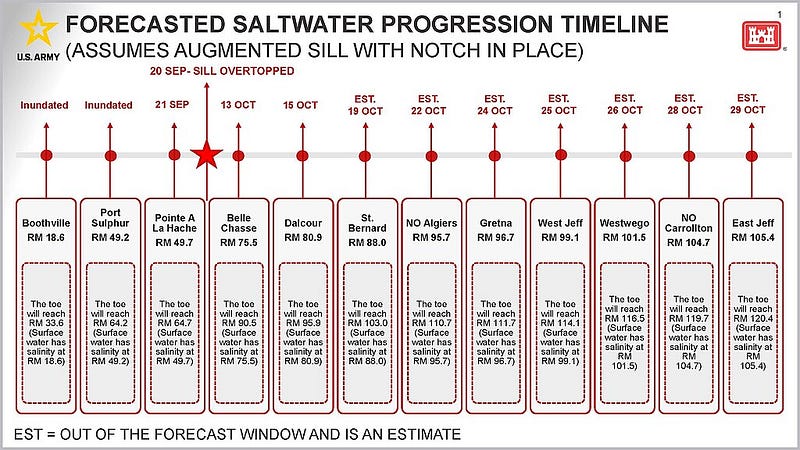
Meanwhile, in Bayou Country, where the Mississippi Delta begins, the river is so low that salt water from the Gulf of Mexico is moving further upriver, jeopardizing water supplies in Plaquemines Parish. Residents there have been advised to drink only bottled water.
The “saltwater wedge” that brings water inland from the Gulf of Mexico up the Mississippi came frighteningly close to New Orleans’ water supply. The river's flow lacked the volume to push back the ocean water. Salt water is more dense and moves along the bottom of the river. The “wedge” became stronger due to the river’s low flow from heat and drought upstream in the Midwest.
Also at odds is sea level rise. Combined, 18 million people depend on the river for their drinking water. Successive saltwater wedges may not be able to be held back by sills.
Warm, dry weather continued in the Mississippi watershed well into November, further evaporating what little flow the river and its tributaries had.
I don’t know if it’s still talked about, but at one point, Arizona water officials proposed a study of a water pipeline to extend from the Mississippi River to portions of New Mexico, Arizona, and California, where the water was needed.
Now that a Mississippi River with lower volume is the norm, I doubt that proposal will ever gain any traction.
In these changing times, New Orleans is a city that is misplaced.
How many times will the city be spared? There are also intensifying hurricanes to consider.
The winter forecast for the upper Mississippi and Missouri River basins calls for less snow and higher temperatures, so this scene could keep repeating itself. The river continues to be dredged as the water level upstream in places like St. Louis and Memphis is still very low, and barge traffic stopped in September and October at the peak of farmers trying to get their crops to market.
Next time, we’ll return to the West, looking at each region in depth and their plans for a world with less water.
Sources for this Series Include:
- Los Angeles Times, 10/17/2023
- The Texas Observer, 10/11/2023
- The Arizona Republic, various reports, 9/28, 9/29, 9/30, 10/1/2023
- NOAA, NASA, NWS, and the United Nations
- “Arizona is running out of water. Big tech data centers are partly to blame” by Alistair Barr in Insider.com, 06/30/2023
- “Tower Rock is normally only accessible by boat. Here’s what it looks like now” by Eric Zerkel and Jullian Sykes, CNN, 9/23/2023
- “Saltwater pushing into Mississippi River could compromise Louisiana’s drinking water” by Tara Suter, The Hill, 9/23/2023
- “Water levels are going up in the West’s massive reservoirs. Has the water crisis been averted?” by Trevor Hughes in USA Today, 4/29/2023
- Beef2Live.com
- “Israel went from water scarcity to surplus. Can it help Utah and the Great Salt Lake?” by Ben Winslow in The Deseret News, Salt Lake City, 4/30/2023
- “Utah’s Church of Jesus Christ of Latter Day Saints donates water shares to Great Salt Lake” by David DeMille in the St. George Spectrum, 3/15/2023
- Copernicus Climate Change Service
- David Reay, Edinburgh Climate Change Institute, 11/9/2023
- “A new Southern California water storage project aims to keep supplies flowing during drought” by Ian James in the Los Angeles Times, 10/29/2023
- “Texas, New Mexico, and Colorado Announce Agreement After Years of Dispute over the Lower Rio Grande River” ~ Press Release from the Office of Ken Paxton, Attorney General of Texas
- “When California’s Water Wars Turned Violent” by Kirstin Butler in PBS’ “The American Experience,’ 3/24/2022.
- U.S. Army Corps of Engineers, New Orleans District
A selection of stories from early in the series: