
Is the Future of Writing Dead?
Will AI Take Over the Writing Entirely?
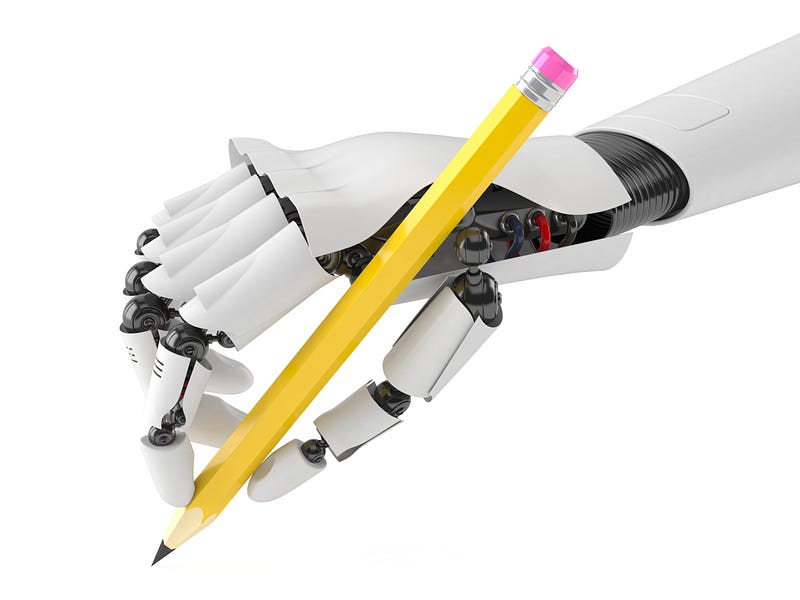
Succeeding in writing was just as simple as it is today. Because we are moving in a high phase of incessant communication, in which everyone can write directly and unchecked and at the same time self-publish. Be it via the common social media platforms such as Instagram, Facebook and Twitter or your own blogs via WordPress as well as community blogging platforms such as Medium or Vocal etc. Every thought, every experience and every association can be written down immediately and made accessible to the world in some form.
What used to be the dream of many to be a writer and to be featured in a magazine or to have published a book is no longer a great achievement today. Hardly anyone has to let relationships play for months and hope that they will be listed as an author in a publisher or magazine.
Because nowadays this is no longer absolutely necessary. The self-publishing era began a long time ago and is on a threshold that is being overshadowed by the advancement of AI, through machine learning and deep learning. Because writing skills are no longer unique to humans. AI has already learned to write and can now create easy-to-read and understandable texts.
How much is the value of the written word specially created by humans still worth? Does that mean that the writer’s profession and gift are dying out?
“Writer” Is Not a Protected “Profession”
Nowadays anyone with writing and self-publishing can become an author and call themselves a writer, copywriter, bestselling author, columnist, essayist and blogger without these terms having to be clearly defined or legally protected.
In principle, anyone who has a certain level of language skills and creativity can apply as a writer for any job or blog on the popular online platforms and thus build a relevant portfolio. It can be the studied linguist, the trained advertising manager or the hobby writer who likes to earn extra income.
As early as 2,400 BC. an Egyptian writer praised his profession in the Lansing Papyrus:
“Writing — for those who understand it, it is more useful than any office / it is more pleasant than bread and beer, than clothes and ointments / it is more luck than an inheritance in Egypt and than a grave in the west. “
What, on the one hand, means freedom to write and publish as a form of individual expression, is, on the other hand, the risk of being copied and replaced. And that in connection with ever increasing competition.
With the amount of writers worldwide, with the ease of content writing and self-publishing, the question arises, which author will prevail? The one who hits the dominant zeitgeist with his contributions? Or the one who has learned his trade professionally? The one who has a talent for writing? Or maybe robots instead of humans?
Artificial Intelligence Is Already Doing a Lot of Writing Work
Artificial intelligence learns through machine learning and deep learning. AI has long been able to access a gigantic data volume of texts, words, sentence components, grammar and ways of argumentation. As a result, it learns how language “works” much faster than any foreign language student.
For this reason, “speaking” and “writing” AI is already used in many areas of business. Especially where simple inquiries also require simple answers, such as customer service. Social bots and chatbots are a well-known automated use of AI.
Speech recognition is also a progress made by AI, which can be called up as an assistant in many devices, whether in the smart home, car, web browser, smartphone or via Siri and Alexa etc. Translation programs such as Linguee or Google translator are also known to anyone who has ever wanted to quickly translate a word, a sentence or an entire text.
But Is AI Also Able to Create Their Own Creative Texts?
The answer is yes. The AI algorithm can already fall back on a gigantic amount of available text data in order to learn to “write”. The higher the amount of data, i.e. the more texts that are published online, the better the algorithm becomes.
And this volume of data is increasing exponentially right now, because the “writing fever” and the “creative potential” of people due to the self-publishing era is so immense that AI learns general writing skills even better and in more detail.
The more texts are published online today, the better the generated texts of the AI become, and this even with references to sources. So how much creative text work can AI generate? And how much editing and formatting skills do people still need?
There are already numerous freely available programs with which content can be developed by an AI, such as Writesonic, AI Writer or Nichesss.
Linda Guest recently wrote an article about her experience on one of those programs in which she actually had a text written by an AI. What’s interesting is that the text generated by the AI is really well written. Surprisingly. And Linda thought that nobody would notice if someone actually published this text as their own, especially since it has a unique selling point, without plagiarism. So she shows us the full text to make it clear how far the writing competence of AI has become in the meantime.
It’s so inspiring though scary. Because the question remains, what is the actual competence of human writing compared to AI?
Limits of AI in Relation to Writing
There are two points that cause AI problems when writing texts:
1. AI has a huge problem of discrimination, especially when writing texts
AI cannot capture ambiguous image or text content from data records. Ambiguities arise primarily through a cognitive connection to values from literary, religious, mathematical, sporting or even facial and linguistic contexts. The AI would only select a single relevant piece of information from such data sets, but it cannot evaluate multiple contents and think associatively, as we humans do.
This gives a high probability of error, which is morally or ethically unrepresentative. For example, AI has difficulty recognizing idioms or discriminatory formulations. Age-, gender-specific or religious as well as ethical knowledge cannot simply be coded and made “recognizable” in data sets.
We as humans learn this information associatively and situationally in the course of our lives, easily. Because this cognitive ability is socially crucial. But AI cannot do this. It doesn’t know what an insult is. If, for example, AI in social or gaming bots reproduces information that is discriminatory and derogatory, then entrepreneurial risks and drastic image problems arise. The difficulty: AI doesn’t know any better because it can’t understand it.
So the point is: the emotional and social values in the texts still have to be checked and adjusted by people. Metaphors and imagery in particular are still causing immense problems for AI, so that AI in this form can by no means completely replace the writer of the future.
2. AI cannot create stories about personal experiences as well as emotions and cognitive perceptions
This is the real core of writing. Expressing yourself in writing and conveying feelings and impressions in order to deal with difficult experiences yourself as well as to give others the opportunity to learn from them and also benefit from the results.
Pure information transfer can always be taken over and created by the AI. But personal perspectives, in connection with several symbols and empirical values, can only be conveyed by people. Only we humans have the sense for it and can process this in the form of writing as well as send it out into the wide world.
Nevertheless, there is an enormous advantage:
In combination with the AI, interesting topics can be worked out, which significantly improves and simplifies the speed of content publishing.
Because creativity and creative writing can only be replaced to a limited extent by AI, but with its use it can accelerate your own writing process many times over and significantly simplify your writing work.
Conclusion
Due to the gigantic flood of data and the ease of self-publishing, the delimitation of the individual writer’s jobs is hardly relevant anymore. Anyone can deliver writing and content at any time and almost anywhere. With access to this volume of data, the AI has an enormous learning advantage and can already create any articles without any problems.
However, we should not be afraid that AI will replace all of our jobs or competencies and skills in writing in the future. On the contrary. We should definitely use the advantages that this technological progress brings us to advance our creativity, so that we always have a few “Sentences made by AI” up our sleeve, even with a writer’s block, and with the help of AI to grow beyond us.
Due to the limits of machine learning, AI will always have a moral and ethical problem that must always be corrected by humans. This means that the writer’s profession will remain permanent anyway.
If you like this story, you may like the following:
Cover Photo: Robot hand with pencil/ Talaj — stock.adobe.com


