
How Far Can Artificial Intelligence Go? The 8 Limits of Machine Learning
Artificial Intelligence (AI) is the field of research that has achieved immense success in recent years and accelerated our technological and digital boom. Everyone knows how beneficial the page or video recommendations on Google and Youtube are and how exactly the image or keyword search is carried out. We know that robots can serve as domestic help or support airport services. But do we know what is happening in the background of the search? Do we know how AI “thinks”? And above all: do we even know their limits?
The Concept of “Artificial Intelligence”
First of all, Artificial Intelligence is a field of science that encompasses several specialist areas, such as psychology, linguistics and computer science, among others. It is dedicated to the task of simulating and automating intelligent behavior. With the aim of developing software that can solve problems for which intelligence is required. It describes functions that develop complex problem solutions and their feasibility in order to support or replace human activity.
AI is divided into two levels: symbolic and sub-symbolic AI. Symbolic AI uses given knowledge and brings about logical knowledge and conclusions in the function of “if-then” formulations. Sub-symbolic AI uses arbitrary knowledge, the complex order of which is brought about by so-called “artificial neural networks”.
The four intelligence categories according to Wahlster help to understand how the different AI competencies are to be identified. Cognitive intelligence describes the learning of and dealing with knowledge. Machine competence is already a priority here. Sensorimotor intelligence is the most sought-after intelligence in AI. It is particularly successful in image, text and audio processing and clearly exceeds human ability. Emotional intelligence includes the empathic behaviors and reaction skills that have already been successfully implemented in robotics. There is still great potential for improvement in machine implementation. Social intelligence expresses itself in social interaction and seems to be the most difficult to control for AI. As a social structure, humans are unchallenged.
Since AI is already more efficient at solving problems in many individual tasks than humans, it is active in all areas of life. It facilitates and optimizes our everyday life, because it is the key technology for the human knowledge bottleneck. AI is mainly used in the following areas: stock market and financial services (data management), games (gaming bots), medicine (image analysis & forecasts), automation (driver assistance systems, autonomous driving) and civil security (audio & video: processing and analysis). Speech and word processing is particularly popular in machine learning. The new bots enable automation in text translations or dialogues (chatbots) as well as music and text productions. Artificial intelligence therefore already supports many fields of work and is becoming strong competition in the competitive economy.
How Does AI “Learn”?
Machine Learning (ML) is a branch of AI. It deals with the learning process and thus the process of “thinking” of Artificial Intelligence. Machine Learning describes the machine competence to gain knowledge from data sets and to categorize their insides. ML “learns” by collecting “experience” from the contents of exemplary data sets, arranging these “experiences”, developing a complex model from it and finally gaining “knowledge” from the patterns and laws that have emerged. In other words, machines learn by being trained — fed with data sets. They create automatic classifications from images, texts and sensor data and more and more often provide a more precise analysis and faster forecast than humans. The AI gets to know the world exclusively from data.
Machine Learning has become a tried and tested means of pattern recognition and process development as well as tool optimization in business. It becomes clear here why computers can learn so much faster than humans: the time factor determines the human knowledge bottleneck. They don’t need breaks or sleep, they don’t have to eat or to die. They can run 365 days a year, analyze data and learn. This redefines the term lifelong learning.
Machine learning is far more effective than human learning. For example, software can run through more game rounds within a short period of time than a person could ever play before death. The human limits of learning, the acquisition of knowledge, intelligence, the aging process and finally death can now be clearly overcome by machines. Do we now have to fear that machines learn and reflect beyond their limits, i.e. how we humans can “think”?
AI only “Learns” in the Development Phase
The answer is: no. Computers can usually only do what they are verbally told to do. The programming — the algorithms, i.e. the instructions in the program code — determine what the AI has to learn. There are three strategies for how AI can learn: supervised, unsupervised, and reinforcement learning.
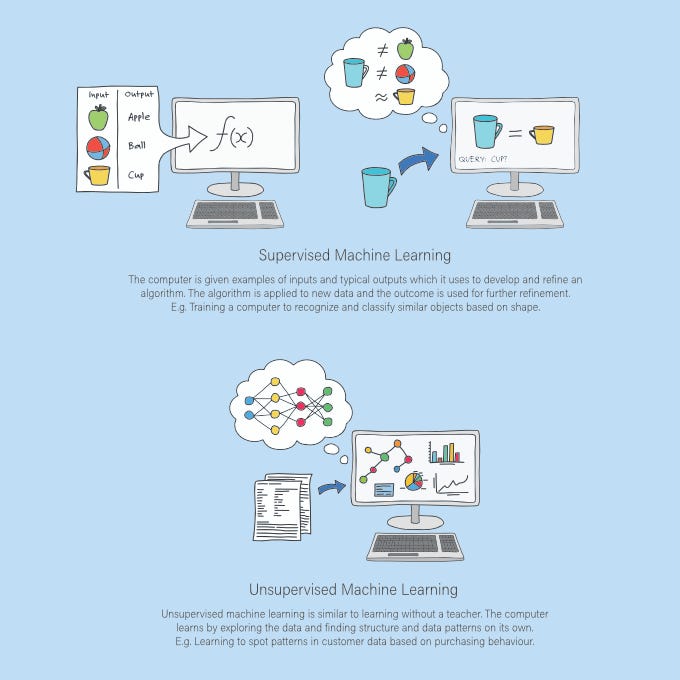
In supervised learning, it is always strictly specified which input and output can be expected. The learning result is fixed and can be “monitored” by humans during the training. Unsupervised learning is trained without previously defined target values, i.e. without human “supervision”. As a result, AI learns different cluster or segmentation functions, for example, and thus opens up new knowledge of data distribution. Reinforcement learning describes the dynamic approach of AI to learn forms of strategy that achieve a reward in order to determine the maximum strategic potential, e.g. in video games.
Accordingly, in the development phase it is clearly defined from the start what is expected of AI, how it should “learn” and what the results can look like. The AI strictly follows the instructions of its program code, is “trained” with tons of data sets and ultimately fulfills the purpose or not. If, for example, a different result is given during supervised learning, the research group improves or reformulates the algorithm. As soon as the AI outputs the application repeatedly without errors, i.e. has successfully “learned” it, it is ready to be transferred to the commercial market. However, care must be taken that not too much emphasis is placed on optimizing the training data so that no “overfitting” occurs. This describes the learning perfection of training data, which in practical application does not correspond to the real data. This can also make the developed AI unusable.
Here it becomes obvious that the AI learning process only takes place in the development phase. It is then brought onto the market as a finished program and from then on always runs through the specified algorithm. “Learning” is neither planned nor does it happen afterwards.
ML competencies that are currently used in economics are in particular: group formation, object classification, value estimation and prediction, selecting actions for agents, image recognition, speech recognition, text extraction, information processing, text understanding.
Speech Recognition Using AI on the Advance
A particular advance in AI lies in speech recognition. Instead of the usual input and output using the keyboard, instructions have been given over the language in many devices, e.g. smartphones or smart home applications, for some time. AI can easily learn vocabulary and the basics of grammar. Semantic content is also hardly a problem, as an almost infinite volume of data is available for “learning”.
The 8 Limits of Artificial Intelligence
The idea that software can learn from data and change its own algorithms in order to exploit its potential even more in the long term is decisive in machine learning. However, machine learning not only has infinite access to databases, but also great restrictions and decisive limits that can hardly be overcome, as the following 8 points show.
1. AI Cannot “Think” Abstractly
Artificial intelligence is not able to react flexibly to small changes or new application problems. It cannot recognize and establish any logical or coincidental connections in abstract concepts. It cannot transfer the knowledge it has learned to other levels. For example, if images in the data set have few pixels, the AI struggles to classify these images correctly. It just doesn’t recognize them. This is a big problem, especially with autonomous driving. Traffic signs on which stickers or graffiti have been applied are no longer recognizable for the AI of the driver assistance program. This has fatal consequences and leads to considerable quality and safety flaws. There are already attempts to intentionally incorporate possible errors into the data set in order to increase the ability to learn. However, this approach has not yet been successful.
This inability to adapt to changed circumstances is due to the fact that the AI only “learns” what is arranged in the programming. However, the coding can only provide abstract conclusions to a limited extent, so that the flexibility of “logical” thinking cannot be realized. For this reason, pattern recognition, for example, is their best skill, which humans could never acquire in the amount of data sets and, above all, in the short amount of time.
The functioning of the human brain is extremely complex, so that it can derive logical traits and abstract concepts without having to learn every problem from scratch. But AI cannot question conclusions or think critically about things. At some point it will not consider that monotonous pattern recognition is no longer a challenge for it. That it would like to have something challenging and begin to use its skills elsewhere. This way of thinking is not possible to “replicate” with algorithms, because AI has no “consciousness”, no feeling of pain or a feeling that grows beyond itself. The simulation of human “consciousness” is not possible if it is not even clear to what extent human consciousness can be organically grasped at all.
2. Problem of Recursivity
As a result, machines can learn and become “smarter”, but they do not have the ability to make an even more powerful machine on their own. There is no AI that can improve itself. Only humans can use their cognitive abilities and creative, associative intelligence to conceive and build optimized machines. As a result, machine learning is limited to increasing learning competence and speed only.
3. Transparency Problem of Machine Decisions
There is a major deficit in the traceability of AI decision-making. How AI decides and why cannot be illustrated, as it depicts and selects different strands within the learning process until it comes to a result. This selection cannot be viewed at any point in time and thus complicates the seamless transparency that is indispensable in competitive activities. Work is already in progress to break down the AI learning process into individual AI tools. However, it will take some time to achieve a breakthrough here.
4. Simulation Limit of Emotions
AI can learn to “understand” the semantics of words and sentences and respond appropriately. Chatbots, for example used in customer service, can “communicate” appropriately and answer simple questions automatically. When talking to an AI of a robot, however, you quickly notice how borderline the ability to communicate is. Because a person’s ability to perceive is not limited to a question-and-answer game. Here, facial expressions, gestures, instinctive action or empathic expressions of feeling are used to “convey” an overall impression that cannot be fully perceived by a machine, let alone simulated equally. Several sensors would be required for this, which would simultaneously analyze and link the behavior and determine a suitable output response. A machine cannot implement this so-called “sensor fusion”. The cognitive linkage function is only available in the human brain.
5. Framework Conditions Must Be Clearly Defined
Artificial Intelligence would thus be the result of numerous linked processes that exchange values with one another, which is not feasible in this way. As a result, there will be no higher machine intelligence. And that’s just as well. Because boundaries and framework conditions are necessary for business purposes. The problems, results and proposed solutions must be clearly defined and formulated in order to achieve the desired result. AI is therefore used to achieve certain competitive goals. It has to break down data sets in such a way that it offers added value to the company. Confidence in a product must be ensured through reliability and consistent quality. Deviations in the AI results would mean a lack of the product and the objective. Such application problems are useless for business purposes.
6. Moral and Ethical Limits
AI has a huge problem of discrimination. It cannot capture ambiguous image or text content from data records. Ambiguities arise primarily through a cognitive connection to values from literary, religious, mathematical, sporting or even facial and linguistic contexts. The AI would only select a single relevant piece of information from such data sets, but it cannot evaluate multiple contents and think associatively, as we humans do. This gives a high probability of error, which is morally or ethically unrepresentative. For example, AI has difficulty recognizing idioms or discriminatory formulations. Age-, gender-specific or religious as well as ethical knowledge cannot simply be coded and made “recognizable” in data sets. We learn this information associatively and situationally in the course of our lives. This cognitive ability is socially crucial. AI cannot do this. It doesn’t know what an insult is. If, for example, AI in social or gaming bots reproduces information that is discriminatory and derogatory, then entrepreneurial risks and drastic image problems arise. The difficulty: AI doesn’t know any better because it can’t understand it.
7. Data access and privacy
An equally big problem in AI is that of data access and privacy. AI is digital and virtual, it always listens and reads everything. AI is built into the loudspeakers and cameras of all devices as a virtual mini spy. Smartphone signals are ready to receive around the clock. It has been known, well before Edward Snowden, that we endanger our privacy. How can we protect ourselves from this? Always sticking up the cameras of laptops, tablets and smartphones? Deactivate microphones of all mobile devices? Block the signals by using airplane mode or putting your smartphone in the fridge? AI can use and process any access to data. All information is saved and analyzed at short notice. But AI can also protect privacy in return. If appropriate data protection functions with the possibility of immediate deletion after data usage are prescribed and implemented without this being circumvented, an anonymous, less traceable system will hopefully be the standard in the future.
8. What about Killer Robots?
What is the point of anonymity and data protection when autonomous killer machines are already in use? Autonomous weapons of mass destruction are no longer a utopia. They already exist. The stationary but fully automatic Samsung robot, for example, can comb through a huge area and identify every person from 4 km away, warn them before entering the area and finally switch off autonomously, i.e. kill them. Autonomously flying drones that (still) respond to instructions from a human soldier in the control bunker have their weak point in the radio sequence. The signals could be easily disrupted from anywhere and can become an easy target for attackers. Where does this carelessness lead?
This requires global ethical guidelines that state that robots must not injure people. It is believed that it is not the intelligent AI that causes fear, but the stupid AI that makes incompetent decisions. But you shouldn’t be afraid of machines, but of the people and their intention behind them. The AI only makes wrong decisions if it has been programmed for such a result beforehand. There must therefore be an ethical basis for the use of AI in order to prevent misuse.
Excursus: The Hype about Deep Learning
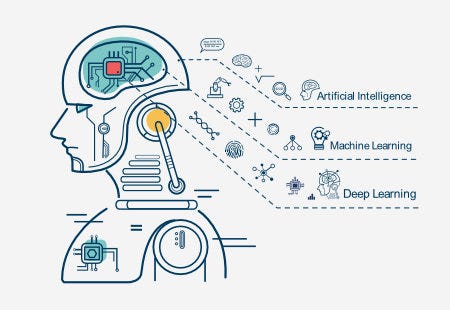
A special branch of Machine Learning is the so-called deep learning model (DL). A learning concept based on more in-depth structures using neural networks. These artificially generated neurons should help to make the results from millions of training examples — from a huge data set — even more transparent. The name of the DL model is based on the biological nervous system of the human brain. Deep learning simulates human “thinking” using artificial neural networks in such a way that the evaluation of the data content in multiple links leads to an exclusion process. Similar to the human “all or nothing law”, the AI decides here whether the information should be passed on and thus compressed or not. The advantage: by means of so-called “knowledge graphs”, machine decision-making can be made more transparent. The problem is, however, that this concept relies on endless training examples, i.e. it has an irrepressible hunger for data in order to be successful. As a result, it is enormously dependent on your original data set later on. This makes it prone to miscalculations when not enough data was available.
Deep Learning is already achieving success in speech processing, pattern recognition, object recognition and bioinformatics. Deep Learning is mainly used in AlphaGo and in open source software. Deep Learning makes it possible to process huge volumes of data in real time, which is especially important in finance, when the storage of such gigantic data sets cannot be realized.

“If the data is the new oil, Machine Learning is the refinery that refines those big data sets. “
— Toby Walsh, Author and Professor for AI
Outlook: Is there a Threat of a Million-Fold Job Loss?
With its successful use in all areas of life and the outstanding benefits of artificial intelligence, many people view AI with skepticism when it comes to their own jobs. Perhaps one has to fear that AI will overcome human unique selling points and exceed their competencies?
Hardly likely. The limits of Machine Learning clearly show that the most technological possibilities lie in replacing work processes that are largely monotonous, that process a large amount of data and that can be automated. This means that Artificial Intelligence cannot develop “higher intelligence”, but only aims at speed and accuracy.
The value of the labour is not lost, but always shifts or even creates new opportunities. The past shows that the way of working had to be reinvented every time technological progress improved or even postponed it. New types of workplaces were created, with unknown challenges and new creative and innovative approaches.
The use of a link between AI and human competence can already be seen under the term “intelligent empowerment”. Many companies attach great importance to the advantages of combining human thinking skills with applications of Artificial Intelligence. There is great potential for innovation if we can use AI to organize our working hours in such a way that AI takes over data-based work and the rest of the time can be meaningfully invested in creative projects. Perhaps this approach will even allow us to shorten the weekly working hours and give us more time for leisure activities in the future? The future will show.
If you like this story, you may like the following:
Cover Photo: 3D Illustration Gehirn Computer/ fotomek — stock.adobe.com
Photo Credits:
- Machine Learning line art infographic showing supervised and unsupervised machine learning/ ChickenDoodleDesigns — stock.adobe.com
- Machine learning 3 step infographic, artificial intelligence, Machine learning and Deep learning/ Buffaloboy — stock.adobe.com
- Data monetization concept with funnel and businessman/ Elnur — stock.adobe.com