
Japanese Language | Culture
Why Is Politeness in the Japanese Language a Hard Concept to Grasp?
The desu/masu form is often translated into English as formal or polite Japanese — but does that fully capture its meaning?

Social media has changed the face of language learning.
Today, language teaching influencers can reach a massive audience with just one post. A traditional teacher could never imagine the same number of students in an entire career.
Unfortunately, as educational content has moved online and our attention spans have gotten shorter, much of this content tends to over-simplify things — especially on Instagram.
Informal vs formal Japanese?
Just a few days ago, I saw a bite-sized Japanese language educational post appear on my Instagram feed that explained formal and informal verb conjugations in Japanese:
Verb: “Is”
- Formal present:です (desu)
- Formal past: でした (deshita)
- Informal present: だ (da)
- Informal past: だった (datta)
In response, one commenter wrote the following — and I quote verbatim:
“Why do languages has [sic] formal and informal. It has exactly the same meaning if I use the so called informal you get upset that’s on you.”
It wasn’t entirely his fault, but our dear friend couldn’t have been further away from the truth.
The distinction between “desu” and “da” is not as straightforward as simply “formal vs. informal Japanese.” For better or worse, this topic requires a far more nuanced explanation.
It’s not simply about formality
Most textbooks and teachers call the verb conjugations ending in “desu/masu” of the Japanese language the “polite form.” In Japanese, it’s called 丁寧語 (teineigo), which is different from the infamous 敬語 (keigo) — honorific speech.
Teineigo is the default form that is taught to all beginning foreign learners of Japanese. And for good reason. Since it is a neutral form, it works for a wide variety of public situations, without causing offense or making you sound childish or rude.
Unfortunately, calling it “formal Japanese” on social media without the nuanced explanation that a good teacher can provide gives the impression that this is only used in “formal situations.”
This could not be further from the truth.
Using the desu/masu form implies both politeness and social distance (the original meaning of the term before the term got co-opted by the pandemic to mean physical distance).
For example, you would use this form of Japanese if you wanted to try on a piece of clothing at a store, you would say 試着してもいいですか (shichaku shite mo ii desu ka?)
Conversely, saying “shichaku shite mo ii?” without ending the question with the question marker “desu ka” sounds a bit childish and perhaps even a little awkward. Unless you are on extremely close terms with the staff or much older than the staff, stick to teineigo.
If you use tamego, or so-called “casual Japanese,” and the staff gets offended, contrary to what our friend believes, it’s on you for committing a social faux pas.
Also, in an informal situation like an after-work party with your boss, contrary to what you might think, you don’t switch to the “casual form” of Japanese. Speaking teineigo (as opposed to tamego or keigo) is a deliberate choice based on the implicit understanding of hierarchy, social rank, and distance.
And social relations do not (usually) change during a casual after-hours dinner. That’s when calling it formal versus informal Japanese can lead to a case of misunderstanding.
Is there no difference in meaning?
Some learners of Japanese may think that having different “forms” for what is essentially the same word is pointless and stupid. The person I was arguing with certainly thought so.
His logic? There is no overt change in meaning between arimasen (formal) and nai (informal)— the present tense of the negative form of the verb “to exist.”
Let’s take a further look at the following example sentences with the most famous Japanese sentence ever written in any textbook.
- 「これはペンだ」kore wa pen da
- 「 [これはペンです」 kore wa pen desu
From a certain point of view, he wasn’t wrong. If you input the two sentences above into Google Translate, the software will spit out the exact same translation in English: “This is a pen!”
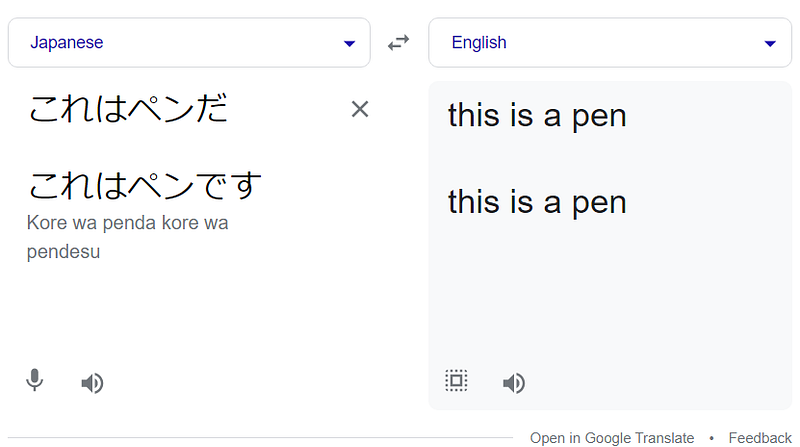
There is no change in the denoted meaning. But from a communicative standpoint, kore wa hon da and kore ha hon desu couldn’t be more different in social meaning.
For one, compared to kore wa hon desu, kore wa hon da sounds more like a declaration or a realization. Imagine an archaeologist sifting through a dig site, finding a strange block of wood, and then declaring “kore wa hon da!” when she realizes that it is a book.
But, when she announces this professional discovery to her colleagues, she might say “kore wa hon desu.”
Back home, while excitedly showing a photograph of her discovery to her friends, she might say “kore wa hon da yo!” (Notice the addition of the particle “yo” to soften the ending of the sentence.)
Each articulation reflects a different social function and social context. In a language as high-context as Japanese — I would even go as far as to say that connoted meaning is perhaps more important than denoted meaning.
Google Translate is still unable to register this level of nuance. Interpreters and translators will not be losing their jobs anytime soon.
Is it more difficult for English speakers to grasp the concept of teineigo or even keigo?
Perhaps the concept of teineigo or keigo takes a bit of time to get used to for English speakers. For one, modern English does not have a grammatical system of honorific speech.
I can hear you scream already. “But hold on— doesn’t English have different levels of politeness or formality?”:
- Least formal: “Can you come here tomorrow?”
- Medium formal: “Would you be able to come here tomorrow?”
- Most formal: “Would it be possible for you to come here tomorrow?”
You would be right, but that’s not what I’m talking about. Notice that in the example above, the phrase has been altered slightly to express politeness. At the risk of oversimplification, in Japanese, the words themselves do not need to change — only the grammatical forms of the words need to.
Linguistically speaking, according to Wikipedia,
“an honorific is a grammatical or morphosyntactic form that encodes the relative social status of the participants of the conversation.”
In simple English, that just means social status is grammatically encoded. To illustrate, one can express the equivalents in Japanese simply by changing the grammatical forms.
- Least formal (tamego): 明日、ここに来ることできる? ashita, koko ni korareru?
- Medium formal (teineigo): 明日、ここに来ることはできますか? ashita, koko ni koraremasu ka?
- Most formal(sonkeigo) :明日、ここにいらっしゃることはできますか? ashita, kokoni irassharu koto ha dekimasu ka? — notice that when using sonkeigo, the verb kuru (来る, to come) changes to irassharu (いらっしゃる)
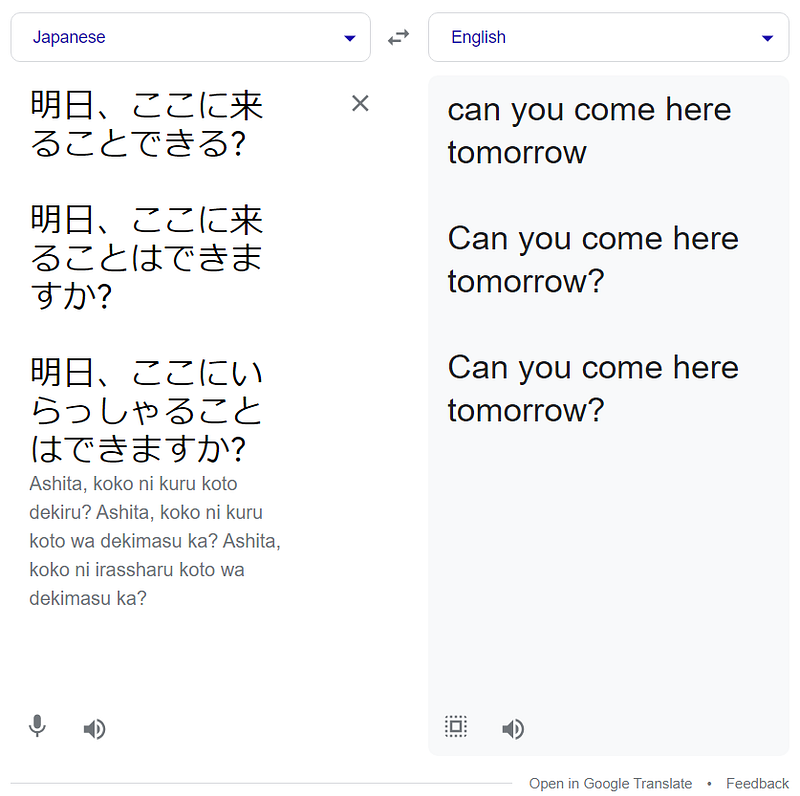
In Japanese, politeness is directly encoded into grammar
When I was first exposed to keigo, my teacher told us that in her many years of teaching Japanese, she had encountered some students who resisted speaking it because it was “anti-egalitarianism.”
In a sense, they are not wrong. Social hierarchy is implicit in the Japanese language. As if the Japanese language wasn’t difficult enough with all the messy writing systems and — the Japanese language grammatically encodes for social hierarchy!
To speak the Japanese language is to understand your role within a larger social drama. Personal pronouns, verb conjugations, and even the verbs themselves might change depending on the situation and who the listener is.
Even a simple phrase like “Tanaka-san ni hon wo watashite moratta,” — which literally means that “I received the act of passing a book from Tanaka-san” — expresses the relation of indebt-ness grammatically.
So, what is my solution for understanding politeness and how it functions in the Japanese language? The answer is simple. Don’t skip your grammar lessons!
For more deep dives into the nuances of the Japanese language, please check the following:
The author is an editor of Japonica, a Japan-focused publication, but also writes on a wide variety of topics. His key topics of interest are society, culture, modern work, creator economy, and cryptocurrency, with the occasional fictional story, creative piece, or personal essay. Discover his most-read stories here.


