
Learning Japanese
Learning Japanese? Avoid Making This Embarrassing Mistake as I Did
An episode highlighting the difficulty of honorifics and the highly contextual nature of the Japanese language
Everyone makes mistakes learning languages. In this story, I am going to talk about a particularly memorable one I made in Japanese.
This episode probably happened during my second month after moving to Japan. Not only was I still getting used to business Japanese 24/7, but I was also still adjusting to the corporate environment.
The first few months after I moved to Japan were tough. Not surprisingly, the biggest struggle was with the Japanese language. Even though I had studied Japanese since the age of 20, and even passed the JLPT N1, using the Japanese language 24/7 — well, that was a new challenge.
I was often fatigued by about 2 PM every day from listening, speaking, reading, and writing business Japanese.
In the office, I had been paired with a mentor, so that I could learn all the nuances of business Japanese, and the ropes of operating in a Japanese corporate environment. We collaborated closely every day.
Let’s call him Tanaka-san.
My Unforgivable Mistake in Japanese
On this occasion, I was to meet with a digital marketing agency that wanted to pitch their services to us. The first thing you do at every corporate meeting in Japan is the famous business card exchanging ritual — also referred to as 名刺交換 (meishi kōkan) in Japanese.
We took turns introducing ourselves and presenting our business cards to our guests. Tanaka-san went first, and then I went after him.
“My name is Alvin and I work with Tanaka-san on overseas marketing. It is my pleasure to meet you.”
「アルビンと申します。田中さんと一緒に海外マーケティングの仕事をしております。どうぞよろしくお願いいたします。」
This was where I had made the mistake!
Did you spot it?
After the meeting was over, Tanaka-san pulled me aside and reprimanded me.
“Alvin, that was a meeting with a guest. You don’t add ‘san’ to my name when in front of outsiders.”
Unpacking the Honorific Title, “San”
“San” is one of the most well-known honorific titles in Japanese. Even people who don’t speak any Japanese have come across this term. It’s usually translated as a gender-neutral version of Mr. or Ms.
My Japanese lessons from my university days came flooding back into my mind. Dropping “san” inappropriately (called 呼び捨て, yobisute) is a faux pas in Japan.
What is lesser known is that adding “san” inappropriately is also a big mistake!
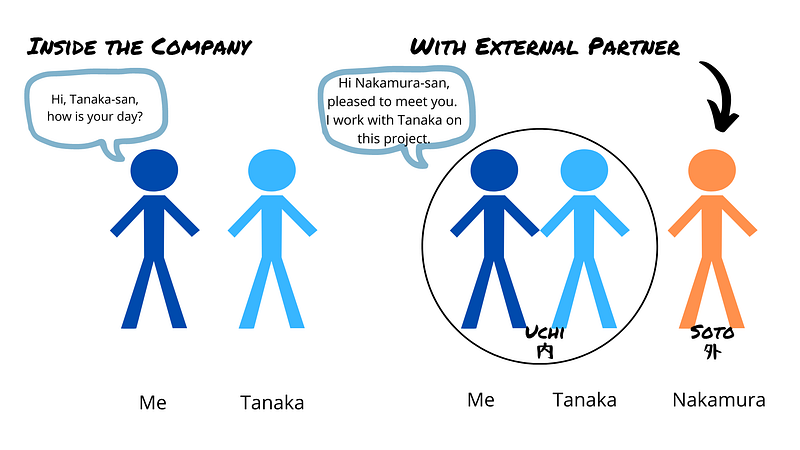
When referring to your colleagues within a company, you add “san” to their names.
But, when you refer to your colleagues in front of guests, “san” is dropped.
Why?
Because adding the honorific “san” reflects the underlying social relations of 内, uchi (in-group) and 外, soto (out-group), core cultural concepts that are built into the very grammar of Japanese itself.
This is an area where the contextual nature of the Japanese language becomes highly apparent.
Your colleague is honorific when you are speaking to him (or her), but when talking about your colleague in front of external partners, your colleague becomes part of your “in-group.”
As a consequence, you apply humble language when speaking about your colleague in front of external parties, and “san” should be dropped.
This applies to all honorific language in Japanese beyond the use of “san” and its discussion alone can fill pages.
How I Should Have Said It
The correct way should have been like this:
“My name is Alvin, and I work with Tanaka. It is my pleasure to meet you.”
「アルビンと申します。田中と一緒に仕事をしております。どうぞよろしくお願いいたします。」
Another example, if you want to discuss with your colleague/boss before getting back (which happens very often in Japan), you might say:
“I will check in with Tanaka and get back to you on that.”
田中と相談してご回答いたします。
Luckily for me, all parties involved in the meeting knew I was a foreigner and not a native speaker of Japanese. So, I was able to get away even though I messed up.
Since that day, I have always been very self-conscious when referring to my colleagues — including my superiors — in front of external parties.
I don’t think I ever made the same mistake again.
© Alvin T. 2022
For more insights into Japanese culture and the Japanese language, follow Japonica.
The author is an editor of Japonica and also writes on a wide variety of topics. His key topics are society, culture, modern work, and cryptocurrency, with the occasional fictional story, creative piece, or reflective essay. Discover his most-read stories here.
If these topics interest you, consider subscribing to receive new stories from the author via e-mail.


