
Why the Japanese Words for “I” and “You” Will Surprise English Speakers
The notion of the self in the Japanese worldview differs from that of the Western view.

One of the first words you learn to say in a new language is the word for “I.”
And for good reason.
Cogito, ergo sum — “I think, therefore I am,” so declared René Descartes in his writings.
Philosophy aside, from a practical standpoint, you do need to learn how to introduce yourself. And to introduce yourself you need to learn how to use the first-person pronoun. The second thing you probably need to learn is how to ask a question to your listener. And to ask your listener a question, you need to use the second-person pronoun, “you.”
Right?
Be prepared to be surprised, because the same rules don’t exactly apply in the Japanese language.
Japanese native speakers prefer dropping the grammatical subject in a sentence
What if I told you that in Japanese, you can, and are often encouraged to omit the subject in many situations?
Many early learners of the Japanese language are somewhat stumped by this, especially if they are English speakers — it’s grammatically impossible to avoid saying “I” if you are talking about yourself.
In the Japanese language, speakers do so — often routinely!
To give an example, in an English sentence, one might say, “I love cake.” In Japanese, you could say the following:
「私はケーキが好きです。」ーDirect translation: “I, cake love.”
Yet, in this context, it’s obvious that the subject of the sentence is “I.” The natural way to say it in Japanese would be to drop the subject.
「ケーキが好きです。」 — Direct translation:, “Cake, love.”
The opposite is also true. If you’re asking a question, you can simply ask,
「ケーキ、好きですか。」 — Direct translation: “Cake, love?”
In this situation, it’s implicitly understood that the subject of the sentence is the listener.
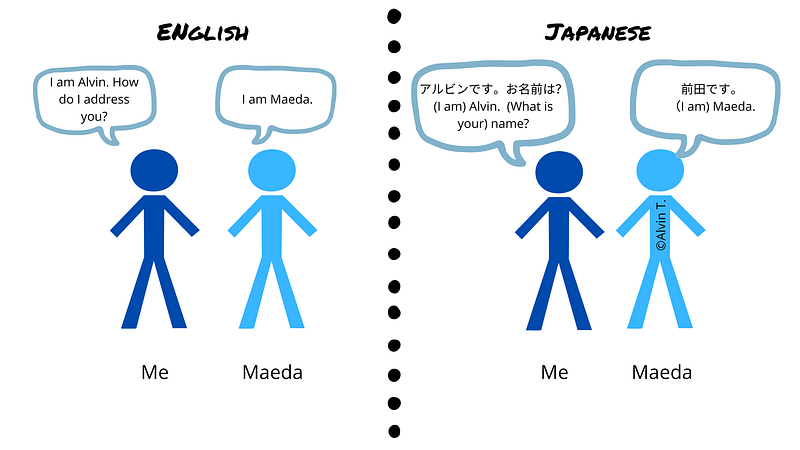
It’s often said that the Japanese language is a high-context language, and just looking at the above sample conversation, it’s obvious that it’s not without good reason.
This concept presents a psychological and grammatical problem for many learners who come from an English background.
If a foreigner always starts a sentence with watashi(わたし) — the subject “I” — it’s a sign that the speaker is probably not that fluent.
It’s not grammatically wrong — it’s just unnatural.
A sign of Japanese fluency, in addition to routinely bowing on the phone, is when the Japanese learner has internalized this concept and learned to drop the subject.
Still, it’s not difficult to see why the preference to omit subjects can sometimes be confusing, even amongst native speakers. In some situations, you need to use the first-person pronoun to disambiguate.
That presents yet another problem for the learner of Japanese: there is no one singular word that maps nicely onto “I.”
Is “I” watashi… or is it something else?
You start to protest — “But hey, in my Japanese textbook here it says that “I” is watashi! What do you mean that there’s no one word for I?”
Watashi is a relatively formal pronoun that’s used in business and other formal situations. It’s the default “neutral” form of I.
But remember, Japanese speech changes forms in different situations. There’s an even more formal or polite way of saying watashi — and that is watakushi (わたくし). This is the pronoun you might use during a formal speech.
Outside of the formal, impersonal situations, when you are with your friends, the pronouns change — and there is a gendered aspect to pronouns. As with most things with gender identity formation, this likely has roots in childhood.
In modern Japanese, boys tend to refer to themselves as boku (僕)and some refer to themselves as ore (俺) — which is something that often requires more self-confidence.
When boys grow up and enter the workplace, they’re expected to use watashi. Even though older men in the workplace still continue to refer to themselves as boku. Ore is much less common in business and formal situations — although that can happen during informal conversations and during the crazy company drinking “nominication” sessions when all hell breaks loose.
In contrast to that, girls grow up using watashi, or even more feminized versions like atashi.
Some girls (and even young women) even go to the extent of speaking in the third person. They address themselves by their own name. This is supposed to present a “cuter” version of themselves.
In short, in the Japanese language, choosing a pronoun is not as easy as simply saying “I.”
Choosing a pronoun is to play a gendered role in society — and accept all of the expectations and meanings that come along with it.
“You” is not “you” either
Ok, fair enough, so personal pronouns are complicated. But surely, it’s simpler when you’re talking to others. In the Japanese textbook, “you” is anata (あなた).
Right?
You’re going to wish you never asked that.
True, in the textbook, “you” is anata, but the Japanese preference for dropping subjects in a sentence means that you hardly hear the word anata in day-to-day situations. When someone uses it, it often sounds direct and straightforward — and therefore, impolite. The other meaning of anata is “dear,” and it is often used by wives to address their husbands.
For these reasons, when I was learning Japanese, my teacher advised me to avoid using anata as much as possible.
So how should you ask a specific someone when you need to address that person within a group?
Simple — just address them by their name — but do not forget to add the honorific suffix “san” correctly. So, when you ask Maeda-san if he likes cake, simply ask:
「前田さん、ケーキ好きですか。」Direct translation: “Maeda-san, cake like?”
The other alternative is to dig into an entire corpus of words that refer to “you” — like kimi(君), omae (お前). These alternative words carry implicit notions of social rank and may even sound rude if not vulgar — as with so many words in the Japanese language. That would require an extensive sociolinguistic study of personal pronouns well beyond the scope of this article.
In any case, as a non-native speaker of Japanese, those words are beyond me — so I try to avoid using them!
Takeaway: The unchanging self does not exist in the Japanese worldview
When we approach a new language from our preexisting notions of how the world works, we tend to force our biases onto it — and this can often hinder how quickly or slowly we learn a new language.
For people coming from a culture rooted in a Cartesian tradition of “cogito, ergo sum,” — the self is taken for granted.
There is ego — the ego is aware, and by the existence of the conscious self, we are all individuals. The entire political philosophy of liberalism is grounded in the assumption that we are all individuals — in-dividuals — un-dividable.
But this sort of thinking behind the individual self has much deeper roots in Western philosophy.
In the Japanese conception — there is no such philosophy. Perhaps largely influenced by Confucian philosophy — people relate dynamically to each other via social rank, position, and situation.
In the Japanese language, personal pronouns are pregnant with implications of social rank which only make sense within a very different worldview. It is one where people relate to each other not as individuals, but as actors recognizing their role within a grand social drama.
Although Descartes’s primacy of the “thinking, conscious, in-dividual self” dominates much of modern thinking, before him, there was Shakespeare who had an idea of what one could refer to as the “role-playing self.” And the Bard was probably closer to the Confucian view when he wrote the now famous words in his Play As You Like It:
All the world’s a stage, And all the men and women merely players; They have their exits and their entrances, And one man in his time plays many parts, His acts being seven ages.
The author is an editor of Japonica, a Japan-focused publication, but also writes on a wide variety of topics. His key topics of interest are society, culture, modern work, creator economy, and cryptocurrency, with the occasional fictional story, creative piece, or personal essay. Discover his most-read stories here.
If these topics interest you, why not consider subscribing to receive a monthly digest of new stories via e-mail?


