
GEEKY | OVERPOPULATION | NATURE | POLLUTION
Is Overpopulation Still a Major Problem?
Let’s take a look at the data

I was inspired to write about overpopulation after reading this article by Jan Sebastian It’s mainly about oil but she also covered overpopulation, suggesting this will be a major problem in the future. She is both right and wrong. Let me explain why.
If you look at population trends at a global level overpopulation is indeed a major issue. Per this counter we’re a hair from 8 billion.
However when you take a closer look at the data, you find out that all continents face a population decline -or decline of population growth- in the coming decades except one: Africa. Currently there are 1.4 billion people in Africa. Asia has 4.72 billion people.
According to UN projections, Africa’s population will triple to ~4 billion people by 2100, and Asia’s will drop to 4.67 billion people. Asia will keep rising due to India. Many other countries, including China, already have a low births issue.
Asia is predicted to peak at 5.3 billion in 2050 and then decline during the second half of the century. Europe in 2100 will drop to 588 million from 745 million, the steepest decline (bear in mind these estimates include immigrants). South America will drop by ~10 million, while North America will have ~70 million more people.
I tried embedding Our World in Data’s live graph but Medium does not support html embeds. For details, with projections per continent and country, the live graph is here:
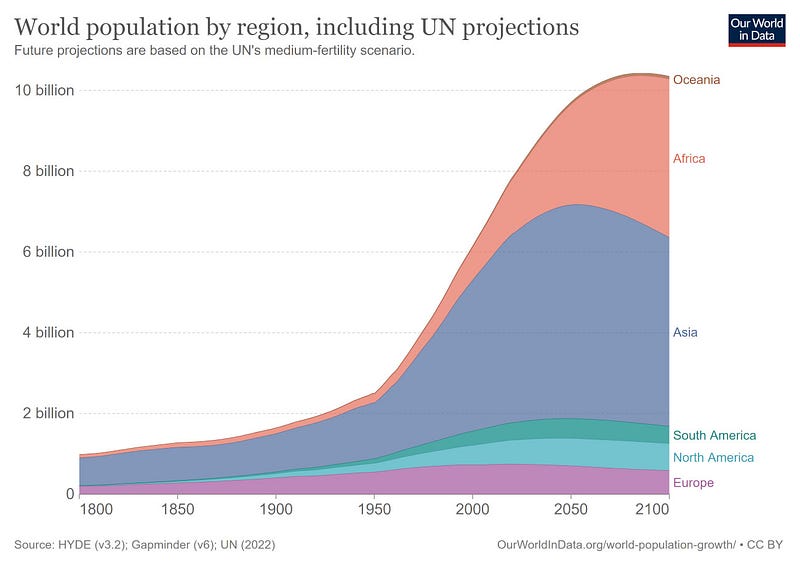
According to UN projections the global population will peak at 10.43 billion in 2083 and henceforth it will start declining. By 2100 Earth is predicted to have 10.35 billion people and in the next couple of decades it’ll fall back to <10 billion levels.
As is evident from the graph and more details in Our World in Data’s deeply researched article, all of the extra population by the end of the century will come from Africa. Africa will have 2.5 billion more people in 2100, 150 million more than the global surplus.
They surpassed 1 billion just in 2008. Africa is the new Asia. They are the last great birth engine of the planet. Their births per woman and births/deaths ratio resemble the peaks of China.
Now China has 1.70 births per woman, a value rapidly decreasing. Japan has an extremely low 1.35 births per woman, and South Korea has an astoundingly low 0.91 births per woman. The Koreans have the saddest world record.
What is the common element of the above countries and every other country that has seen its birth rate collapse? High grade education of women -in particular- and a rise in the standards of living, occasionally paired with uncertainty about the future and certain cultural factors. That’s it.
Most countries have gone through this. Jan is right that the global population exploded in the last couple of centuries. Here is another OWID graph that shows this. We went from 4 million in 10,000 BC to 7.98 billion today:
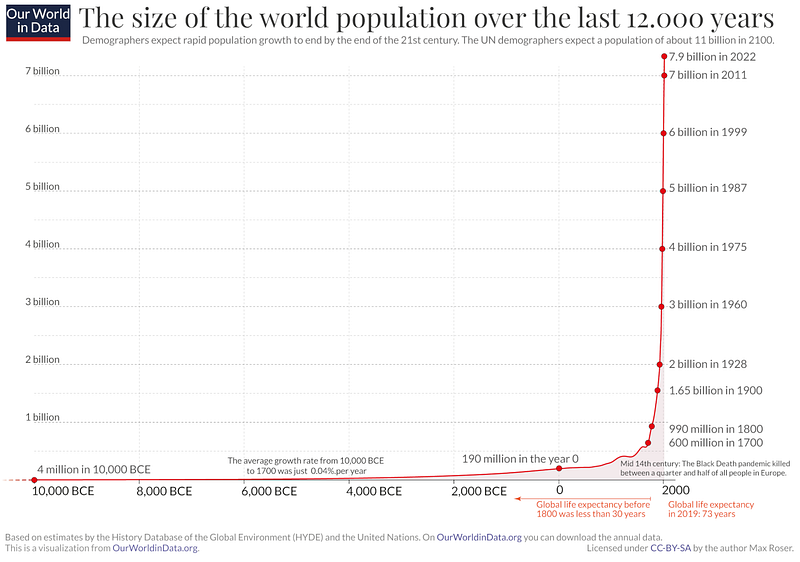
Population growth the last ~200 years has been exponential. The growth rate line is almost vertical despite two world wars. That rise came after the industrial revolution and medical and scientific advances. The global life expectancy was <30 years in <1800 and now it is 73 years.
However the progress and development that followed the industrial revolution has been a two-edged sword. At first it leads to explosive births. Poor farmers moved en masse from rural areas to the newly built urban centers. Their finances somewhat improved so they could afford to have more children than 2.1 on average.
Most people were still uneducated, deeply religious and superstitious. If scripture said ‘multiply and prosper’ those people took it seriously. They did not consider such words might have been relevant ~2,000 years ago but not today. So they multiplied, even if they could not truly prosper. The lack of effective contraception did not help either.
After a certain ‘progress threshold’ though that trend reverses, and births start falling. High grade education and self-sufficiency of women is the key. Japan went through an explosive growth the decades after WW2, as did Germany. Births rose in both countries, at a time when more workers were needed.
Though the conditions and the culture of the two countries wildly differ, eventually their birth rates slumped. Germany solved it by opening up to immigrants, but the Japanese are xenophobic. They do not do immigrants.
And the few they accept are western ‘expatriates’ who usually choose to move to the country. Due to that and some other cultural quirks the Japanese face an even bigger demographic bomb than the Koreans.
They’re also highly workaholic, an additional factor. Occasional crude remarks by male Japanese government officials that women should make more babies have not helped at all.
My point is that modest progress leads to more births. With much progress though -particularly education and self-sufficiency of women- birth rates can fall back to pre-industrial levels but with a much higher life expectancy, a very dangerous mix.
This pattern has been observed in almost every country. Africa is now at the same stage Europe, Japan and China were post-WW2.
Their population is still highly superstitious, with a mix of Muslim, Christians and local African religions. The education of the population is still low, particularly of women.
So if overpopulation is no longer a major issue should we stop worrying about Earth and the environment and live like there is no tomorrow? Should we go nuts with CO2 emissions? Should we congratulate polluters and urge loggers to destroy more forests?
Of course not. The ravaging of Earth needs to stop now. Temps will keep on rising unless we cap emissions. If we exceed 500 ppm of CO2 all bets are off.
It’s also possible that our planet cannot absorb 2.5 more billion people by 2083, so nature might unleash a super-Covid next time, unless we take a few steps back. That was what Jan suggested might happen too.
I think the following decades are the most critical for our species, as I wrote below. I try to stay cautiously optimistic, but if we pass the point of no return -as I wrote in this poem- of global warming no demographic slowdown is going to save us.
cited research by: Max Roser, Hannah Ritchie, Esteban Ortiz-Ospina and Lucas Rodés-Guirao — “World Population Growth | Our World in Data”
Liked what you read? Such articles require a lot of time and research, so I’d be obliged if you helped me write more. One way is to join Medium via my referral link.
Another is to help me buy a drawing tablet so that I start illustrating my comics scripts. Or simply read more of my words😊


