
Physics
Is hydrogen gas a medium for holding information? (# 30)

Article 28 - Predicting rotation velocities of stars - described the results of an empirical investigation of 2,665 stars’ rotation curves in 161 galaxies. The conclusion was that the fabric of space could be explained by expanding Newton’s inverse square law for gravity to include the memory of what has been experienced in that space during the lifetime of a star. In other words, instead of Einstein’s description of the fabric of space being like a rubber sheet with depressions caused by the presence of mass, space is more like the memory foam of a mattress in acknowledgment of Carlo Rovelli’s description of Quantum Loop Gravity where space consists of spinfoam.
The issue considered in this article is how the fabric of space might instantiate memory.
Memory as information
Chiara Marletto has extended David Deutch’s ideas about Construction Theory. She argues that the laws of physics need to be considered in terms of a counterfactual approach (Article 24 - Is Information Matter?). This approach requires an understanding of the properties of information, particularly the properties of a medium that can instantiate information.
Interstellar hydrogen gas is considered to be a suitable medium for instantiating information because it has the properties identified by Marletto, namely:
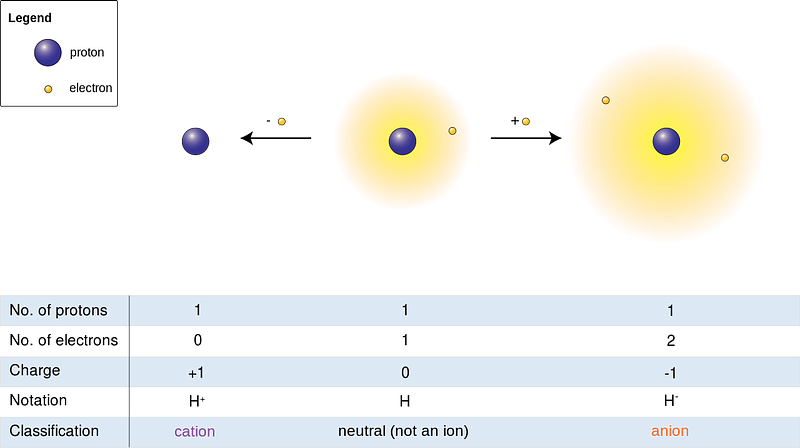
- The spin state of a hydrogen atom can flip by gaining or losing an electron;
- Individual atoms can be copies of other atoms in hydrogen gas;
- An individual spin state cannot be accurately measured but combinations can be measured;
- An individual atom can transform its state based on laws of physics;
- Transformations of the spin states of individual atoms are reversible and do not change the total energy of the gas.
Does dark matter have an electrical charge?
Two scientists, Julian Muñoz, a theoretical cosmologist at Harvard University in Cambridge, Massachusetts, and Avi Loeb, a theoretical physicist and professor at the Harvard-Smithsonian Center for Astrophysics (CfA), have been investigating whether some dark-matter particles have a small electrical charge. According to Muñoz:
“We are constraining the possibility that dark matter particles carry a tiny electrical charge — equal to one-millionth that of an electron — through measurable signals from the cosmic dawn”. … However, the team has no way to prove the theory yet, as “such tiny charges are impossible to observe even with the largest particle accelerators.”
Principle of Least Action
Nobel Prize-winning chemist, Ilya Prigogine, demonstrated when studying the transformation and exchange of energy, non-linear or chaotic behaviour is a precursor of ‘order’. When a thin layer of liquid is heated from underneath, the behaviour of molecules in the liquid becomes chaotic at first: the nonlinear regime. Soon after, molecules start following orderly paths to transport heat from the bottom to the surface more efficiently. These paths are visible at the surface of the liquid as a honeycomb-like pattern of cells, so-called Bénard cells or convection cells.
In physics, nothing happens without an energy inequality or gradient i.e. neighbouring areas of relative surplus or shortage. In such situations, a flow can develop when energy drifts to bridge these areas reducing the inequality; molecules follow orderly paths to reduce a temperature gradient. The path taken involves the least action and not necessarily the shortest route or, even, the least time.
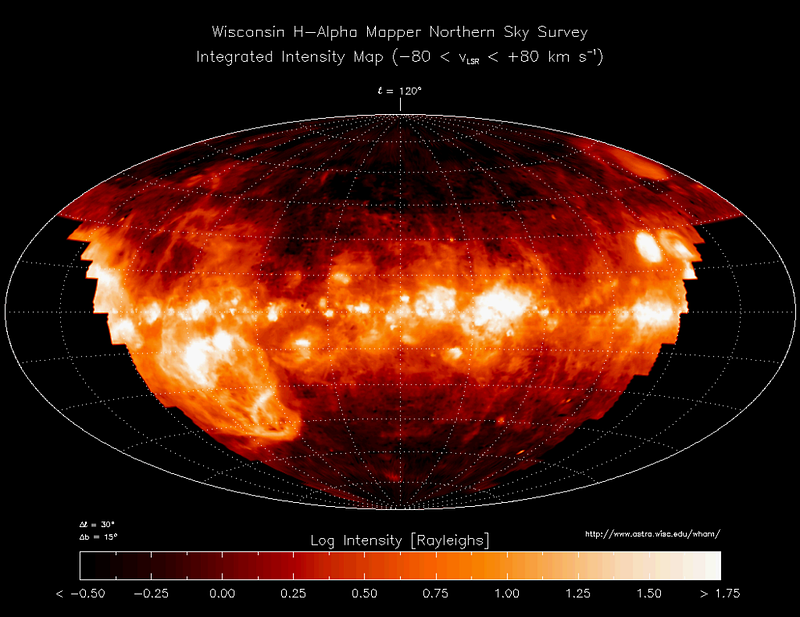

In the context of interstellar hydrogen gas, close to the center of a galaxy, the temperature is high and so the molecules of the gas behave chaotically. Hydrogen gas at the center of a galaxy is not a suitable medium for instantiating information. Newton’s inverse square law may not need to be modified to take into account what happens close to the center.
Further away from the center of the galaxy, hydrogen gas cools and can become a medium for ‘instantiating’ information. Both a proton and an electron act is if they spin like tops, and spin axes of the two tops can either be pointed in the same direction (aligned) or in opposite directions (anti-aligned). When a proton and electron spin in opposite directions, the atom as a whole has very slightly lower energy than when the two spins are aligned. When an atom in the lower-energy state (spins opposed) acquires a small amount of energy, then the spins of the proton and electron are aligned, leaving the atom in a slightly excited state. When the atom loses that same amount of energy, it returns to its ground state.
Neutral hydrogen atoms can acquire small amounts of energy through collisions with other hydrogen atoms or with free electrons. Such collisions are extremely rare in the sparse gases of interstellar space. An individual atom may wait centuries before such an encounter aligns the spins of its proton and electron. If there were no collisions, an excited hydrogen atom would wait an average of about 10 million years before emitting a photon and returning to its state of lowest energy. The amount of energy involved corresponds to a wave with a wavelength of 21 centimeters. Spin is a quantum-mechanical property, akin to the angular momentum of a classical sphere rotating on its axis, except it comes in discrete units of integer or half-integer multiples of ħ which is the modified Planck constant.
The idea proposed in this article is that a hydrogen atom in a positive spin state has a positive charge, while an atom in a negative spin state has a negative charge. The presence of dark matter in a galaxy reflects the density of negatively charged atoms. Over time, the spin state of atoms could change thus changing the amount of dark matter within galaxies.
Understanding quantum spin
Most of the information in this section is taken from an article in Medium by Wilhelm Schultz (https://readmedium.com/but-what-is-quantum-spin-de66e030e17e). An alternate name for quantum spin is intrinsic angular momentum. Spin is an intrinsic property; spin is a property such that a particle possesses angular momentum without rotating.
School textbooks give the impression that electrons possess a magnetic field because the electron is spinning. However, an electron does not spin. The Stern-Gerlach experiment shows that when electrons pass through the apparatus (two magnets), they emerge either at the top or the bottom of the detector. There is no distribution of positions. This result is different from that for particles with spin.
The magnet field wants to twist the electron … to align the electron’s magnetic field with its own. However, the electron does not rotate, but precesses.
To understand what this means we need to introduce torque. Torque is a vector quantity so it has a direction as well as magnitude and is the result of a force that causes rotation. …
So, although the field wants to twist the electron, the torque produced changes the angular momentum such that it will describe a circle. This is called precession.
In brief, when dark energy creates new space, particles near that space acquire intrinsic angular momentum. The resulting torque causes torsion in the fabric of space (see Article 22 — How increasing computational complexity manifests). The spiral shapes of galaxies are acquired as a consequence of dark energy with its associated spin.
Estimating the quantity of dark matter
After a star is formed, it will still be surrounded by hydrogen gas. As the universe expands due to dark energy, hydrogen gas will occupy the new volume of space. In line with the idea that space is a type of memory foam, negative hydrogen atoms in the space adjacent to a star could encode information about the star. In brief, dark matter represents information about space surrounding a star.
Space expands in three dimensions but the shape of many galaxies is more like a disk than a sphere. With the expansion in space, the hydrogen gas may occupy a volume that is more than a two-dimensional surface but less than a three-dimensional sphere. Assume for discussion purposes, the increase in space occupied by hydrogen gas is the average of the expansion of a disk and the expansion of a sphere.
The following table shows the size of the expansion in space for a disk and a sphere for stars of different ages. The relevant formulae are: surface of disk πr²; and volume of sphere 4πr³/3. Every billion years, space expands by 0.074%. The column called dark matter ratio is the average dark matter to baryonic matter ratio for galaxies with stars of that age or younger.
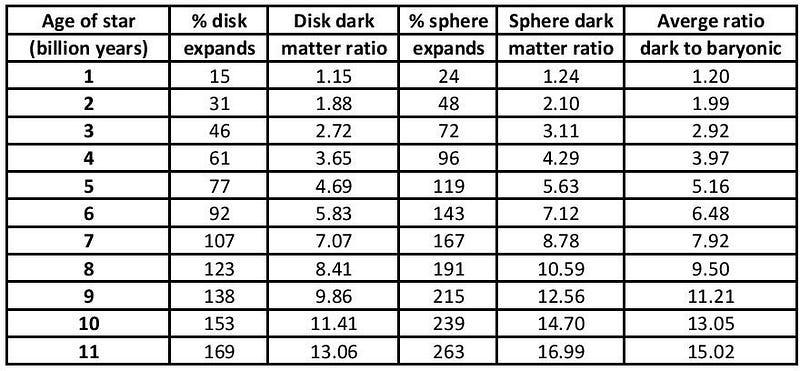
The data in the table assumes that new stars are made at a constant rate over time i.e. there are an equal number of stars in each age group. Dark matter associated with a galaxy increases with the age and size of its stars. Around 90% of all the stars will live for more than 10 billion years. As most galaxies were formed around 12 billion years ago, some stars will be at least 11 billion years old. The quantity of dark matter in a galaxy is proportional to the increase in the space around its stars. When a new star has a value of 1, dark matter has a value equal to the square or cube of the percentage growth in new space. Dark matter keeps increasing as a star ages because of the growth in space.
The dark matter number describes the curvature of the fabric of space around a star. The number can be affected by the mass of adjacent stars. In other words, the curvature associated with new space is not zero. As a star gets older, the curvature of space adjacent to the star increases. This curvature might be instantiated in space via the density of the negative hydrogen atoms in that space. The curvature of the new space creates a gravitational lensing effect affecting the path of photons traveling near a star or galaxy.
When the shape of the hydrogen gas around stars closely resembles a disk, the dark matter ratio for a universe containing stars 11 billion years old or younger could be around 13. When the hydrogen gas occupies a shape more like a sphere, the dark matter ratio could be around 17. The actual ratio is likely to be between these two values e.g. the average of 15. As some galaxies are younger than 11 billion years and old galaxies may stop producing stars, this estimate is not inconsistent with current estimates of the ratio of dark matter to baryonic matter in the universe.
Dark matter does not cause curvature in space; dark matter is information about the curvature of new space around a star. The creation of a star precedes the creation of dark matter. The ΛCDM model of the universe needs to be revised.
This information interpretation of dark matter suggests the mass of dark matter is associated with a negatively charged ion. The fabric of space conforms to a curvature consistent with the density of negatively charged ions in hydrogen gas.
Orbital resonance
In celestial mechanics, orbital resonance occurs when orbiting bodies exert regular, periodic gravitational influence on each other, usually because their orbital periods are related by a ratio of small integers. Most commonly, this relationship is found between a pair of objects. Although Newton’s equation predicting the rotation velocity for stars only depends on the mass of a galaxy within the radius of a star, Newton’s equation is a simplification of a more complex relationship i.e. the mass of a galaxy is made up of millions of stars. The idea that the velocity of a star could be related to the velocity of a neighboring star is not inconsistent with Newton’s equations when taking orbital resonance into the relationship.
Innate choreography
Various scientific theories provide explanations for why dark matter could be a form of information. These explanations generally do not require the introduction of new concepts like dark matter that are difficult to test empirically. Using the principle of Occam’s razor — entities should not be multiplied beyond necessity — there could be benefits from more detailed investigations into the idea of dark matter being information.
For example, physicist Marcus van der Erve suggests:
Physics offers an explanation of how a neural learning model, trained with gravitational displacement data, might predict in little time a future state of the Universe — in terms of gravitational densities — for different cosmological parameters without additional training. The clue is in gravitational displacement that, like motion, necessarily unfolds on paths of least action. The pattern of paths identified by the model therefore represents a least-action choreography. This innate choreography is the behavioral signature of gravitational densities. I arrived at this view by relating the finding of the researchers to the work of Prigogine on the emergence of orderly behavior.
The question for this article is:
Do locations on Earth have memory foam characteristics?
To view the headings of all the articles to be published in this series please click on https://readmedium.com/orbiting-stars-and-origin-of-our-universe-338906930f51
To obtain a copy of the book ‘Orbiting Stars’ which contains the first drafts of all these articles, please visit https://www.amazon.com