
Astrophysics
Predicting rotation velocities of stars (# 28)
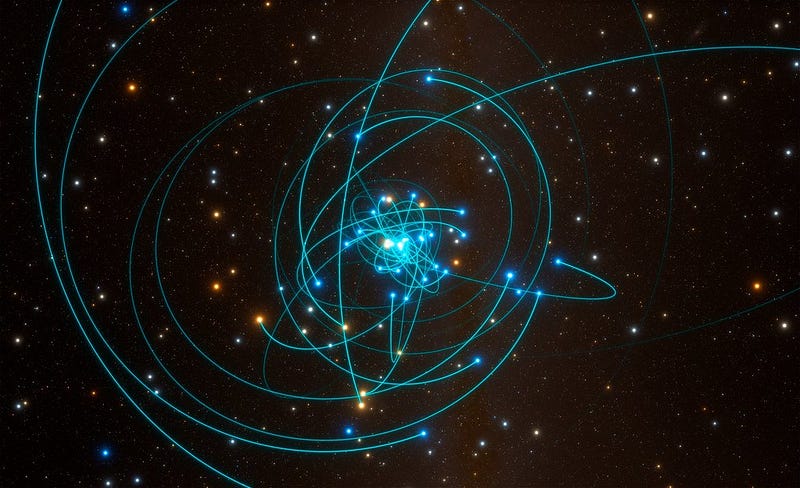
The previous article (Testing a new equation for gravity) set out an equation for estimating the rotational velocity of stars. The theory behind this Kolmogorov equation explains why the velocity of stars is inversely related to the distance of a star from the center of gravity i.e. this equation provides a theoretical explanation for Newton’s Inverse Square Law. The theory, however, also implies that the history of the star needs to be included in equations used to predict the velocities of stars. This history needs to include information about the age and temperature of a star as well as how far a star has moved relative to the center of the galaxy. The Kolmogorov equation describes the effect on the velocities of stars for small increments in time. The full history of a star is incorporated into the equation by including the prediction error associated with a star nearer to the center of the galaxy
Data on galaxies
Lack of qualifications in astrophysics and lack of access to computers capable of managing large databases has meant that data about stars in galaxies has not been easy to access. The analysis reported in this article has been carried out using an excel spreadsheet on a personal computer. The primary aim of this article is to provide empirical evidence to show that the ideas in these articles are worth investigating in more detail.
Data from the SPARC database has been published on the internet. This database consists of 3,660 stars in 175 galaxies. The data used in the excel spreadsheets include:
- An estimate of the age of the galaxy;
- Velocities of the bulge, disk, and gas masses;
- Distance of masses from the center of the galaxy;
- Constant expansion of universe at 72 km/second/megaparsec.
As discussed next, the excel spreadsheet is based on stars that are 2 kiloparsecs (kpc) or more from the center of a galaxy. The results reported here are for 2,665 stars in 161 galaxies.
Adjusting for age and temperature
During the analysis of the data, it became apparent that the mass associated with the gas in the galaxy needed to be treated differently from the masses of stars in the bulge and the disk. This conclusion is consistent with the hypothesis that some forms of gas are suitable mediums for instantiating information. When hydrogen gas is very hot near the center of the galaxy, it is ionized and not a suitable medium. Further out from the center, hydrogen gas cools and can instantiate information.
The Kolmogorov formula used for predicting the velocity of a star (not including the gravitational constant) is:
v₂² ~ {(mᵇ + mᵈ + mᵍ) + [(mᵍ * k₁) * (1 + k₂)]} / d₂
where:
v₂ = velocity of a star;
mᵇ = mass of stars in the bulge at center of the galaxy within radius d₂;
mᵈ = mass of stars in the disk of the galaxy within radius d₂;
mᵍ = mass of gas in the galaxy within radius d₂;
d₂ = distance of a star or gas from center of the galaxy i.e. radius d₂;
k₁ = adjustment factor based on average age and temperature of a star in the galaxy;
k₂ = adjustment factor based on the average increase in distance of a star from the center due to expansion of space. k₂ is based on a value of 0.074 for every billion years.
When k₁ equals 0, the Kolmogorov formula is the same as Newton’s inverse square law. Values for k₁ were determined by examining the effect on the mean error and associated standard deviation for all the stars. The best estimate for the adjustment factor is 2.7.
Stars less than 2 kpc from the center of a galaxy were assessed as requiring an adjustment factor of 0 and were omitted from the analysis as the difference in predictions between Newton’s inverse square law and the Kolmogorov formula would be the same. As discussed in article 30, gas closer to the center of the galaxy is hot and not an appropriate medium for instantiating information. Thus k₁ is set equal to 0 for stars close to the center.
The value of k₁ for an individual star depends on the age of a star and its temperature which are not readily available. The formula describing how k₁ could vary with age and temperature is ([13.7/A]*[4/T])/([{d₁/d₂}*{4/T}]+1)² where A is Age of star, T is temperature and d₂ = d₁ * (1 + [A * 0.074]). The constant 0.074 is the expansion of the universe in kpc per billion years. The values in Table 1 are for k₁ divided by 4. Thus when k₁ equals 2.7, the appropriate value in the Table is 0.675 e.g. the average age of stars in the SPARC database could be 6 billion years with an average temperature of 7,000 ᵒK.
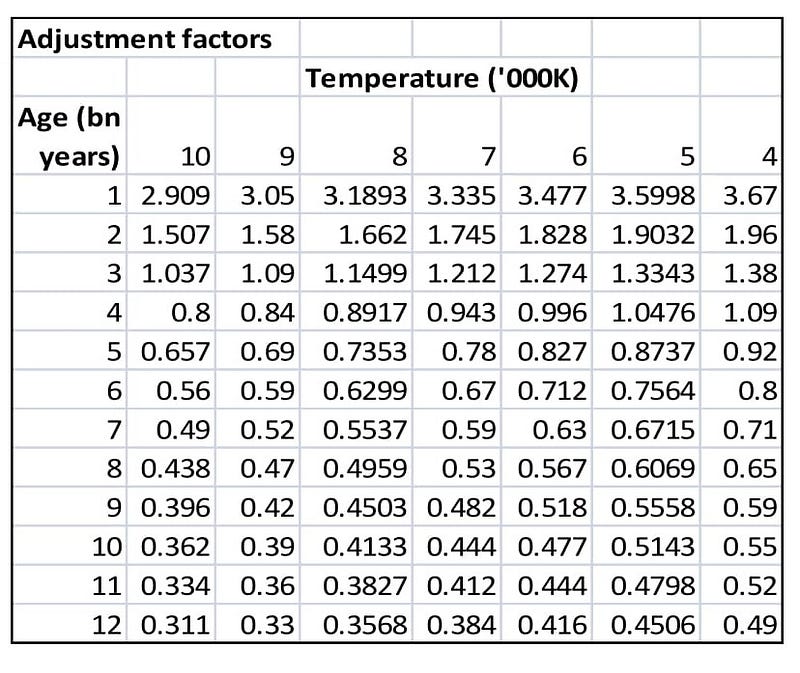
According to astrophysicists, once the core temperature of a star reaches about 10 million ᵒK, fusion of hydrogen occurs releasing energy. How hot the star eventually becomes depends importantly on its mass. From an initial average temperature for the whole of the star of around 4,000 ᵒK, large mass stars can reach more than 10,000 ᵒK. The higher the temperature, the lower is the value of k₁.
Reduced prediction error for velocities of stars
The results of the simulation show that, for galaxies with stars orbiting 2 kpc or more from the center of their galaxy, the root mean square error (RMSE) for predicting the velocities of stars is -19% for 2,665 stars in 161 galaxies using Newton’s inverse square law with a standard deviation of 28%. The equivalent RMSE for the Kolmogorov equation is -17% with a standard deviation of 25%. In other words, when the formula for predicting the velocity of stars is modified to include the ability of hydrogen gas to instantiate information, there is a reduction in the average prediction error. This reduction suggests dark matter could be a form of mass associated with information.
The Kolmogorov equation is a formulation that describes the effects of small changes in time, analogous to the use of a differential equation in calculus. Over long periods, the equation may need to be modified. As discussed in Article 1 - Dark Matter mystery - one way of modeling the effects of large changes in time is to modify the equation to include errors associated with predicting the velocity of a neighboring star i.e. the size of the error is the sum of the differences over time between the equation used to predict the velocities and the actual velocities.
When the Newton and Kolmogorov equations include the velocity of a neighboring star, significant reductions in the mean prediction errors and standard deviations are achieved. In these calculations, a slight alteration to the Kolmogorov equation has been made because the prediction errors include some of a star’s history; the value of k₁ has been changed from 2.7 to 0.3 although values around 0.3 do not significantly change measures of the equation’s predictive performance.
The Newton and Kolmogorov equations are:
Pᵣ = Nᵣ — (Nr-1 - Ar-1)
and
Pᵣ = Kᵣ — (Kr-1 - Ar-1)
where:
Pᵣ = Predicted velocity of a star at radius r;
Nᵣ = Velocity predicted only using masses of stars i.e. Newton’s equation for gravity, at radius r;
Kᵣ = Velocity predicted using masses of stars and information i.e. the Kolmogorov equation for gravity, at radius r;
Ar-1 = Measured velocity of a star at radius r-1 i.e. the nearest star closer to the center of the galaxy.
The comparative statistics for 2,665 stars are:

These equations accurately predict the velocities of stars with small standard deviations, particularly as the standard errors for the estimated velocities of stars in the SPARC database could be 5% or higher. Furthermore, the predicted velocities of stars need further ‘adjustments” to take into account the age and temperature of the star. Such data are not provided in the STARC database. While the predictions using the Kolmogorov equation are not statistically different from the predictions using Newton’s equation, the Kolmogorov predictions have a theoretical explanation for why the error associated with predicting the velocity of a nearby star should be included in the equation. This interpretation explains why the movement history of stars in a galaxy should not be ignored.
The idea that the fabric of space could incorporate information about its history is consistent with Loop Quantum Gravity’s explanation for gravity. According to Carlo Rovelli (Kindle location 2124):
Space is a spin network whose nodes represent its elementary grains, and whose links describe their proximity relations. Space-time is generated by processes in which these spin networks transform into one another, and these processes are described by sums over spinfoams. A spinfoam represents a history of a spin network, hence a granular space-time where the nodes of the graph combine and separate.
Effect of torsion in predicting stellar velocities
The equation in the table called Kolmogorov (adjusted for torsion) is based on the idea that the fabric of space is twisted (torsion). As discussed in Article 22 - How increasing computation complexity manifests - a Russian scientist, Dr. Nikolai Kozyrev, discovered time has an energy that adds a spinning or spiraling movement to the fabric of space; this torsion is what makes celestial bodies rotate. Kozyrev believes this spiraling motion could be the same as the Golden Spiral of Sacred Geometry.
Article 24 - Is information matter? - discusses how interstellar hydrogen gas is made of particles with different spin states. These spin states could cause the curvature of space to twist in time.
According to the website www.rigobertomuniz.com:
The great sages of ancient India … claimed that by the phenomenon of precession the equinoctial points of our Sun would take 24,000 years to complete one circuit around the Zodiac of the Constellations. Modern science tells us that the present rate of precession is 50.1" yearly, or 1°0" in 72 years. At that rate, it would take, not 24,000, but 25,920 years for the Vernal Equinox to make one whole circle of the Zodiac of the Constellations and return to any given starting point (fixed star). However, there is no proof that the present rate of precession, or 50.1" yearly, is constant, and the ancients claimed that at certain stages of the cycle the rate of precession is slightly more rapid than at other stages. … [For example] the great astronomer, Hipparchus (146 years BC), … gave the rate of precession at the time of his observations as 50–2/3", or a rate somewhat faster than at present.
Based on a cycle of 24,000 years and the Golden Ratio of 1.618, an individual year in the Golden Spiral would be equivalent to 0.002% of the cycle i.e. 1.618 = (1.00002)^24,000. While the distance between stars in the Milky Way varies depending on how close stars are to the center of the galaxy, the average distance is estimated to be between 2.2 and 3.5 light-years. As one parsec is 3.25 light-years, a stellar unit could be set equal to 1 parsec.
The distance between neighboring stars changes as a result of the expansion of space and rotation of stars around the center of a galaxy. The rotation movement around the center could be analogous to the movements in the Golden Spiral i.e. one stellar unit in distance between stars is equal to one year in a Golden Spiral cycle.
The average distance between stars at radii greater than 1.99 kiloparsecs (kpc) in the STARC database is just over 1 kpc or 1,000 stellar units. The 2.1% prediction error in the Kolmogorov equation might be partially explained by a failure to include the effect of torsion in space on the velocity of a star. For example, when a 1 stellar unit in distance between stars increases the predicted velocity by 0.002%, then 1 kpc increases the velocity by 2%. When all velocities predicted by the Kolmogorov equation are proportionately increased by 2% for every kpc, the mean prediction error is reduced to — 0.2%.
Dark matter is not part of the explanation for reducing the mean prediction error to -0.2%. Based on information in the SPARC database, if dark matter existed, the amount of dark matter would be the difference between the required mass for the observed velocity and the sum of the measured masses for the bulge, disk, and gas. For stars greater than 1.99 kpc from the center of the galaxy, dark matter would average 1.27 times more than baryonic matter with a standard deviation of 189%. However, this calculation shows 26% of stars have negative dark matter i.e. some stars have velocities less than predictions using Newton’s inverse square law. Furthermore, 18% of stars have a quantity of dark matter that is less than the dark matter associated with the neighboring star closer to the center of the galaxy. The latter two findings are inconsistent with the common understanding of dark matter i.e. dark matter does not have a negative mass and the total quantity increases as the radius increases. The definition of dark matter needs to change to be consistent with the Kolmogorov equation. Why invent a new type of matter when it is not needed to explain the velocities of stars?
Galactic collisions
As discussed in a later article, the way information about the history of a star is communicated could be associated with the spin of hydrogen atoms. For example, the density of molecules with negative spin could influence the curvature of space. As information has mass, the amount of dark matter that seems to be associated with a star could be due to the spins of hydrogen atoms. A spin may ‘flip’ according to whether when more or less matter is needed.
Astrophysicists suggest that most galaxies have experienced at least one collision with another galaxy. The history of star movements affected by these collisions accumulates over time. Prediction errors in the adjusted Kolmogorov equations may provide a record of how the shape of space changes as a result of such collisions.
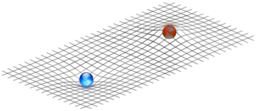
Einstein’s visual explanation of gravity likens space to a rubber sheet that becomes depressed when there is a mass on the sheet. The imagery implied by the Kolmogorov equation is that the fabric of space is more like a memory foam mattress. Each part of the mattress retains the memory of what used to rest on the mattress.
Does dark matter determine the shape of galaxies?
This empirical analysis suggests that dark matter is associated with information. Discrepancies between expected velocities of stars using Newton’s inverse square law and the observed velocities of stars, however, are not the only reason why dark matter has been introduced into the Lambda Cold Dark Matter (ΛCDM) model explanation of the evolution of our universe. As discussed in Article 24 - Rethinking Dark Matter - astrophysicists argue that dark matter provides the scaffold for determining the shape and evolution of galaxies. The information explanation for dark matter in galaxies is worthy of more detailed investigation by astrophysicists researching the evolution of our universe.
The question for this article is:
Should information be recognized as having mass?
To view the headings of all the articles to be published in this series please click on https://readmedium.com/orbiting-stars-and-origin-of-our-universe-338906930f51
To obtain a copy of the book ‘Orbiting Stars’ which contains the first drafts of all these articles, please visit https://www.amazon.com


