
Astrophysics
Testing a new equation for gravity (# 27)
Applications of the scientific method involve proposing and then testing hypotheses. Previous articles in this series have set out several hypotheses. Many of these hypotheses relate to what may have happened before the Big Bang. Testing such hypotheses is difficult, if not impossible. An indirect way of testing such hypotheses involves making deductions about what the hypotheses imply for our universe. As there may be several different hypotheses implying the same conclusions, it would not be possible to demonstrate conclusively that the proposed hypotheses are the correct ones. Nevertheless, when the tests are not statistically significant, a reasonable conclusion would be that the primary hypothesis is not supported by the evidence.
Velocities of stars
The previous article #26 - Does Dark Matter exist? - described how Newton’s inverse square law for gravity may need to be modified. Some of the ways of testing the modified law involve predicting the velocities of stars and the velocities of galaxies in galaxy clusters. For nearly 100 years, physicists have noted that the velocities of many stars are generally higher than predicted by Newton’s law. The idea of dark matter has been introduced to explain these discrepancies. The problem is that physicists have not been able to explain the nature of dark matter.
The proposed modifications to Newton’s law of gravity involve including the ages of the galaxies, the temperatures of the star at birth and now, as well as the distance of a star from the centre of the galaxy at birth as well as now. Not all this information is readily available. Based on Professor Susskind’s ideas about what happens inside a black hole, a new equation for the force of gravity for small increments in time has been identified:
Fg = KC ~ {4 * m₁ *m₂ *(A₁ / A₂) * (T₁₂ / T₂₂)} / (G² * {[d₁ * (T₁₂ / T₂₂)] +d₂}²)
where:
Fg = Force of gravity;
KC = Kolmogorov Complexity;
G = Gravitational constant;
A₁ = Age of the galaxy;
A₂ = Age of the star;
d₁ = Distance between the star and the centre of the galaxy when the star was born;
d₂ = Distance between the star and centre of the galaxy now;
m₁ = Mass of the galaxy at a radius of d2;
m₂ = Mass of the star;
T₁₂ = Temperature of the star at birth;
T₂₂ = Temperature of the star now.
When A₁ = A₂, T₁₂ = T₂₂, and d₁ = d₂, this equation reduces to Newton’s law.
Newton’s Second Law of Motion is:
Force = mass * acceleration
For a mass orbiting another mass, the gravitational force is known as centripetal acceleration. The relevant equation is:
Centripetal acceleration (i.e. Force) = mass (i.e. m₂) * v₂² / distance of star from the centre of the galaxy (i.e. d₂)
where: v₂ is the velocity of the star.
This equation can be rearranged to predict the velocity of the star after substituting the equation for the force of gravity, Fg, for centripetal acceleration. The new equation is:
v₂² = {4 * m₁ *(A₁ / A₂) * d₂ * (T₁₂ / T₂₂)} / (G² * {[d₁ * (T₁₂ / T₂₂)] +d₂}²)
In the absence of information about the temperature of a star at birth, assume T₁₂ = T₂₂. The equation reduces to:
v₂² = {4 * m₁ *(A₁ / A₂) * d₂} / (G² * {d₁ + d₂}²)
Another simplifying assumption is that, for small increments in time, the difference between d₁ and d₂ is only due to the expansion of space (dark energy).
Galaxy Rotation Curve
Astrophysicists are continually improving their technologies for measuring the velocities of stars around the centre of mass of a galaxy. They have discovered that most stars are moving much faster than the predictions of Newton’s Second Law of Motion. Two of the more popular explanations are (i) invisible mass inside each galaxy that is called dark matter because it does not reflect light; and (ii) Modified gravity (MOND) where modifications are made to Newton’s equation for gravity, these modifications are deduced from observations not derived from theoretical principles.
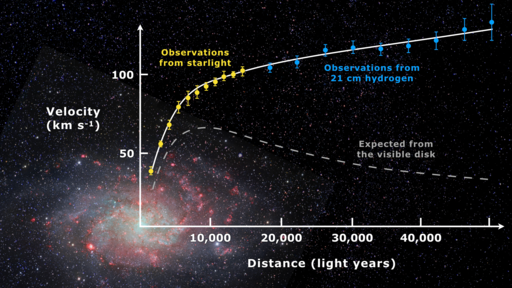
Astronomers agree the galaxy rotation curve (i) increases close to the centre of the galaxy; and (ii) becomes relatively flat rather than declining as per Newton’s Laws. For example, observations have been made for the Messier 33 galaxy. In this figure, the curve labeled ‘Expected from visible disk’ is derived from Newton’s equation for gravity. The other curve plots actual observations. The mass of a galaxy is calculated from both the masses of the stars as well as the mass of gas. The figure shows that the divergence in prediction from Newton’s laws is based on observations about mass associated with hydrogen gas. The observations associated with 21 cm hydrogen gas come from photons being emitted and the hydrogen atoms returning to their state of lowest energy.
.png)
In the next article, data from a database of 175 galaxies are used to compare star velocity predictions using Newton’s laws with predictions using the formula deduced in this article. There are, however, some limitations in applying the formula. The SPARC database does not include information on the ages and temperatures of the stars. Furthermore, the equation deduced in this article does not distinguish between masses that can instantiate information and masses which do not. Consequently, a modified formula has been used.
The basic formula used (not including the gravitational constant) is:
v₂² ~ {(mᵇ + mᵈ + mᵍ) + [(mᵍ * k₁) * (1 + k₂)]} / d₂
where:
v₂ = velocity of a star
mᵇ = mass of stars in the bulge at the centre of the galaxy within radius d₂
mᵈ = mass of stars in the disk of the galaxy within radius d₂
mᵍ = mass of gas in the galaxy within radius d₂
d₂ = distance of star or gas from the centre of the galaxy i.e. radius d₂
k₁ = adjustment factor based on the average age and temperature of a star in the galaxy
k₂ = adjustment factor based on the average increase in distance of the star from the centre due to expansion of space.
The data in the SPARC database contains estimates of the velocities of different types of mass: bulge, disk and gas. The mass of a galaxy within a given radius was calculated by taking the square root of the sum of the squares of the velocities of the different types of mass within the same radius.
The first term in the velocity equation i.e. mᵇ + mᵈ + mᵍ, is the same as Newton’s mass and represents Lloyd’s nodes in space. The second term (mg * k₁) is approximately the number of links and the third term, k₂, represents the growth in the length of the links. For a galaxy that is 13.8 billion years old, k₂ has a value of 1.02. The adjustment factor k₁ which depends on the age and temperatures of the stars is discussed in the next article.
When comparing the root mean square errors (RMSE) for predicting velocities using this equation, the gravitational constant can be omitted from both calculations without affecting the conclusions about the relative predictive performance of the two equations.
In brief, the revised equation for predicting the velocities of stars reduces the RMSE for galaxies from -19% using Newton’s equation to -0.04% when k₁ has a value of 2.7. When the revised equation is modified in the manner described in Article 24 - Rethinking Dark Matter - i.e. including the prediction deviation associated with a star nearer the centre of its galaxy, the RMSE using the modified equation is the same as the RMSE using Newton’s unmodified equation. In summary, this revised equation provides information that could help explain the observed rotation curves for galaxies.
In a later article, actual data for our sun will be used to show that the actual velocity for our sun would be predicted by the Kolmogorov equation when the mass of the galaxy is adjusted by a factor of 4.5. This adjustment factor is remarkably close to the average of 5.7 for dark matter to matter content in our universe.
For the Earth, when the Kolmogorov equation is used to take account of a threefold increase in Earth’s temperature after formation, this increase in temperature offsets the impact that dark energy could have had on the force of gravity over the lifetime of Earth.
The question for this article is:
Should Newton’s force of gravity be replaced by a law explaining how information affects the fabric of space-time?
To view the headings of all the articles to be published in this series please click on https://readmedium.com/orbiting-stars-and-origin-of-our-universe-338906930f51
To obtain a copy of the book ‘Orbiting Stars’ which contains the first drafts of all these articles, please visit https://www.amazon.com