
Astrophysics
Does Dark Matter Exist? (# 26)
.jpg)
Professor Leonard Susskind has explored what may happen inside a black hole in Anti-de Sitter (AdS) space. He argues that the interior of a black hole grows for a long time after it has reached thermal equilibrium. As discussed in Article 21 - Is there a rational explanation for Dark Energy? -, Susskind suggests this dark energy is the equivalent of increasing computational complexity (CC). Susskind derived two equations/components. The CC component is concerned with positional aspects of entropy, the other component which is called Kolmogorov complexity (KC) deals with kinetic aspects of entropy in a thermodynamic system. In brief, Susskind explains events inside a black hole in terms of phenomena experienced outside a black hole. The current article argues that the KC component explains Newton’s inverse square law for gravity.
Optimal quantum computation is linked to gravity. Information and gravity may seem like completely different things, but one thing they have in common is that they can both be described in the framework of geometry.
Kolmogorov Complexity
Susskind examines what happens to the complexity of a black hole when one qubit (a quantum bit of information) is added to the black hole. When two identical thermodynamic systems are combined, the entropy is additive. Susskind explains that combining two complexities multiplies the degrees of freedom e.g. when one qubit is added, the complexity of the combined system is doubled. Applying this logic when both complexities consist of more than one qubit, the resulting complexity is the product of the complexities rather than the addition.
Susskind makes a distinction between what he calls maximum complexity and relative complexity. He argues that the difference which he calls uncomplexity is a resource for doing work (computation). He specifically mentions Kolmogorov uncomplexity might be used as a resource for erasure (of quantum computations) e.g. observation of an event collapses the probability wave function.
Susskind derives the following expression for KC where ~ means proportional to:
KC ~ V / (G * ℓ²AdS)
where:
V = new space-time volume after insertion of an additional qubit;
G = a gravitational constant;
ℓAdS = AdS radius of curvature. The radius of curvature is a distance. The square of a distance is an area on the surface of AdS space.
An intuitive interpretation of this formula is:
- the numerator, V, is related to the maximum possible number of computer operations;
- the denominator is related to information already stored;
- the ratio is a measure of capacity to do elementary computer operations (op).
In the following discussion, the variables in the KC formula are converted into classical variables based on Professor Seth Lloyd’s interpretation of our universe as quantum computation. Inevitably, any comparisons will only be approximations to the exact values.
According to Lloyd:
In the computational universe, space is filled with “wires”, paths along which information flows. The wires tell information where to go. The wires meet at quantum logic gates, where that information is transformed and processed. The quantum logic gates, in turn, tell space how much to curve at that point. The structure of space-time is derived from the structure of the underlying computation.
Professor Carlo Rovelli’s version of Loop Quantum Gravity (Kindle location 2124–2133) states:
Space is a spin network whose nodes represent its elementary grains, and whose links describe their proximity relations. Space-time is generated by processes in which these spin networks transform into one another, and these processes are described by sums over spinfoams. A spinfoam represents a history of a spin network, hence a granular space-time where the nodes of the graph combine and separate.
… So what is the world made of? The answer now is simple: the particles are quanta of quantum fields; light is formed by quanta of a field; space is nothing more than a field, which is also made of quanta; and time emerges from the processes of this same field. In other words, the world is made entirely from quantum fields.
Rovelli’s links and nodes seem to be analogous with Lloyd’s wires and quantum logic gates. Rovelli is also clear that a spinfoam represents a history of a spin network.
When two thermodynamic systems in AdS space, each consisting of several qubits, are merged, the numerator of KC is V₁ * V₂ i.e. the volumes of system 1 and system 2 are multiplied not added together.
History of movements of a star
When converting volume into Lloyd’s ops, information is instantiated into both the fabric of space and matter. As matter is associated with communication which is information, the definition of matter needs to include its age which is related to the quantity of stored information, and temperature which is related to the speed of communication. This interpretation suggests that a volume in AdS bulk space, Vi, could be represented on a boundary as:
Vᵢ ~ mᵢ * Aᵢ * Tᵢ
where:
Vᵢ = Volume of the system i in AdS bulk space with i being 1 or 2. V₁ is the volume of system 1 immediately before interaction with V₂. V₂ is the volume of system 2 before interaction with V₁;
mᵢ = Mass at the boundary associated with the Vᵢ in AdS bulk space. The meaning of mass is discussed in more detail in other articles.
Aᵢ = Age of mᵢ
Tᵢ = Temperature of mᵢ
In the denominator of the formula for KC, the term ℓ²AdS which measures the curvature of AdS space, needs to be transformed using Lloyd’s model for calculating the computational ability of the universe. As suggested earlier, ℓ²AdS is an area on a boundary in AdS space-time. Based on Rovelli’s idea that the fabric of space includes history, transforming ℓ²AdS into an area means including information about the history of interactions into the distances between the two masses.
Figure 1 is a two-dimensional geometric representation of the history of interaction between the two masses. As suggested by Rovelli, the distance between masses (links in LQG, wires in Lloyd’s terminology) incorporates information about the number of ops and the speed of computation. Using Figure 1 as an example, a mathematical expression describing the history of interactions could consist of the sum of the area of a square i.e. height (A₂) times its base (d₁ * T₁₂) and the area of the triangle i.e. half the height (A₂) times its base ([d₂ * T₂₂] –[d₁ * T₁₂]) where T₁₂ is the temperature of a star when it was formed and T₂₂ is the current temperature of the star.
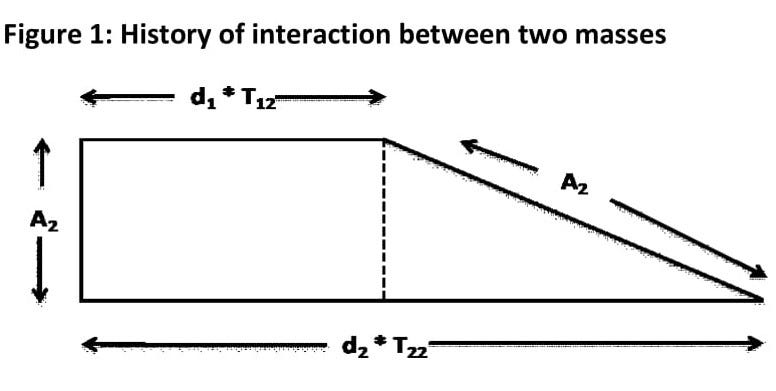
The area of the shape in Figure 1 represents the history of the interaction between m₁ and m₂ encoded in the fabric of space around the younger mass (m₂). For much of the life of a star, the masses are most likely to be moving apart because of the expansion of space (dark energy).
The following discussion derives an equation describing a small increment in time i.e. the first derivative or gradient of an equation describing what happens over the lifetime of a star. Ignoring the temperatures associated with m₁ and m₂, the incremental history of interactions between masses (H₁₂) could replace ℓ²AdS in the denominator of the KC equation. The new equation is:
Hⱼ₂ ~ A₂d₁ + [0.5 * A₂ * (d₂ — d₁)]
where:
Hⱼ₂ = History of interaction between m₁ and m₂ over time j (the age of the star);
A₂ = Age of the star;
d₁ = Distance between the star and the centre of mass of the galaxy when the star was born;
d₂ = Distance between the star and centre of mass of the galaxy now.
The Hⱼ₂ equation can be rearranged to become:
Hⱼ₂ ~ [A₂ * (d₁ + d₂)]/2
The new formula for KC describing a small increment in time is:
KC ~ {4 * m₁ *m₂ *(A₁ / A₂)} / (G² * {d₁ + d₂}²)
When A₁ = A₂ and d₁ = d₂, the formula for KC reduces to Newton’s inverse square law for gravity. The temperatures of a star at different times can be included in this formula.
An equation describing what happens during the whole life of a star instead of a small increment in time may take the following form:
KC(now) = KC(previous period) + any change due to the small increment in time such as the expansion of space due to dark energy.
In the absence of being able to observe KC in a previous period, predictions for KC(now) may be possible by finding something that can be observed now that is likely to be similar to KC(previous period) such as the KC for a nearby star closer to the centre of a galaxy (because stars move outwards due to the expansion of the universe).
Testing the equation for gravity
Information on the history of movements of stars, ages, and temperatures are not readily available for someone without formal qualifications in cosmology. The next two articles apply a ‘back-of-the-envelope’ approach to test whether the new equation might provide reasonable estimates for the movement of stars and galaxies.
The results of these calculations suggest that this KC equation could explain the movements of stars and galaxy clusters with a new interpretation for dark matter.
The question for this article is:
Is our universe a huge ongoing quantum computation?
To view the headings of all the articles to be published in this series please click on https://readmedium.com/orbiting-stars-and-origin-of-our-universe-338906930f51
To obtain a copy of the book ‘Orbiting Stars’ which contains the first drafts of all these articles, please visit https://www.amazon.com