
Astrophysics
Is there a rational explanation for dark energy? (# 21)

This and the next ten articles are necessarily quite mathematical. If you have no interest in understanding how the equations were derived and used to test the hypothesis about the origins of our universe, I suggest you wait for Article 33 - Is our universe inside a wormhole? The primary hypothesis is that our universe resembles what happens when a wormhole is created inside a black hole in Anti-de Sitter (AdS) space. Professor Susskind of Stanford University derived the original form of the equations as part of ongoing research into computational complexity.
Inside a black hole
Many scientists believe the surface of a black hole is a hologram. Susskind wondered how to describe the interior of a black hole in holographic terms. According to Susskind:
When a star collapses a horizon forms and its area grows until it reaches its final value. This is visible from outside the horizon and is known to be a manifestation of a statistical law, the second law of thermodynamics: Entropy increases until thermal equilibrium is reached.
There is another similar but less well-known phenomenon: the growth of the spatial volume behind the horizon of the black hole. At first sight this could be another example of the increase of entropy, but more careful thought shows that this is not so. The growth of the interior continues long past the time when the black hole has come to thermal equilibrium. Something else — not entropy — increases. What that something else is should have been one of the deepest mysteries of black hole physics — if anyone had ever thought to ask about it.
Susskind believes this ‘something’ is quantum computational complexity. Susskind’s derivation of his conclusion will not be discussed here. The following summary of his paper (co-authored with Adam Brown) on ‘The Second Law of Quantum Complexity’ indicates the level of mathematics that would be required to follow his argument:
We give arguments for the existence of a thermodynamics of quantum complexity that includes a “second law of complexity.” To guide us, we derive a correspondence between the computational (circuit) complexity of a quantum system of K qubits, and the positional entropy of a related classical system with 2K degrees of freedom. We also argue that the kinetic entropy of the classical system is equivalent to the Kolmogorov complexity of the quantum Hamiltonian. We observe that the expected pattern of growth of the complexity of the quantum system parallels the growth of entropy of the classical system. We argue that the property of having less-than-maximal complexity (uncomplexity) is a resource that can be expended to perform directed quantum computation. Although this paper is not primarily about black holes, we find a surprising interpretation of the uncomplexity resource as the accessible volume of spacetime behind a black hole horizon. (Brown and Susskind)
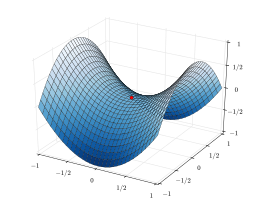
The Brown/Susskind paper argues that the Second Law of Complexity for a quantum system is a consequence of the second law of thermodynamics for an auxiliary classical system. Drawing on the work of Michael Nielsen concerning geometrizing complexity, Susskind’s mathematical model for the inside of a black hole assumes an AdS space with constant negative curvature. A hyperbolic plane is a surface of constant negative curvature. In two dimensions, a hyperbolic plane is saddle-shaped with the mathematical interpretation that the same point on the plane may be a maximum in terms of one dimension and a minimum in terms of another dimension. It is difficult to visualize a hyperbolic plane of more than two dimensions.

Regarding Susskind’s Second Law of Computational Complexity, this correspondence means the equations that Susskind derives for the complexity inside an AdS space (i.e. the bulk space) have a complementary interpretation for what happens on the boundary of that space. Susskind argues that computational complexity increases linearly up to a maximum point over time.
Estimating the rate of expansion of the universe
According to Einstein, the force of gravity is instantiated into the fabric of space. The fabric of space exists on the boundary of an AdS bulk space. One way that the growth in quantum complexity could be instantiated into the fabric of space is to establish a density representing the fabric’s capacity to store information e.g. [Vₜ * Tₜ] where Vₜ is the Volume of space at time t and Tₜ is the temperature at time t. The temperature is included in the description because according to Professor Lloyd of the Massachusetts Institute of Technology (see Article 20 -What happens inside a black hole) the capacity for the universe to do computations depends on the temperature of space.
Combining Susskind’s and Lloyd’s insights:
Cₜ ~ [Vₜ * Tₜ] = a * t
where:
Cₜ = Quantum computational complexity at time t.
Vₜ = Volume of the universe at time t (currently 1.2151 * 10^13 mega-parsecs)
Tₜ = Temperature of the universe at time t (currently 2.73 ᵒK)
a = rate at which complexity increases
t = Age of the universe at time t (currently 13.8 billion years)
To calculate the rate of growth in the capacity of the universe (δV/δt) to make computations:
V * T = a * t
log (V) * log (T) = log (a) + log (t)
(1/V) * δV/δt = 1/t — (1/T) * δT/δt
To calculate the change in the temperature of the universe, assume dark energy adds information into the universe. Cosmologists suggest the temperature of the universe has fallen over time. So as information is added to the universe, the average temperature of the universe falls. The ‘temperature’ of new information can be calculated from the fall in the average temperature. Physicists have calculated the temperature of the universe 6.6 billion years after the Big Bang to be 5.1 ᵒK. The current temperature is 2.73 ᵒK.
The growth in the size of the universe depends on the cosmological model used (see Figure 14 - Size of the universe against time). This graph shows that the universe may have doubled in size since about 6.375 billion years after the Big Bang (i.e. 7.425 billion years ago) at a reasonably steady rate. Assuming a linear rate of increase because Susskind suggests complexity is increasing linearly, a linear equation describing the growth is:
Increase in size of universe = — 0.71717 + (1/7.425) * increase in age in billion years
The choice of 6.375 billion years as the point at which the universe was half its current size is backward engineered to calculate the rate of expansion of the universe which cosmologists have estimated to be about 72 km/sec/megaparsec. Consequently, the estimates presented in this article are intended to show that this approach is consistent with actual observations. From a base of 6.6 billion years after the Big Bang (based on published research by physicists estimating the temperature for the universe), the volume of the universe (V) has increased by a factor of 1.8865. The following formula incorporates this information.
V * T₀ + V * (0.8865) * T₂ = V * 1.8865 * T₁
where:
V = Volume of the observable universe 6.6 billion years after the Big Bang;
T₀ = Temperature of the universe after 6.6 billion years (5.1 ᵒK);
T₁ = Temperature of the universe now (2.73 ᵒK); and
T₂ = Temperature added to the universe with each bit of new information.
Hence T₂ = (1.8865 * 2.73–5.1)/0.8865 = 0.0565 ᵒK i.e. each new bit of information has a ‘temperature’ of fractionally above absolute zero degrees K. This number may be considered as the ‘temperature’ of dark matter, although such temperature is a statistical measure. The change in the average temperature of the universe for a small increment in time/information is the temperature of a new bit of information divided by the computational capacity of the universe i.e. the age of the universe.
The change in the average temperature associated with a unit of information (δT/δt) is negative T₂/ t because T₂ is less than the current average temperature of the universe (2.73 ᵒK).
Hence δT/δt = — 0.0565 / (13.8 * 31.536 * 10^15) = — 0.1298 * 10^–18 ᵒK
and δ²T/δt² = T²/t² = 0.0565 / (13.8 * 31.536 * 10^15)² = 2.983 * 10^-37 ᵒK
From earlier:
δV/δt = V/t — (V/T) * δT/δt = 2.85 * 10^–5 mps/second = 72 km/sec/mps
where:
V = 1.2151 * 10^13 megaparsecs (mps)
T = 2.73 ᵒK
t = 13.8 billion years
Furthermore:
δ²V/δt² = (1/t) * δV/δt — V/t² + V * (1/T²) * δ²T/δt² — (1/T) * δT/δt * δV/δt
= 0.3 * 10^–23 mps/second = 7.62 * 10^–19 km/sec/mps
These results show that Susskind’s equation for Computational Complexity is consistent with a current estimate for the universe’s rate of expansion (72 km/second/megaparsec) as well as the observation that the rate of expansion seems to be accelerating. The predicted rate of acceleration is so small that it cannot yet be accurately estimated using current technology.
The question for this article is:
Is our universe a hologram inside a black hole?
To view the headings of all the articles to be published in this series please click on https://readmedium.com/orbiting-stars-and-origin-of-our-universe-338906930f51
To obtain a copy of the book ‘Orbiting Stars’ which contains the first drafts of all these articles, please visit https://www.amazon.com