
Astrophysics
What happens inside a black hole? (# 20)
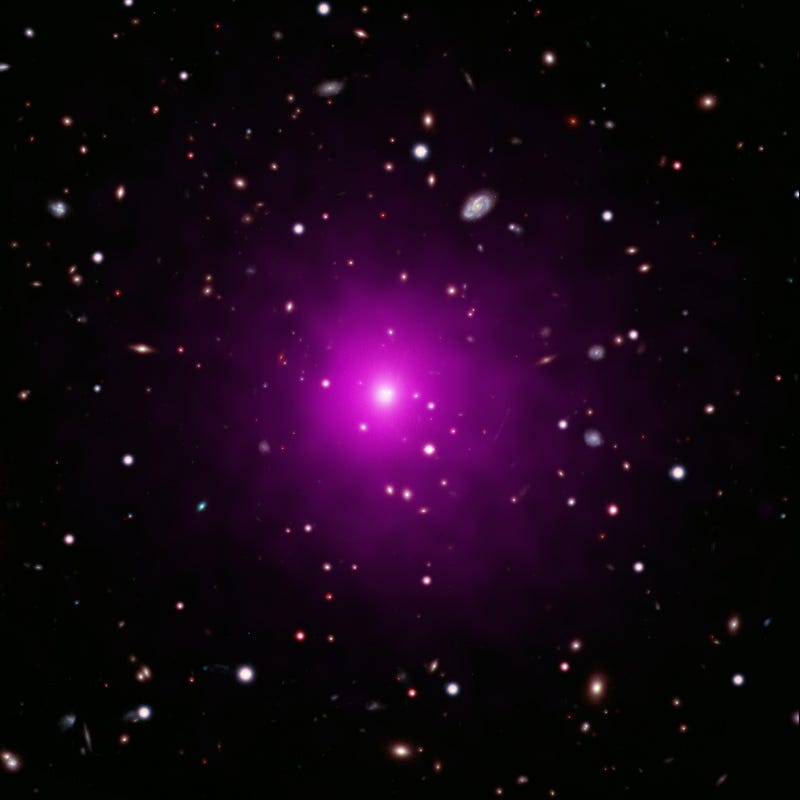

A black hole is a region of spacetime where gravity is so strong that nothing — no particles or even electromagnetic radiation such as light — can escape from it.
If nothing can escape from a black hole, how is it possible to know what happens inside the black hole? Professor Leonard Susskind of Stanford University explores some of the possibilities in the context of quantum computation.
Quantum complexity
According to Brown, Susskind, and Zhao:
There is evidence that the evolution of quantum complexity and the growth of the geometry behind black hole horizons follow identical patterns. … In this paper we will show that a third system — the ‘analog model’, namely a classical nonrelativistic particle that moves along the geodesics of a two-dimensional, compact, negatively curved surface of high genus — shares the same behavior. Although we do not fully understand the reasons for this correspondence it most likely has its roots in Nielsen’s geometrized approach to complexity.
Susskind et al are suggesting that what happens inside of a black hole appears to be similar to the behavior of a classical particle on a negatively curved surface; the evolution of quantum complexity behind a black hole could be described in terms of how particles move outside a black hole.
In a later paper, Susskind and Brown argue:
We observe that the expected pattern of growth of the complexity of the quantum system parallels the growth of entropy of the classical system.
Susskind has also argued that an Einstein Rosen Bridge, also known colloquially as a wormhole, exists between two black holes when they are entangled. When two entangled black holes are created, the wormhole connecting the two black holes grows in quantum complexity. Susskind argues that the existence of a wormhole allows, in some sense, quantum teleportation to take place through the wormhole.
Susskind’s research investigates the mathematics of the growth in quantum complexity in a wormhole. He discovered two equations that could explain what is happening inside the wormhole. This and subsequent articles discuss how to understand what is happening inside the wormhole in terms of events in our universe. Susskind does not necessarily agree with this interpretation.
Our universe as a quantum computer
Seth Lloyd, Professor of Mechanical Engineering and Physics at Massachusetts Institute of Technology in the US, has argued that our universe could be a giant quantum computer; the history of our universe is, in effect, a huge and ongoing quantum computation. The following quotes are taken from pages in Lloyd’s book ‘Programming the Universe’, Vintage Books:
An op is an elementary logical operation. Each collision between elementary particles acts as a simple logical operation or “op” (p6) … [T]he universe is nothing but bits — or rather, nothing but qubits. … since the universe registers and processes information like a quantum computer and is observationally indistinguishable from a quantum computer then it is a quantum computer (p154).
… As the horizon expands, more and more objects swim into view, and the amount of energy available for computation within the horizon increases. … On average, every cubic meter of the universe within the horizon contains a mass of about one hydrogen atom. … To get the maximum rate at which the universe can process information. … apply the Margolus-Levitin theorem: take the amount of energy within the horizon, multiply by 4, and divide by Planck’s constant (p164–5).
… the total number of ops the universe has performed in the entire time since the Big Bang is proportional to the square of that time. (p 167)
… Einstein challenged John Wheeler to sum up general relativity in a simple phrase. Wheeler rose to the challenge: “Matter tells space how to curve,” he said, “and space tells matter where to go.” Let’s rephrase Wheeler’s dictum for the computational universe: “Information tells space how to curve; and space tells information where to go.” In the computational universe, space is filled with “wires”, paths along which information flows. The wires tell information where to go. The wires meet at quantum logic gates, where that information is transformed and processed. The quantum logic gates, in turn, tell space how much to curve at that point. The structure of space-time is derived from the structure of the underlying computation. (p 174)
… The “matter” in a computational universe arises out of quantum logic gates. Recall that any form of quantum mechanical matter that arises out of local interactions can be simulated or constructed out of quantum logic gates. (p173)
The Margolus-Levitin theorem states that the maximum rate at which a physical system can move from one state to another is proportional to the system’s energy: the more energy available, the smaller the amount of time required for the electrons to go from here to there. Thus the total number of possible ops is a function of the temperature of the universe.
When the speed of computation is taken into account in calculating the number of ops, the total number of ops the universe could have performed since the Big Bang is proportional to the square of the age of the universe and the temperature of the universe.
Combining quantum computation with events inside a wormhole
Susskind deduced that two equations could explain what is happening inside a black hole. The first equation describes the increase in computational complexity over time. The second describes what Susskind called Kolmogorov complexity. These equations could be re-expressed to describe what happens inside a wormhole by making algebraic substitutions for variables that take account of the number of ops that our universe could have performed since the Big Bang.
Cosmologists with detailed knowledge of the evolution of our universe could derive a more detailed formulation of Susskind’s equation dealing with computational complexity. These articles are based on a simplified version of the algebraic equation; this equation shows that: (i) our universe could be expanding at about 72 km per second per mega-parsec and (ii) the rate of expansion is accelerating. As the predicted expansion rate seems to be reasonably close to the actual rate measured by cosmologists, this result suggests dark energy is the same as increasing computational complexity.
Susskind’s second equation, Kolmogorov complexity, could be used to explain what happens when two masses collide. Susskind suggests that a new thermodynamic equilibrium is reached very quickly when two masses merge. In our universe, rapid adjustment to thermodynamic equilibrium could be the explanation for the brief period of cosmic inflation at the time of the Big Bang.
The Kolmogorov equation can be modified to describe the merger of two masses, both of which are greater than one qubit. Some of the variables in this modified equation can then be replaced by variables representing masses on a boundary in AdS space. Once these substitutions have been made, rearrangements of terms in the equation suggest that the new formulation of the equation is an explanation for Newton’s inverse square law for the force of gravity. Newton’s equation, however, needs to be expanded to include terms such as the ages and temperatures of the masses.
An analysis based on actual data available for 175 galaxies suggests that the root mean square error associated with using Newton’s equation to predict the rotation curve of stars in a galaxy could be reduced to close to zero. This result is achieved assuming all stars have the same age and temperature. Further reduction in the standard deviation of the errors may be achieved using information on the age, temperature and movement history of individual stars.
Actual data has been used to predict dark matter associated with our sun. A rough calculation suggests that Newton’s estimate of the force of gravity between the centre of our galaxy, the Milky Way, and our sun needs to be modified by a factor of about 4.5. This factor is remarkably close to the average ratio of dark matter to normal matter i.e. 5.6. In other words, when Newton’s equation for gravity is modified to take into account information about the age and changes in temperature of our sun, the quantity of dark matter appears to be related to baryonic mass in the Milky Way.
The question for this article is:
Is dark matter information?
To view the headings of all the articles to be published in this series please click on https://readmedium.com/orbiting-stars-and-origin-of-our-universe-338906930f51
To obtain a copy of the book ‘Orbiting Stars’ which contains the first drafts of all these articles, please visit https://www.amazon.com