
Is Consumerism Dying?
How online purchasing has affected our buying habits.
Last update: May 10, 2022

One of my favorite websites in all the interwebs is the Art of Manliness. If you’re not familiar, it’s creator, Brett McKay, created the website because he thought the existing men’s magazines missed a certain gravitas.
While there are many fun articles, one of the things I appreciate most about the articles is the writing, particularly the depth achieved on some serious topics. It seems that Brett’s background as a law school graduate prepared him to exhaustively research something, then distill that info so we can still understand it (or rather, not get bored with it).
One of the most recent entries is Curbside Pickup and the End of Peak Consumerism. The article discusses how retailers have manipulated our physical senses while we are shopping, enticing us to buy more with pleasurable music appealing colors, even unconsciously directing us to certain products with the layout of the store.
After being away from in-store shopping for a while, I felt like I saw the [grocery] store with fresh eyes. And what I was so strongly struck by, was just how full it was of absolute — and pardon my French, but this is really the most apt word here — bullsh*t food.
Flamin’ Hot Funyuns, 3D Doritos, Twix-topped yogurt, Little Debbie Oatmeal Creme Pies Cereal (which admittedly does sound really good). A dozen different kinds of Oreos. Endless varieties of soda and frozen dinners.
Aisle after aisle of unnecessary, unhealthy, laboratory-created, market-tested, packaged products that could only be called food in the most generous sense.
He continues to write that his hope is that by physically staying out of stores, grocery or any other kind, we will continue to be removed from those manipulations, resulting in a much smaller desire for impulse purchases. This is a bold hope, and one that I would like to see occur.
However, manufacturers and retailers are not going to sit idly by and let this happen. What will most likely occur is that they will merely increase their advertising bombardment upon us wherever our attention end up going now that we aren’t shopping in stores.
That might be online, through e-mail, social media, or website ads. They could also increase direct mail, given the density of data collection that is now available due to the aforementioned internet-based tools.
There could also be a brand new way to increase advertising that we haven’t even thought of. Or until now, hasn’t been cost effective.
This isn’t the first time there has been an existential crisis among the makers of our stuff. 100 years ago, the Roaring 20’s weren’t so roaring for the manufacturing industry, so they turned something that had not been necessary before: novelty.
Shareholder Supremacy Started Everything
The 1920’s are mostly remembered as a time of “speakeasy party culture”, but that environment was only indulged in by the favored few (i.e. the wealthy). In fact, the majority of the population experienced circumstances that were similar to those of the Great Depression, but overshadowed by the economic boom of the overall economy.
Because of this wealth inequality, the lower classes learned to live with less, essentially driving down demand and leading to overproduction that threatened the profitability of manufacturers.
Even though families that couldn’t afford to pay for radios, cars, dishwashers and other expensive items upfront could now purchase them on credit, the amount of new products companies produced still exceeded the number that families were able to buy.
One of the contributing factors to this overproduction was companies’ desire to expand and drive up profits for shareholders. [Emphasis added]
To combat the depressed demand, the captains of industry got together and created what would later be known as the “Gospel of Consumption”.
A Problem Solved (and a Problem Created)
Imagine for a moment that the stores were closed for half the year because no one needed, or rather no one could afford, to buy anything more.
- No random trips to the mall.
- No last minute dash to get school clothes.
- No new pants to replace the one you ripped.
The mantra was “Use it up. Wear it out. Make it do. Or do without.”
Better yet. Imagine a world where you didn’t really want to go to the store. Partly because you couldn’t afford it. Partly because you just didn’t want or need something new.
That’s a decent snapshot of where things were in the 1920’s.
In a 1927 interview with the magazine Nation’s Business, Secretary of Labor James J. Davis provided some numbers to illustrate a problem that the New York Times called “need saturation.”
Davis noted that “the textile mills of this country can produce all the cloth needed in six months’ operation each year” and that 14 percent of the American shoe factories could produce a year’s supply of footwear.
This was an amazing feat, one that humanity had been pursuing for centuries. Everyone was able to get fed, clothed, and sheltered en masse. The problem, however, was that there was no money in it.
Wealth inequality was even more pronounced than it is today, so the masses had very little money to spend on frivolities. Sure, they had clothes and food and shelter to keep them alive, but it was a pittance compared to the clothes and food and shelter we (well, most of us) currently have.
The population wasn’t frugal by choice; they were frugal by necessity. Even with access to credit, their level of demand just wasn’t that high, giving rise to a big problem.
What good was the amazing machinery that could produce all of these products when they were only running for half the year? They needed to be running all year to pay for themselves (or rather, pay their owners more).
We Were (and Still Are) Manipulated by Marketing
Manufacturers and retailers had a collective, years-long freakout in the 1920’s, with even the federal government fueling the flames of worry. Their fear was twofold.
- The companies were worried that profits would be lost.
- The government worried that idle hands would lead to revolution.
Their answer? Keep the consumer dissatisfied.
Artificially create new demand for products through advertising, stirring up our dopamine by manufacturing newer and better products that the consumer “just had to have”.
By the late 1920s, America’s business and political elite had found a way to defuse the dual threat of stagnating economic growth and a radicalized working class in what one industrial consultant called “the gospel of consumption” — the notion that people could be convinced that however much they have, it isn’t enough. [Emphasis added]
President Herbert Hoover’s 1929 Committee on Recent Economic Changes observed in glowing terms the results: “By advertising and other promotional devices . . . a measurable pull on production has been created which releases capital otherwise tied up.”
They celebrated the conceptual breakthrough: “Economically we have a boundless field before us; that there are new wants which will make way endlessly for newer wants, as fast as they are satisfied.”
Let’s take a look at clothing.
It used to be that there were two seasons: summer and winter. The creation of artificial demand required the novelty of the four-season wardrobe, which evolved into monthly styles and, ultimately, the rise of fast fashion and the 52-week clothing cycle.
In 1930, the average American woman owned nine outfits. Today, that figure is 30 outfits.
And it’s not just clothing. Demand creation is everywhere.
Impulse Spending
Impulse spending is one of the most potent “promotional devices” employed by retailers, dictating the setup, flow, colors, music, and smell of a store. Every now and then it backfires, like when I made my first visit to Bed Bath & Beyond.
A few minutes after stepping through the doors, I started experiencing vertigo. The floor to ceiling shelves, tiny aisles, recycled air, and ubiquitous display stands overwhelmed me, and everything started spinning. Amelia and I left early because I was just minutes away from vomiting.
We went back a couple of times, but I experienced the same queasiness each visit. Ultimately, we stopped going to the store completely.
BBB is an assault on your senses by design because most of the time, it works. I guess I’m an outlier at BBB, as I’ve seen people literally jump for joy at some random knick knack that just happened to be on display at the endcap of the aisle where their main purchase was located.
But that doesn’t mean I’m immune. Just yesterday, I grabbed a Snickers while checking out from Meijer for no other reason than it was located within arm’s length.
The Next (R)evolution
The idea that a business’s main driver is to create profit for its shareholders came back into vogue during the late 70’s, was eagerly embraced in the 80’s, and perfected to a T in the 90’s. Since then we have had the dot-com bust, the Great Recession, and, if not for COVID, probably some other financial catastrophe right now.
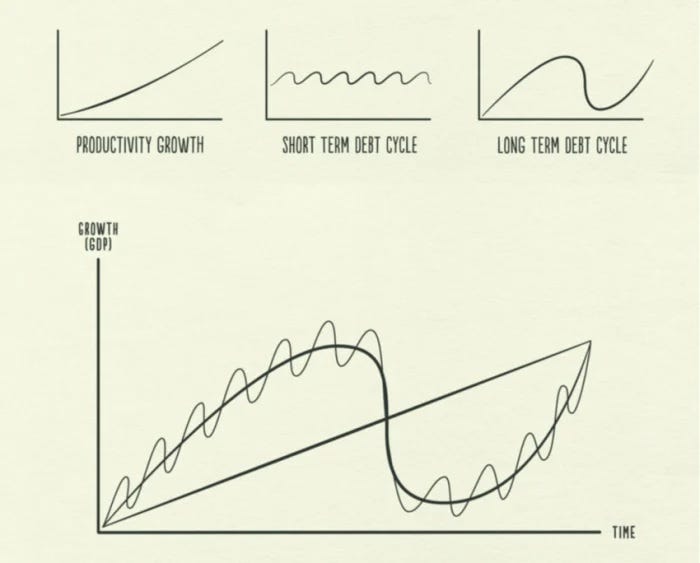
This repetition is not unexpected, but rather part of the long-term debt cycle, which occurs every 75–100 years.
The image below shows the combination of productivity growth, short term debt cycles, and a long term debt cycle. This is why we have booms and busts very few years.
The quote below can be used to describe the political and economic landscape both now and in the 1920’s.
“Wealth gaps increase during bubbles, and they become particularly galling for the less privileged during hard times… It is during such times that populism on both the left and the right tends to emerge.
How well the people and the political system handle this is key to how well the economy and the society weather the period.
…both inequality and populism are on the rise in the US today, much as they were in the 1930s. In both cases, the net worth of the top 0.1 percent of the population equaled approximately that of the bottom 90 percent combined.” — Big Debt Crises
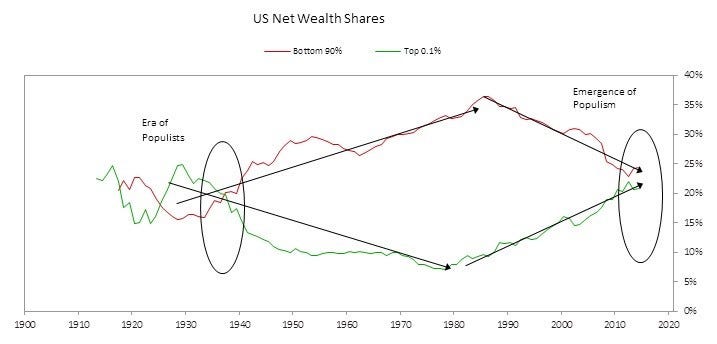
From a macroeconomic viewpoint, the 2020’s are mimicking the 1920’s.
The Takeaway
We are headed towards a reckoning, again, about how this country is supposed to operate.
Do we work to enrich and empower corporations, or do we work for the good of the community?
That question will undoubtedly play out in national debates and splashed across out TV screens, but it will also be decided by the myriad individuals who make up this country.
Now that you’ve had some time away from the store, what are your thoughts about the excess that is present? Does the novelty still entice you, or are you just done with the 14 types of Cheerios?
One thing that I have learned recently is that variety is the spice of life, but only if used sparingly. If we want to experience all new things all the time, then sooner or later the dopamine will wear off. At that point, our only desire will be to cook a meal we’ve perfected over the years, wearing the clothes we know and love, while chatting with old friends.


