
With apologies to Shakespeare and Dr Seuss
Is a poem, is a dribble, is a …?
The trouble with labels
I wrote a poem the other day.
I’ve called it, In the moment gone. It was going to be just plain, Gone, which sort of matched the mood I was in when I picked up my pen and started writing, but despite gone being the only word common to all three stanzas, I realised that calling the poem, Gone, wouldn’t do justice to its message. It got me thinking about titles and labels and how much we rely on them. And how misleading it can be to have the wrong title or the wrong label.
I’m happy I’ve chosen the right title for my poem.
In the moment gone
For me, at least, it speaks of time being both fleeting and lingering. And if it does that for you too, then I’ve succeeded because the poem is meant to be one you can meditate on — a mindfulness poem. But don’t let me influence your thinking. Be your own judge. Read the poem for yourself.
In the moment gone
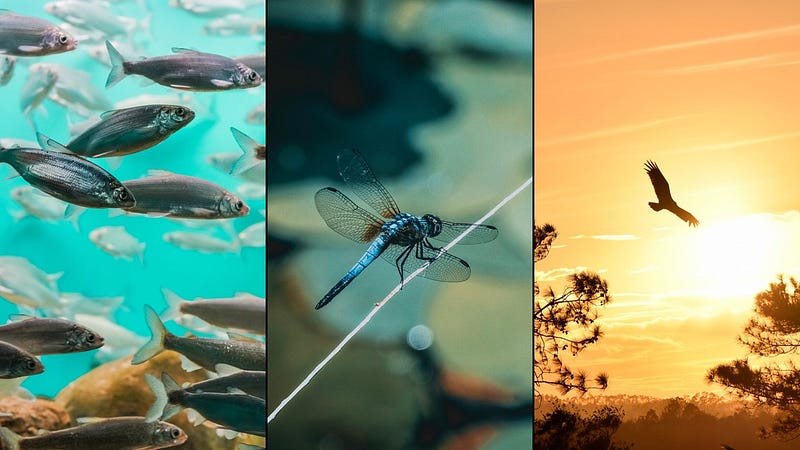
Silvery minnows, oh how effortless with grace do skim and sashay forever free of spirit now alone in this moment gone away
Yon dragonfly, iridescence replete pulse of silken wing attune o’er water whence did come but by thereafter gone too soon
A crested eagle, fine silhouette soars on thermal waves ahigh silent vigil upon solitude timeless stills the age gone by
For those of you who like visual imagery to enhance the experience, here’s a pictorial version of the poem.
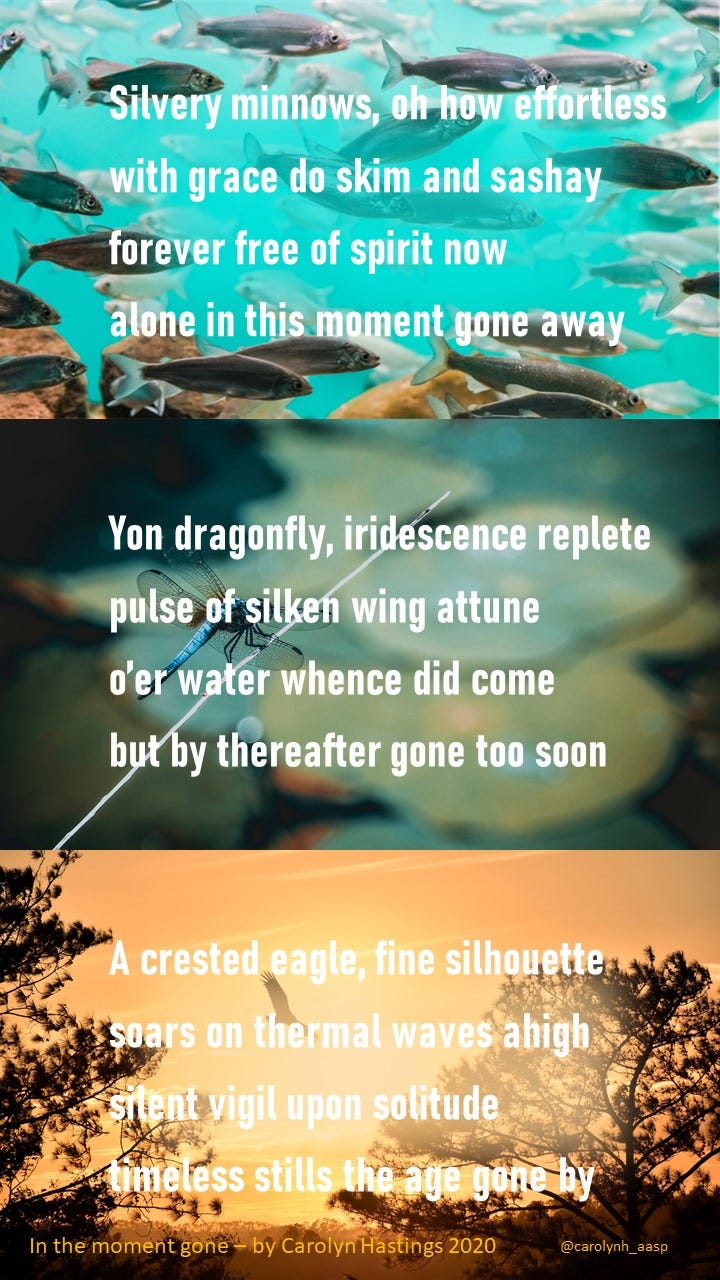
Sorry if you were hoping for a video version accompanied by gentle ambient music but I need you to stay on the page here and focus on the issue at hand. The issue, in case you’ve forgotten, is the trouble with labels.
What’s the trouble?
For the sake of the argument, let’s assume you agree the title is an appropriate choice for the poem. Let’s also assume you agree the poem lends itself to being used in a mindfulness exercise. And lastly, let’s assume you agree the poem is about time and nature. That takes care of four labels.
- Title — In the moment gone
- Function — relaxation
- Theme — time and nature
- Literary classification — poetry
Four labels. Isn’t that enough for one little poem?
Well, yes, in a general descriptive sense, four labels should be plenty. In the moment gone, a relaxing mindfulness poem about nature and the passage of time. Tells you everything you need to know, doesn’t it?
So what’s the trouble?
The trouble is the fourth label — the one about literary classification. Poetry.
A poem is a poem, is a poem, is a poem. Right?
Well yes, but not if you want to know what sort of poem it is.
Let me ask you a question. Do you know how many different types of poems there are? If you go to this website, they’ll tell you 50. But that can’t be right because here, there’s a list of 100 different poetic forms and here, you’ll find tons more and counting. You see people are creating new forms of poetry all the time. And I’m one of those people! I created a new poetic form, harlequin poems. I wrote about them recently in this article.
So what sort of poem is In the moment gone?
Promise you won’t laugh when I tell you.
My poem is a dribble!
Three dribbles to be precise. A chain of dribbles. In another context, it would be a drool!
Now do you understand what I mean about the trouble with labels and how misleading it can be to have the wrong one?
Technically, my poem is a relaxing mindfulness dribble about time and nature. What do you think of that? Does it work for you? Imagine for a moment if you were a mindfulness trainer leading a meditation class and in your most dulcet tones you’re saying,
“Now close your eyes. Breathe in and out, in and out, and let the soothing sounds of my dribble wash over you.”

Yes, hilarious but hardly helpful.
Are we agreed that dribble is not the most appropriate label for my poem? Apart from the rude, crude and straight out silly varieties of ditty, it would be hard to imagine dribble being an appropriate label for any poem. Which raises the next question.
What is a dribble poem and where did it come from?
According to Poets Collective,
‘The dribble is a brief poem consisting of exactly 100 letters (not 100 characters — spaces and punctuation are not counted). Dribbles most often take the form of a quatrain that turns on a single rhyme…’
Let’s break that down.
A dribble is a 100-letter poem. It might also be -
- a four-line poem
- a rhyming poem
- a quatrain
The feature that distinguishes a dribble from any other four-line rhyming poem (aka a quatrain), is its letter count. It’s not a dribble if it doesn’t have exactly 100 letters. For the record, each stanza in my poem, In the moment gone, satisfies the set of descriptive labels listed above.
Where did the term, dribble, come from?
All indications point to flash fiction where a dribble is a short story of exactly 50 words and a drabble is a 100-word story.
Why a 100-letter poem is called a dribble and not a drabble defies logic but when you factor in that the verb ‘drabble’ means ‘to make wet and dirty by dragging in mud and water’, I’m not going to argue the point! A mindfulness drabble about time and nature is about as close to an oxymoron as you can get!
The trouble with a triple dribble poem
Taking stock, let’s agree that my poem, In the moment gone, is a set of three dribbles. A triple dribble if you please. The question now becomes —
What’s a triple dribble called?
Bear with me, I need to call on Shakespeare and flash fiction writing mentor, Jude Higgins for some help.
‘Dribble, drabble, toil and trabble;’ ‘speare Shake and beldam babble. Mix it with a poet’s rhyme, Then the spell is cast in time!
We’ve toiled with dribbles and drabbles, but what’s this about trabble?
Jude tells us that a trabble is a 300-word story i.e. a triple drabble. Some would have us believe that trabble pertains to a certain world leader’s communication style and elsewhere it’s the name of a travel app. More importantly, there’s no mention of spittle or puddles anywhere!
Time for some trabble-drabble-dribble babble.
If a triple drabble is a trabble, a triple dribble is a …
…a tribble!
Oh wow, can you believe that? I’ve gone from parodying Shakespeare to Dr Seuss!! I’m glad neither one of those illustrious gents is still with us. I’m not sure who would be more insulted!!
But hold your Hortons! Before we get too excited and run off to tipple the tribble, there’s more toiling to be done.
Does tribble mean anything to anyone?
It seems it does. Here’s what I found.
A tribble is a horizontal wire frame for drying paper — think drying racks used in school art rooms.
And as any Star Trek devotee would know, a tribble is -
‘a small, furry, gentle, attractive, and slow-moving but rapidly reproducing lovable species’ that debuted in the 1967 episode entitled ‘The Trouble with Tribbles’.’ https://en.wikipedia.org/wiki/Tribble
Damn it! That’s the end of the line for the triple dribble-tribble label. We have a different sort of ‘trouble with tribbles’ — a very expensive licensing trademark kind of trouble. Besides that, those little furballs remind me of fuzzed-up coronavirus parasites — not exactly the mental imagery one needs to have competing with a relaxing mindfulness triple dribble about time and nature.
Time to call in some friends of the Dr Seuss variety.
If a tribble causes trouble, with your triple treble dribble, it’s a tribble load of throuble, of a thrice, threeble thribble.
Thribble!?
Is that what my threesome dribble is called? A thribble!
Okay, you know the routine. Thribble — an obsolete adjective meaning threefold and for those of us who have let our oil drilling jargon slip, a thribble is a generic term for a three-section length of pipe. The operative words here are ‘three’ and ‘generic’ as in no brand name — no registered trademark — no ‘trouble with tribbles’. Yay!!
Is a poem, is a dribble, is a thribble! We’ve done it!!
A thribble is —
- a portmanteau derived from ‘three’ and ‘dribble’
- a poetic form with three 100-letter stanzas, often styled as quatrains
- a single, stand-alone poem of three dribbles based on one theme
An example of a thribble is In the moment gone by Carolyn Hastings 2020
Finishing Label (aka Conclusion)
Believe me, I didn’t mean for this to be such a brain-teasing, tongue-twisting experience but I hope I have demonstrated the point that labels can cause all sorts of trouble and coming up with the right label can indeed be a tricky business - even for something as benign as a trio of 100-letter quatrains, formally known as dribbles.
To the person or persons who thought it was a good idea to call literary works, dribbles, drabbles and trabbles, all I can say is, “Look what you’ve done!”
To my fellow poets, it’s our responsibility to not only inspire, entertain and challenge readers with our words but to educate them by supplying an accurate label for the poetic forms we craft and by doing so, making it easier for everyone to document, store and retrieve them. To put it bluntly, I don’t accept that a ‘a poem is a poem, is a poem, is a poem’ — not when I know a poem is an alouette, is a bagarthach, …is a zeno. For an extensive inventory of poetic forms, I recommend you refer to the Poets Collective.
If you’re a social media junkie with a fancy for micropoetry, then might I suggest you try a few twibbles (twitter dribbles — yeah, I just made that up!) and see what sort of response you get. Who knows, it might put you on the path to becoming the next influencer — if I don’t beat you to it, that is!
If you’re an entrepreneur or an inventor with a product to launch onto the market, my advice to you is to think long and hard about the labels you attach to your projects. Try as best you can to have labels that accurately reflect your product’s most distinguishing features. And remember to always do your due diligence.
If you’re a speech pathologist or a teacher, go ahead and have fun with my tribble-trouble-threeble-thribble tongue twister. And to save you the bother of counting letters, the answer is yes, the thribble tongue twister is exactly 100 letters which qualifies it as a tongue twister dribble — literarily that is, but no judgment if you find yourself taking it literally!
If you’re a parent, be prepared for the day when your child races home from school spitting and spluttering about how they and everyone in the class dribbled on the teacher. It won’t be what you think!
And in case you feel the need to untangle your brain, I can recommend this mindfulness thribble about time and nature called In the moment gone.
If you’re looking for a pdf of my poem, you’re in luck! You will find it here.
Attributions
Minnows https://unsplash.com/photos/5BE_aWJUCNI Photo by Yomex Owo on Unsplash
Dragonfly https://unsplash.com/photos/JAaNcB_k7Kc Photo by Deva Darshan on Unsplash
Eagle https://unsplash.com/photos/XFkkYwKiC_U Photo by Sam Bark on Unsplash
If you enjoyed this article, you might also like these other articles I’ve written about poetry.


