Investments in energy transition reach record levels in 2023
Research firm BloombergNEF (BNEF) has published the latest edition of its annual new energy investment report, ‘Energy Transition Investment Trends’.
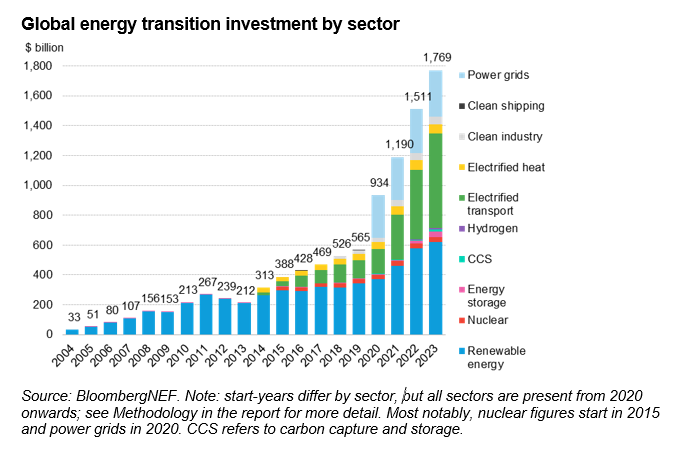
According to the findings, global investment in the “low-carbon energy transition” totaled US$1.77 trillion in 2023, according to a new report. This is a new record, which is 17% higher than the 2022 figure.
In its calculations, BNEF considers renewable energy sources, electrified transport, electric grids, energy storage systems, nuclear power, etc.
In 2023, investment in the electrification of the transport sector, which grew by 36% to $634 billion, overtook investment in renewable energy for the first time, which increased by 8% to $623 billion.
Grid investments were the third largest area of investment, totaling $310 billion. Networks are a critical driver of the energy transition, and investment in them is set to increase even further in the coming years.
There was also strong growth in emerging areas such as hydrogen (investment tripled from last year), carbon capture and storage (nearly doubled), and energy storage (up 76%).
China remains the largest investor in the energy transition. It invested $676 billion in 2023, equivalent to 38% of global investment.
While China remains the dominant player, its gap with rivals has narrowed as investment in the United States and the European Union has grown faster. Nevertheless, as we have repeatedly noted, the BRICS countries (China, first of all, of course) are today the leaders of the energy transition. In terms of investment volumes, they are ahead of the United States and the EU combined. It’s the same for many other parameters (for example, installed capacity and renewable energy generation).
Investment in the US jumped 22% year on year to $303 billion as the effects of the Inflation Relief Act (IRA) began to be felt.
Despite rapid growth, the current level of investment in low-carbon energy technologies is far from sufficient to put us on track to achieve net-zero emissions by mid-century. According to the report, investment in the energy transition must average $4.8 trillion per year between 2024 and 2030 to match the trajectory agreed to by the Paris Agreement.
BNEF also reports that investment in clean energy technology manufacturing capacity rose to $135 billion globally in 2023 and could rise to $259 billion by 2025. This will ensure further reductions in equipment prices across most sectors, “which is good news for the energy transition”. At the same time, there is a risk of oversupply and reduced profits for manufacturers of solar modules and batteries.
Read more updates about China’s energy transition strategies in the publication Areas & Producers.