China increased both its production and imports of coal, oil, and natural gas in 2023

According to data from the Chinese National Bureau of Statistics, both the production of key energy commodities (coal, oil, and natural gas) and their imports increased in China in 2023.
In 2022, a different situation was noted. Then China increased its hydrocarbon production but reduced its imports.
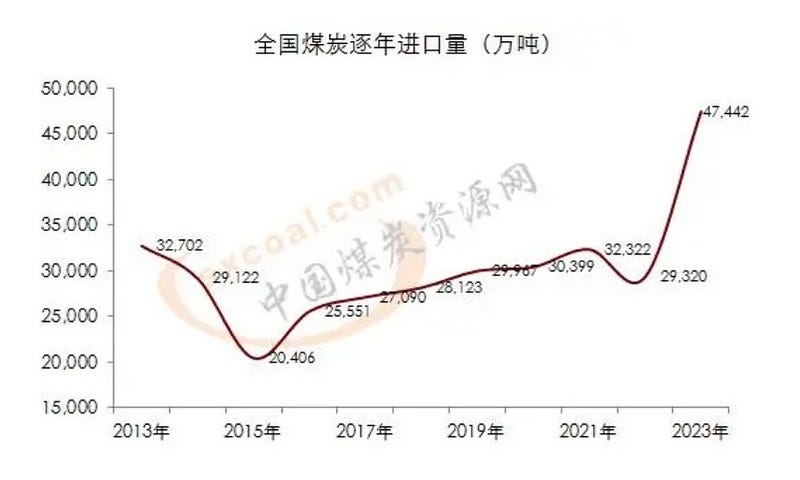
Of particular note is the import of coal, which increased by as much as 61.8% in 2023 to 474 million tons. This is a record volume. Before this, the historical maximum of coal imports was 327.02 million tons, which was reached in 2013 (the dynamics of Chinese coal imports are shown in the graph). At the same time, the average price per ton of imported coal in 2023 decreased by about 20%, which partly explains the increase in imports. Coal production within the country last year increased slightly — by 2.9% to 4.66 billion tons.
In 2023, crude oil production was 208.91 million tons, an increase of 2.0% year on year. China imported 563.99 million tons of crude oil, an 11.0% increase compared to 2022.
In 2023, China’s natural gas production amounted to 229.7 billion cubic meters, an increase of 5.8% year on year. 119.97 million tons of natural gas were imported, an increase of 9.9% compared to 2022.
According to a separate report from the china5e portal, a decrease in coal imports is expected in 2024, since China will restore customs duties from January 1, 2024. It is noteworthy that the duty rate on coal imports from Australia and Indonesia, following the interstate agreement, will be 0. Tariffs will be levied on coal imports from other countries, including Russia, the United States, South Africa, Mongolia, etc.
From January to November 2023, China imported thermal coal mainly from Indonesia (61%), Russia (17%) and Australia (13%), and coking coal from Mongolia (52%) and Russia (26%). Therefore, the restoration of import tariffs will have a greater impact on Russian coal and Mongolian coal.
More than 80 legacy coal-fired power units were shut down in China during 2023, according to a separate report from BJX News.
Let me remind you that in April 2021, Chinese President Xi Jinping said that China would strictly control coal-based electricity generation projects, strictly limit the growth of coal consumption during the 14th Five-Year Plan (2021–2025) and gradually reduce it during the 15th Five-Year Plan. five-year plans (2026–2030). This is necessary to achieve China’s promised peak CO2 emissions by 2030 and carbon neutrality by 2060.
Read more updates about India’s and China’s energy transition strategies in the publication Areas & Producers.