
Inside The Mind of Speaker and Listener [Part 2 — The Listener]
Insights into what goes behind the scenes for the speaker’s and the listener’s minds answering “how to effectively exchange ideas”.

Imagine a world where you could not only speak your mind but truly be heard, where every conversation is a symphony of understanding, and where the art of communication weaves connections stronger than words alone. Welcome to the world of “Inside The Mind of Speaker and Listener,” a journey that unravels the intricate threads of effective exchange of ideas.
In this exploration, we get on through an adventure to explore inside the minds of both the speaker and the listener, shedding light on the skills and nuances that highlight the art of communication.
Through stories, insights, and practical tips, we’ll traverse the landscape of speaking and listening, discovering how these twin pillars shape the way we connect with others.
This article is the second part of “Inside The Mind of Speaker and Listener”, in the first part I’ve shared thoughts about what goes inside the mind of a speaker, and how to effectively communicate your thoughts. If you haven’t read it already, please do as it will complete the cycle for you to understand this article:
In Part 1, I shared this diagram below:
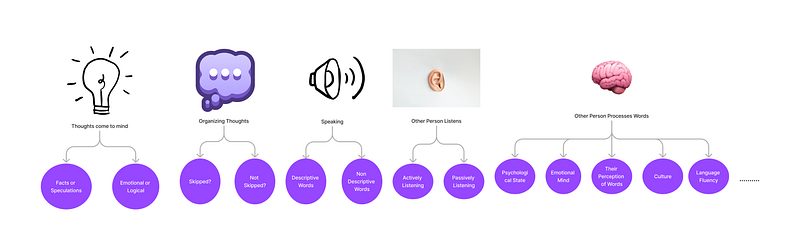
Now let's go about the listener’s stages…
Listening Is Hard
It’s essential to recognize that not everyone excels at listening to others, and it often demands effort, especially for those not used to it. It’s human nature to prefer speaking over listening.
Nonetheless, many renowned and successful individuals worldwide have historically emphasized the importance of developing the skill of listening more than speaking.
Doug Noll discusses this in detail during an interview with Ame-Lia Tamburrini in this article:
When you speak, what transpires within the mind of a listener? Let’s delve into this intriguing question in the sections that follow.
In the realm of listening, we typically encounter two primary types of listeners (though there may be more categories, we’ll focus on these two):
Active Listeners
- They show a keen attentiveness to what you have to share.
- Active listeners engage with you, asking clarifying questions and responding through gestures like nodding or verbal interaction.
- These individuals refrain from interrupting your flow of thoughts and only interject once you’ve concluded your idea.
- They make an effort to navigate your thoughts by steering the conversation toward topics they believe are significant to both parties.
- Active listeners tend to be characterized by their selflessness, care for the speaker, and an attitude of deciding when to listen and when to contribute to the dialogue.
But, is every listener an active listener, or do active listeners consistently maintain their attentive stance? Well, naturally, the answer is no. Imperfections are inherent in us all.
Some individuals need to cultivate the courtesy of active listening, striving to gift others with their undivided attention.
Even those highly skilled in the art of listening may occasionally find themselves unable to listen due to unforeseen circumstances such as illness, mental preoccupation, or simply not being in the mode.
Passive Listeners
- Passive listeners typically demonstrate disinterest in the topic at hand, resulting in less than attentive listening.
- They might either repeatedly interrupt your discourse or remain completely silent throughout the conversation.
- Often, passive listeners divert their attention to other activities, such as checking their phones or reading.
- They tend not to offer responses or engage with the content of your conversation.
As a speaker, it becomes paramount to possess a heightened awareness and sensitivity, particularly when encountering passive listeners. If your audience appears disengaged and unresponsive, it’s advisable to consider pausing and facilitating a shift in the dialogue, encouraging them to voice their thoughts.
In situations where they are willing to participate, consider assuming the role of the listener, thereby exhibiting care. However, if they aren’t in a conversational mood, it may be prudent to postpone the discussion for a more suitable time. In cases where urgency is a factor, it’s essential to convey the reasons necessitating their immediate attention.
Factors Affecting The Listener’s Understanding

Numerous factors come into play, significantly affecting a listener’s conceiving of spoken words. There is a substantial gap between a speaker’s thoughts and a listener’s perception, apparently bridged by words. However, there are influential elements filling the spaces in between, contributing to the understanding of spoken words.
Psychological state
The listener’s current psychological state contributes heavily to how they interpret the spoken words. Depending on their emotional disposition, their reception of words can shift significantly.
I can think of unlimited times when my psychological state affected how I am listening to other people. For instance, a sentence that I would typically welcome with an open mind and without any emotional provocation can take on an entirely different, and often negative, contrary when delivered to me during moments of stress.
This phenomenon highlights the interconnection between our emotional well-being and our ability to receive and process spoken words, making it crucial to consider the impact of psychological states on effective communication.
Perception of words
On a personal note, I’ve encountered numerous instances when the combination of words and body language presented a divergence between my interpretation and the speaker’s intent. I am confident that many others share this experience. This phenomenon is perhaps why many people fear expressing their thoughts openly, dreading potential misunderstandings.
Culture
The cultural background from which an individual hails plays a main role in shaping their understanding of words, body language, and actions.
For example, consider when an American engages in conversation with a Briton without using polite language. The Briton may take offense, while the American may view this as a more direct and efficient communication style.
Another personal example I face daily, residing abroad from my country of origin, involves the challenge of expressing sympathy to others. In my homeland, we employ emotionally charged language when consoling someone during challenging times. However, if I were to translate these sentiments into English, they might be perceived as overly intimate, although our intent is to convey deep concern, a precision that the English language may not fully capture.
Language fluency
Language can serve as a substantial barrier when neither the speaker nor the listener employs it as their native tongue. As a speaker, articulating thoughts and emotions can become hard when attempting to express them in a non-native language. Likewise, the listener may face significant challenges in understanding the speaker, as they struggle with filling in the gaps in their comprehension.
Body Language
The manner in which a speaker employs body language can either enhance or reduce understanding. For instance, when a speaker looks away while speaking, it can make it challenging for the listener to follow their message.
Similarly, when the listener’s attention roams elsewhere in the room, it can deter the speaker’s engagement and lead to a desire to cut short their conversation.
To promote effective communication, both the speaker and the listener must ensure that their body language undoubtedly brings genuine care and undivided attention. This commitment to non-verbal communication extends to both sides of the conversation, enriching the quality of understanding and dialogue.
Now, we’ve journeyed through the complex domains of speaking and listening, unraveling the essential dynamics that highlight the effective exchange of ideas.
We started by exploring the art of the speaker, shedding light on the importance of communicating thoughts effectively. Then, we transitioned into the equally crucial domain of the listener, discovering the different aspects of active and passive listening.
As we wrap up our exploration, we must acknowledge that effective communication is a two-way street, influenced by numerous factors.
The listener’s current psychological state can dramatically alter their interpretation of spoken words, as emotions play a vital role in how we perceive what we hear.
Additionally, the interplay between words and body language can often lead to disparities in understanding, showcasing the complexities of human communication.
Cultural backgrounds, language fluency, and body language all add layers of complexity to our conversations, influencing how we both convey and receive messages.
This complexity dance of spoken and unspoken words highlights the importance of genuine care and undivided attention in the art of communication.
In our journey to understand “Inside The Mind of Speaker and Listener,” we’ve gone through the essence of effective dialogue, emphasizing that the ability to both speak and listen with intent and empathy can truly enrich our exchanges and deepen our connections.