
Inside The Mind of Speaker and Listener [Part 1 — The Speaker]
Insights into what goes behind the scenes for the speaker’s and the listener’s minds answering “how to effectively exchange ideas”.

Our minds undergo a complex process before we speak, which can vary in complexity. For example, when responding to someone on the street with a simple “Thank you!” or asking a family member at home to adjust the heating, it differs from speaking in public, discussing uncomfortable topics with someone close, or conversing with colleagues and a manager.
The nature of these conversations varies greatly, and thus, the stages involved also differ. Some stages, such as organizing your thoughts, may be skipped, but the basic process remains the same, whether one is aware of it or not.
This article is the first part of a two-part series that I am writing. My goal in these two articles is to analyze the stages that both the speaker and the listener go through during a conversation. Additionally, I aim to emphasize the various perspectives that we should take into account in order to become more aware of how our words can influence our relationships and affect others.
In this particular article, I will go through the speaker’s experience, while in the upcoming article, I will focus on the listener’s experience.
I drafted the following diagram to visualize the stages of the speaker’s and listener’s experience.
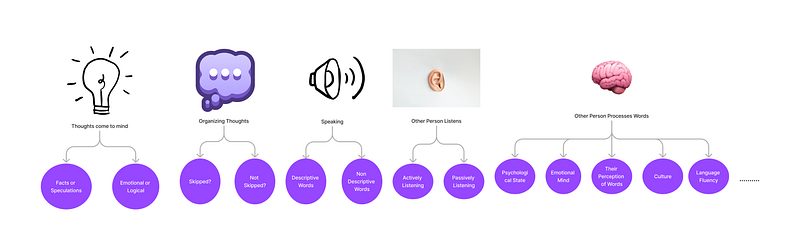
Let’s go through the speaker’s stages…
Thoughts Come to Mind
There are various types of thoughts that may cross our minds, but in short, let’s categorize them into four groups: “Emotional,” “Logical,” “Facts,” or “Speculation.”
Emotional thoughts

They typically arise when we emotionally engage with the events around us. These thoughts are inherently non-logical and can be either correct or incorrect.
Depending on the context of the conversation and the specific emotion involved, we face a choice between speaking or withholding our words, taking into account several factors:
- Is the listener receptive to my emotional expressions?
- If you’re experiencing anger or sadness, is it advisable to step back, maintain silence, and gather your thoughts first?
3. Will sharing your emotions evoke happiness or skepticism in the listener?
In conclusion, it is essential to develop your ability to judge the situation and the person you are communicating with. This judgment relies heavily on your knowledge of the listener(s) and your assessment of them. Our judgments are influenced by various factors (as discussed in “Thinking, Fast and Slow” by Daniel Kahneman, which I may go through in a future article).
Logical thoughts

These kinds of thoughts are rooted in analytical thinking, and individuals often invest time in developing and substantiating their assumptions with gathered facts. Ideally, they have already gone through the process of validating these assumptions and can support them with evidence.
However, it’s important to note that while these thoughts are labeled as “logical” and may appear intelligent, they may not always sound as such to the listener. Therefore, one should consider:
- Is the listener currently open to my logical reasoning?
- Should I defer discussing this for a more suitable time?
- Do you have enough time to thoroughly present and discuss these logical ideas?
Once again, the appropriateness of sharing these thoughts hinges on your assessment of the situation and your understanding of the listener(s). It’s crucial to assess whether they can grasp the details and context of what you intend to express.
Facts vs Speculations

When you intend to discuss facts, it is imperative to possess supporting evidence for those facts. This evidence can take the form of pictures, books, references, and so on.
You should diligently scrutinize the credibility and reliability of these sources.
In today’s digital age, many individuals tend to assume that everything they encounter on the internet is accurate.
In reality, it often works the other way around: a substantial portion of online content is inaccurate and necessitates validation and a closer examination of its sources.
Speculations typically involve personal guesses or intuitions about various matters.
They may not necessarily be grounded in factual information, or they can stem from facts for which you lack concrete evidence or simply cannot recall.
Speculations may also arise from accumulated knowledge or past experiences.
It’s important to note that speculations can be potentially risky because they can create a false sense of certainty. In such cases, individuals may believe they are certain about something when, in reality, they are not.
Organizing Thoughts

The stage of organizing our thoughts is one that can easily be overlooked, as we engage in conversations throughout the day, often on the fly. It’s perfectly normal and even efficient to have a quick and spontaneous process for many of our daily interactions. However, there are certain conversations where careful thought organization is essential. Here are some examples of situations where it’s crucial:
- Speaking to a loved one in an important conversation: Just because a loved one is close to us doesn’t mean we should disregard the need to organize our thoughts before speaking. Doing so can help us avoid making hasty judgments, assumptions, or emotional outbursts that might harm the relationship.
2. Speaking to your manager: When communicating with your manager, it’s vital to be well-prepared and organized to convey your thoughts clearly and professionally.
3. Providing feedback to someone: When giving feedback, taking the time to think through your words and approach can help you be more compassionate and considerate of the other person’s feelings.
4. Sharing opinions on social media: In today’s digital age, the influence of social media is widespread. Therefore, it’s essential to be cautious about the messages you send to the world. Misjudgment, false news, or inaccurate information can significantly impact others’ lives. Even the smallest piece of incorrect information can have a substantial effect.
In these situations, organizing your thoughts beforehand can lead to more effective and considerate communication.
Speaking

Once you’ve made the decision to speak, finding the right words becomes crucial. If you’ve gone through the previous stages effectively, especially if you’ve efficiently organized your thoughts, selecting the appropriate words should be considerably easier.
Here are some considerations when choosing your words:
- Empathy: Put yourself in the listener’s shoes. Consider how you would feel if you heard the same words from someone else. If you think you would prefer a different phrasing, consider rewording your statement.
- Avoid Blaming Language: Steer clear of blaming words, such as “you should have,” “you could have,” “why didn’t you,” or “it’s your fault.” Instead, try to use more constructive and empathetic language. For example, replace these phrases with expressions like “Have you considered doing…,” “I understand that you did your best, but what do you think you can change next time?” or “I suggest you try 1, 2, 3 next time.”
- Use Wisdom in Defense: When you feel the need to defend yourself, aim to do so calmly and wisely rather than resorting to shouting. Be conscious of your volume and try to maintain a calm tone. Employ thoughtful words to express your defense. For instance, say, “I attempted 1, 2, 3, but it didn’t work,” or “How do you think I should have approached it?”. You can also acknowledge the other person’s feelings while expressing your own, such as “I understand your perspective, but I also need to share how I felt. I was disappointed with 1, 2, 3.”
Choosing your words carefully and with empathy can lead to more productive and respectful communication.
As we’ve seen, understanding the nature of our thoughts — whether they are emotional, logical, factual, or speculative — helps us make more informed decisions about when and how to speak. It’s not just about the words we choose, but also the timing, context, and empathy we bring to our conversations.
Recognizing the significance of organizing our thoughts, especially in critical discussions, is essential. Whether it’s with a loved one, or a manager, or when sharing opinions on social media, thoughtful preparation can lead to more considerate and effective communication.
Finally, when we do decide to speak, we must remember that the words we select can have a profound impact on others.
Practicing empathy, avoiding blaming language, and using wisdom in our responses can foster more productive and respectful exchanges.
In the next part of this series, together we’ll go through the listener’s experience, completing the interconnected view of the dynamics at play in our conversations.
Understanding both the speaker’s and the listener’s sides is a key step toward becoming more conscious of how our words shape our relationships and influence those around us.