avatarPaul Myers MBA

Free AI web copilot to create summaries, insights and extended knowledge, download it at here

6721

Abstract

e to the customer.”</p><p id="262e">Utterback (1976) found that around 70–80 percent of innovations result from <i>demand-pull</i> whereas 20–30 percent from ‘<i>technology push’</i>, like the iPhone.</p><p id="305a">While <i>demand-pull</i> produces minor product modifications, few are truly innovative, game-changing breakthroughs have come from technology push (Shanklin, 1983).</p><p id="05f9">Apple, Google, Airbnb, and Uber have all used the <i>technology push</i> strategy.</p><p id="9594">The Solvay Business School survey (2000) explored culture to measure the ability of an organization to develop a culture of innovation, its capacity to implement ideas and management of Intellectual Property thereafter.</p><p id="b367" type="7">“Innovation — any new idea — by definition will not be accepted at first. It takes repeated attempts, endless demonstrations, and monotonous rehearsals before innovation can be accepted and internalised by an organisation. This requires courageous patience.”</p><p id="ccf9" type="7">— Warren Bennis</p><p id="5371">In the UK, <a href="https://www.nesta.org.uk">NESTA</a> developed an <a href="https://www.nesta.org.uk/project/innovation-index/">Innovation Index</a> designed to measure the UK’s performance as an Innovative nation (Adams, <i>et al</i>, 2008), recording behavioral data at all stages of the process, by sector.</p><p id="7c40">Interestingly, organizations are asked about their use of external knowledge, proposed by Romijn and Albaladejo (2000) and Ahmed & Shepherd (2010) above, using a structured three-phase model, an innovation value-chain:</p><ol><li><i>Knowledge assessment</i></li><li><i>Building innovation and</i></li><li><i>Commercializing innovation</i></li></ol><p id="717a">Unlike other models that don’t account for industry-specific innovation metrics, the NESTA Index asks sector-specific questions.</p><figure id="f171"><img src="https://cdn-images-1.readmedium.com/v2/resize:fit:800/1*pnLXe_adbdX1o0WiTY21eA.png"><figcaption>Innovation Excellence by <a href="https://www.accenture.com/">Accenture</a></figcaption></figure><p id="8f52">The impact of this offers insight into innovation across a range of different sectors. The benefits of which include benchmarking, high-potential identification, and opportunities for collaboration.</p><p id="896e">The <a href="https://hbr.org/2007/06/the-innovation-value-chain">Hansen and Birkinshaw’s (2007) questionnaire</a> is based on an <i>Innovation Value Chain</i>, whereby employees, representing a cross-section of organizational functions, complete the questionnaire. This model seeks to unveil strengths and weaknesses in an organization's value chain.</p><p id="190c">In Ireland, the <a href="https://www.enterpriseresearch.ac.uk/our-work/data-sources/the-irish-innovation-panel-iip/">Innovation Panel (IIP)</a> utilizes five surveys to measure activities in innovation across organizations. The IIP model, measured over a three year period, is designed to provide sector-by-sector results in order to capture activities in small firms, north and south of the border.</p><h2 id="6014">Indicators</h2><p id="fe22">The innovation qualification phases shown below are indicators of innovation, which can be vast but not always visible.</p><figure id="f3df"><img src="https://cdn-images-1.readmedium.com/v2/resize:fit:800/1*_ZPenaviYIpjCDJk08Uc2w.png"><figcaption>Qualification phases by Author</figcaption></figure><p id="ac2a"><b><i>Innovation audits</i></b> also indicate its existence in an organization but in reality, many other factors play a role.</p><p id="2235">The most obvious indicator is financial <b><i>Investment </i></b>in innovation projects, “Irish enterprises spend an estimated €5.3bn per annum on innovation-related activities” (Carney et al, 2010).</p><p id="76e3" type="7">Ryanair, CitiGroup, and Accenture have publicly shared their digital lab investments in Ireland.</p><p id="ffea"><b><i>New product launch</i></b> is another indicator, leading onto <b><i>innovativeness benchmarking</i></b>, a concept that measures new product or service releases over a period of time, compared to the market leader.</p><figure id="fad5"><img src="https://cdn-images-1.readmedium.com/v2/resize:fit:800/1*w87vwWSfJkoJCzCS-74k8g.png"><figcaption>Pillars of Value by <a href="https://www.accenture.com/">Accenture</a></figcaption></figure><p id="e26c"><a href="https://www.nesta.org.uk">NESTA</a> is well-positioned to measure this due to their industry and sector-specific focus. Recent launches, like <b><i>Virtual Reality</i></b> headsets, <b><i>Artificial</i> <i>Intelligence</i>, </b>and <b><i>Drone</i></b> technology, are examples of industry-specific indicators.</p><h2 id="a341">Collaboration</h2><p id="e957"><a href="https://readmedium.com/great-collaborations-make-an-impact-on-the-world-824205fb0dfa"><b><i>Collaborative</i></b></a><b><i> ventures</i></b> are a relatively new indicator of Innovation. For instance, Facebook partnered with Stripe to introduce an eCommerce channel to its consumer base, on the one platform.</p><p id="6f19">This mirrors the strategy adopted by Apple in the past, leaping market boundaries to compete in a new sector, Shopify, Magento, and WooCommerce now have to compete with Facebook as a new entrant.</p><p id="cf84">Ryanair, and indeed other airlines, employ <b><i>collaborative ventures</i></b> known in the industry as <a href="https://www.diggintravel.com/2019-airline-ancillary-revenue-trends/"><b><i>ancillary revenue</i></b></a>. In fact, Ryanair accrues up to 20 percent of its revenue through this channel, €1 Billion (Ryanair.com, 2015), an indicator of innovative effectiveness.</p><figure id="3eaa"><img src="https://cdn-images-1.readmedium.com/v2/resize:fit:800/1*DK3WBxdqfBHqRKOcu0pJmw.png"><figcaption>Innovation brand spectrum</figcaption></figure><p id="f525">The Romijn and Albaladejo (2000) audit questionnaire, to gauge the ability of an organization's innovation capabilities with respect to internal and external inputs, ties into <b><i>Brand <a href="https://www.thebrandingjournal.com/2016/11/brand-positioning-definition/">positioning</a></i></b> as an indicator.</p><p id="ddcc">Whereas <b><i>innovation indication levers</i></b> are recognizable from the consumer's perspective like <b><i>user-experience</i></b> (UX) for example, demonstrated by Ryanair's’ digital overhaul undertaken in 2014.</p><p id="4bc1">Digital innovation positions an organization to accurately measure <i>external forces</i> and pivot <i>internal forces</i> accordingly by leveraging real-time data captured through website performance analytics and traffic, revealing indicator insights into <b><i>consumer engagement</i></b>.</p>

Options

<figure id="197b"><img src="https://cdn-images-1.readmedium.com/v2/resize:fit:800/1*Elyt-dgpwPIgEgMvoVDppg.png"><figcaption><b><i>Innovation Indication Levers</i></b></figcaption></figure><p id="4f77">Mairesse and Mohnen (2007) capture a range of innovation activities as indicators. Inputs like R&amp;D expenditure, patent acquisition, product design, and investment in human capital through training and development.</p><p id="7043">Also, output indicators include <b><i>organizational change</i></b> or <b><i>business transformation</i></b> and <b><i>marketing innovations</i></b>, measured in part by new product sales or market share and the percentage of sales from existing and new products.</p><div id="3be3" class="link-block"> <a href="https://readmedium.com/great-innovators-ask-for-forgiveness-not-permission-d2841a51c9ed"> <div> <div> <h2>Great Innovators Ask for Forgiveness Not Permission</h2> <div><h3>True innovation is grounded in rule-breaking not conformance</h3></div> <div><p>medium.com</p></div> </div> <div> <div style="background-image: url(https://miro.readmedium.com/v2/resize:fit:320/1*_NYDSU6HTTJO91UpmfEqhg.jpeg)"></div> </div> </div> </a> </div><h1 id="5520">Final Thoughts</h1><p id="6438">Innovation audit programs and indicators can improve innovative evolution, in terms of new products, processes, services, business models, marketing or new technologies.</p><p id="cce3">From a business perspective, innovation should be evaluated by the impact it has on performance, like reduced costs, social impact, or revenue growth.</p><p id="9ad9">One problem is that many of the effects on performance are only evaluated post-implementation. The solution is to deploy data analytics from the outset.</p><p id="0003" type="7">The Lean Startup model in one strategy whereby Build-Measure-Learn iterations ensure regular feedback occurs at a low cost.</p><p id="0cc8">The fact is innovation is not a singular process, nor is it a stand-alone pillar, it requires connection across an array of indicators and business verticals to map the steps that innovators must navigate.</p><p id="6751">There is no one framework or approach to measuring innovation that fits every company or sector, as metrics can vary. That said, the methods described above offer a great starting point to create the world of tomorrow.</p><div id="4ab3" class="link-block"> <a href="https://readmedium.com/three-types-of-innovation-29227046a95"> <div> <div> <h2>The Ultimate Guide to Innovation — 3 Types of Innovation!</h2> <div><h3>Learn the 3 Types of Innovation and built the future!</h3></div> <div><p>medium.com</p></div> </div> <div> <div style="background-image: url(https://miro.readmedium.com/v2/resize:fit:320/1*TcwriQQhuqsoR-F28MVO6A.jpeg)"></div> </div> </div> </a> </div><div id="d534" class="link-block"> <a href="https://readmedium.com/what-drucker-wrote-about-successful-innovation-595ae041f544"> <div> <div> <h2>What Drucker Wrote About Successful Innovation</h2> <div><h3>Simple lessons from business thought leader</h3></div> <div><p>medium.com</p></div> </div> <div> <div style="background-image: url(https://miro.readmedium.com/v2/resize:fit:320/1*L7WIQdNet3JZbeQPSWU9UQ.jpeg)"></div> </div> </div> </a> </div><div id="18b6" class="link-block"> <a href="https://readmedium.com/managing-and-communicating-innovation-in-a-startup-b932b7a1a49"> <div> <div> <h2>Managing and Communicating Innovation in a Startup</h2> <div><h3>Capturing, nurturing and executing innovation is the lifeblood of a fledgling businesses</h3></div> <div><p>medium.com</p></div> </div> <div> <div style="background-image: url(https://miro.readmedium.com/v2/resize:fit:320/1*R6DfwpLCo56Nk-bGS2-wPg.jpeg)"></div> </div> </div> </a> </div><h1 id="7128">References</h1><p id="9c1e">Aarikka-Stenroos, L., and Sandberg, B. (2012). From new product development to commercialization through networks. <i>Journal of Business Research</i>, 65(2), pp.198–206.</p><p id="b864">Armstrong, J. (2016). <i>Guest Article by Reuben May “The Man behind Ryanair's Digital Marketing Transformation</i>. [online] Irishtechnews.net. Available at: <a href="http://irishtechnews.net/ITN3/guest-article-by-reuben-may-the-man-behind-ryanairs-digital-marketing-transformation/">http://irishtechnews.net</a> [Accessed 4 Feb. 2016].</p><p id="dc33">Baumol, W. (1990). Entrepreneurship: Productive, Unproductive, and Destructive. <i>Journal of Political Economy</i>, 98 (5, Part 1), pp.893–921.</p><p id="b0d3">Burn-Callander, R. (2014). <i>Ryanair’s Michael O’Leary: ‘I was wrong; the customer is always right’</i>. [online] Telegraph.co.uk. Available at: <a href="http://www.telegraph.co.uk/finance/newsbysector/transport/11201992/Ryanairs-Michael-OLeary-I-was-wrong-the-customer-is-always-right.html">http://www.telegraph.co.uk</a> [Accessed 4 Feb. 2018].</p><p id="9a4b">Department of Jobs, Enterprise, and Innovation, (2014). <i>National Policy Statement on Entrepreneurship in Ireland</i>. Dublin.</p><p id="36b3">McCraw, T. (2007). <i>Prophet of innovation</i>. Cambridge, Mass.: Belknap Press of Harvard University.</p><p id="04b1">O’Reilly, B. (2014). <i>I’ve always been warm and cuddly“ Michael O’Leary on Ryanairs image — Independent.ie</i>. [online] Independent.ie. Available at: <a href="http://www.independent.ie/business/irish/ive-always-been-warm-and-cuddly-michael-oleary-on-ryanairs-nicer-image-30200475.html">http://www.independent.ie</a> [Accessed 4 Feb. 2017].</p><p id="782e">Taylor, C. (2015). <i>Ryanair shares at an all-time high after airline raises full-year guidance</i>. [online] The Irish Times. Available at: <a href="http://www.irishtimes.com/business/transport-and-tourism/ryanair-shares-at-all-time-high-after-airline-raises-full-year-guidance-1.2345394">http://www.irishtimes.com</a> [Accessed 4 Feb. 2018].</p><p id="48a8">Thiel, P., and Masters, B. (2015). <i>Zero to one</i>. London: Virgin Books. pp.59–62</p><p id="105e">Tidd, J., and Bessant, J. (2013). <i>Managing innovation</i>. 5th ed. Chichester: Wiley.</p></article></body>

BUSINESS | INNOVATION

Innovation Is Needed Now More Than Ever

A discussion about innovation readiness in business

Image by felixioncool from Pixabay

Charles Handy described innovation as something that “includes all activities directed to changing the things that the organization does or the way it does it” (Handy 1999).

The Merriam Webster Dictionary defines innovation as:

“(1) the introduction of something new or (2) a new idea, method, or device”.

Innovation is a process, the ability to think differently, ideate, challenge the status quo but most importantly, execute, and deliver. Its what sets businesses apart, underpinning competitive advantage.

Porter (1990) described is as a means of enterprises achieving competitive advantage through the adoption of new technologies and new ways of doing things.

“We cannot solve our problems by using the same kind of thinking we used when we created them.”

— Albert Einstein

This article will discuss innovation readiness.

The Innovation Audit

Innovation can spark growth and significantly contribute to a company’s performance, highly important given today’s economic conditions, that call for new sources of growth to deliver value in differentiated ways.

Innovation programs enhance brand image, promote innovative dialogue while improving offerings and processes. The question is are they effective and do they work, creating an Audit need.

In terms of an Innovation Audit it's important to first identify what’s being measured, scope, objectives, stakeholders, planning, how metrics are recorded, organized, measured, and examined.

The size of the organization and type of organization are other noteworthy elements to consider.

The Oslo manual Definition of Innovation lends itself to the service industry, addressing four types of Innovation, namely:

  1. Product
  2. Process
  3. Marketing, and
  4. Organizational

The 4P model, like the Oslo manual Definition of Innovation, proposes four cornerstones in organizational innovation, plotting the impact of incremental versus radical Innovation.
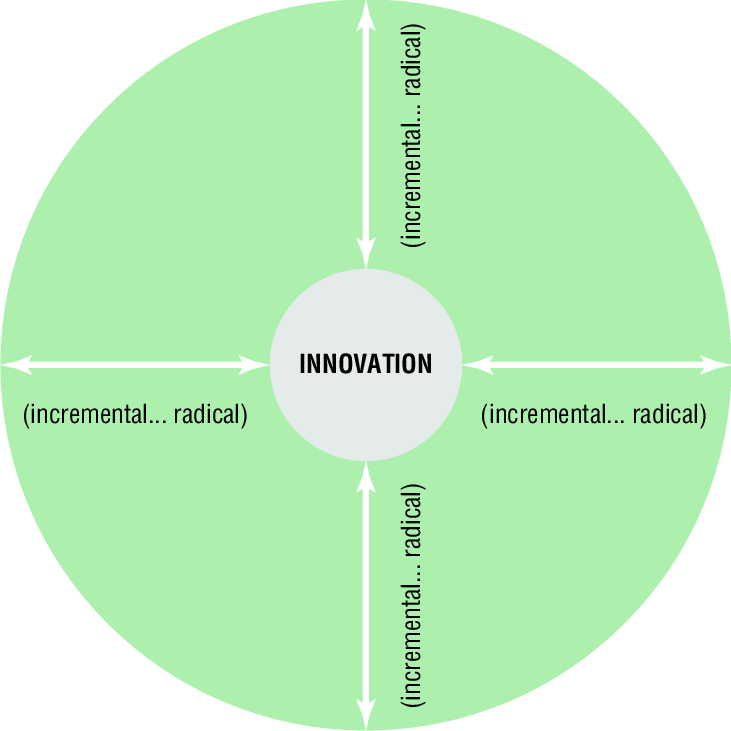
Image source

Gary Hamel would argue the benefit of incremental in the modern world:

“Most companies long ago reached the point of diminishing returns in their incremental improvement programs. Radical, non-linear innovation is the only way to escape the ruthless hyper-competition that has been hammering down margins in industry after industry.“ (Hamel, 2011)

Examples of radical Innovation and the underlying mechanism are shown in the table below.
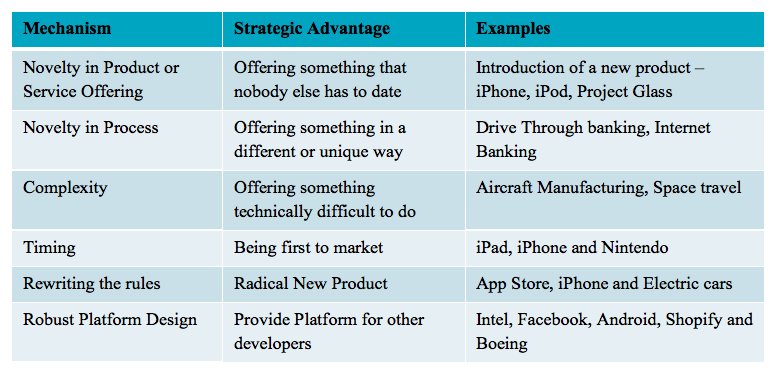
Image by Author

Questionnaire

Romijn and Albaladejo (2000) introduced an audit questionnaire and two core indices to measure innovation capability, akin to Hansen and Birkinshaw’s (2007) innovation capability questionnaire.

Both designed to gauge the ability of an organization to make improvements, overhaul, modify existing technologies, or create new technologies. A concept that fits well with process and product technology and how production is planned, managed, and organized.

Romijn and Albaladejo (2000) concur that the accumulation of an organization's innovation capabilities is a result of internal and external inputs.

Like Ahmed & Shepherd (2010), innovation has different formats that fall into two categories:

  1. Those within the firm’s control and
  2. That outside the firm’s field of influence

The importance of each presumes a contribution towards competitive advantage, by enhancing an organization's ability to initiate technological change and advancement.

Examples and forces

Kodak and Nokia are examples of companies that ignored External Forces, casualties of the effective execution of Internal Forces demonstrated by Apple, Samsung, and Google.

In 1971, Xerox established the Palo Alto Research Centre to dominate the paperless office of the future. Hiring between 50–60 of the top computer scientists in the world at the time, they brought them together with a huge budget and creative freedom.

This is an example of Internal Forces at play.

Steve Jobs, however, recognized the value of External Forces, jumping at the opportunity when he was invited to visit the PARC facility. This resulted in Apple launching the Desktop Mouse and GUI software, first to market, products, and ideas that Jobs witnessed at PARC.

Jobs was ahead of his time, he appreciated the innovation process.
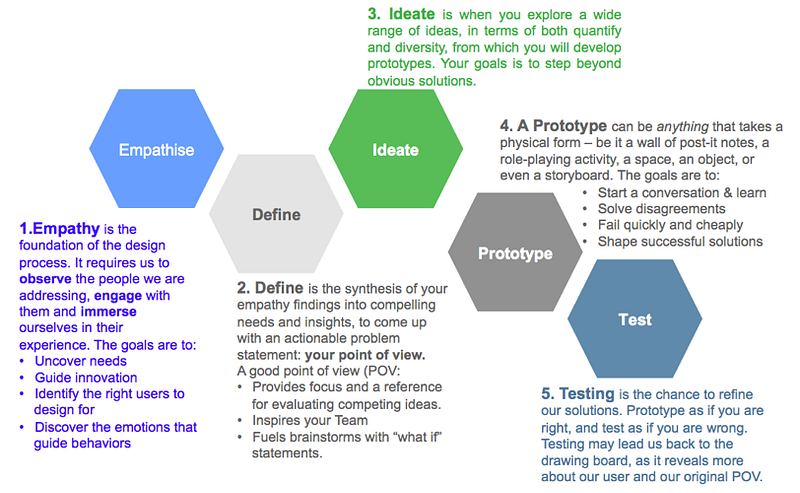
Image source

This is evidence that the ability to convert External Forces into Internal Forces solidifies competitive advantage, an ethos where Innovation is embedded in Strategy and Culture.

Push-Pull

Stalk et al (1992) noted that the building blocks of corporate strategy are not products or markets but rather business processes:

“Competitive success depends on transforming a company’s key processes into strategic capabilities, delivering superior value to the customer.”

Utterback (1976) found that around 70–80 percent of innovations result from demand-pull whereas 20–30 percent from ‘technology push’, like the iPhone.

While demand-pull produces minor product modifications, few are truly innovative, game-changing breakthroughs have come from technology push (Shanklin, 1983).

Apple, Google, Airbnb, and Uber have all used the technology push strategy.

The Solvay Business School survey (2000) explored culture to measure the ability of an organization to develop a culture of innovation, its capacity to implement ideas and management of Intellectual Property thereafter.

“Innovation — any new idea — by definition will not be accepted at first. It takes repeated attempts, endless demonstrations, and monotonous rehearsals before innovation can be accepted and internalised by an organisation. This requires courageous patience.”

— Warren Bennis

In the UK, NESTA developed an Innovation Index designed to measure the UK’s performance as an Innovative nation (Adams, et al, 2008), recording behavioral data at all stages of the process, by sector.

Interestingly, organizations are asked about their use of external knowledge, proposed by Romijn and Albaladejo (2000) and Ahmed & Shepherd (2010) above, using a structured three-phase model, an innovation value-chain:

  1. Knowledge assessment
  2. Building innovation and
  3. Commercializing innovation

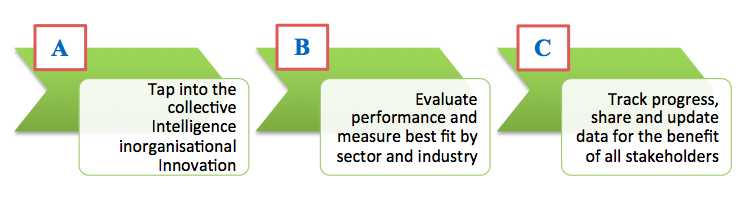
Unlike other models that don’t account for industry-specific innovation metrics, the NESTA Index asks sector-specific questions.
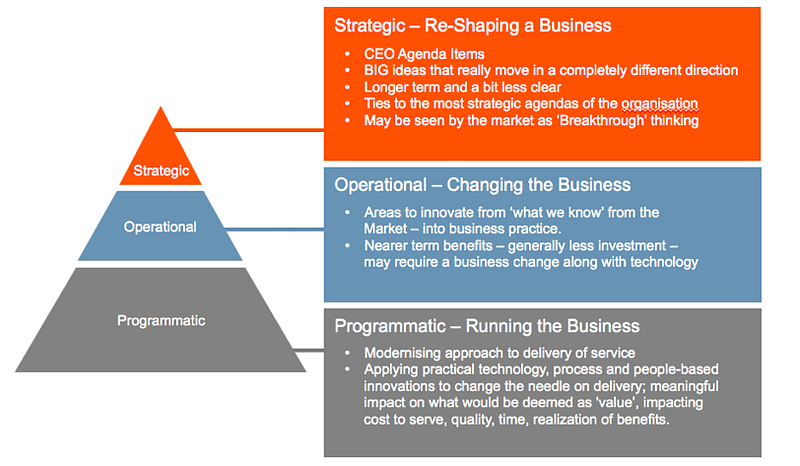
Innovation Excellence by Accenture

The impact of this offers insight into innovation across a range of different sectors. The benefits of which include benchmarking, high-potential identification, and opportunities for collaboration.

The Hansen and Birkinshaw’s (2007) questionnaire is based on an Innovation Value Chain, whereby employees, representing a cross-section of organizational functions, complete the questionnaire. This model seeks to unveil strengths and weaknesses in an organization's value chain.

In Ireland, the Innovation Panel (IIP) utilizes five surveys to measure activities in innovation across organizations. The IIP model, measured over a three year period, is designed to provide sector-by-sector results in order to capture activities in small firms, north and south of the border.

Indicators

The innovation qualification phases shown below are indicators of innovation, which can be vast but not always visible.
Qualification phases by Author

Innovation audits also indicate its existence in an organization but in reality, many other factors play a role.

The most obvious indicator is financial Investment in innovation projects, “Irish enterprises spend an estimated €5.3bn per annum on innovation-related activities” (Carney et al, 2010).

Ryanair, CitiGroup, and Accenture have publicly shared their digital lab investments in Ireland.

New product launch is another indicator, leading onto innovativeness benchmarking, a concept that measures new product or service releases over a period of time, compared to the market leader.
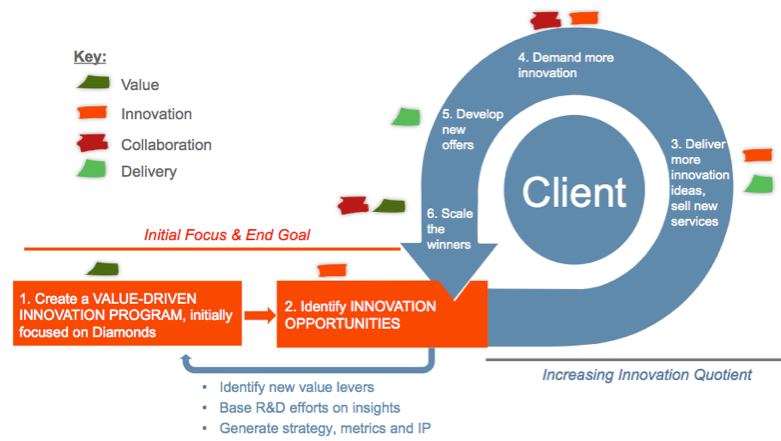
Pillars of Value by Accenture

NESTA is well-positioned to measure this due to their industry and sector-specific focus. Recent launches, like Virtual Reality headsets, Artificial Intelligence, and Drone technology, are examples of industry-specific indicators.

Collaboration

Collaborative ventures are a relatively new indicator of Innovation. For instance, Facebook partnered with Stripe to introduce an eCommerce channel to its consumer base, on the one platform.

This mirrors the strategy adopted by Apple in the past, leaping market boundaries to compete in a new sector, Shopify, Magento, and WooCommerce now have to compete with Facebook as a new entrant.

Ryanair, and indeed other airlines, employ collaborative ventures known in the industry as ancillary revenue. In fact, Ryanair accrues up to 20 percent of its revenue through this channel, €1 Billion (Ryanair.com, 2015), an indicator of innovative effectiveness.
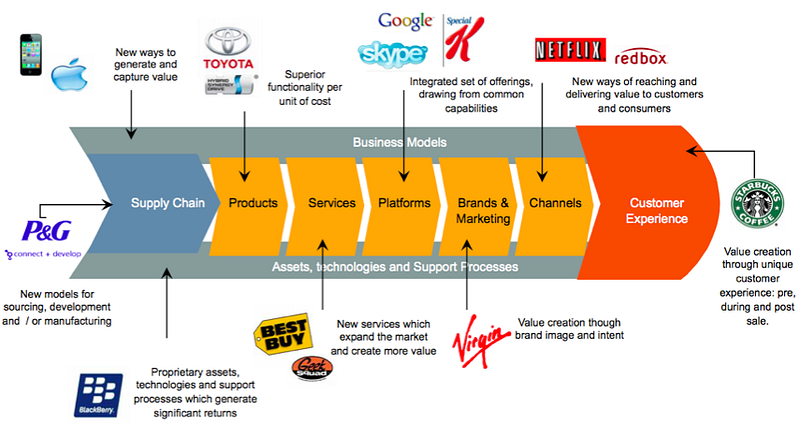
Innovation brand spectrum

The Romijn and Albaladejo (2000) audit questionnaire, to gauge the ability of an organization's innovation capabilities with respect to internal and external inputs, ties into Brand positioning as an indicator.

Whereas innovation indication levers are recognizable from the consumer's perspective like user-experience (UX) for example, demonstrated by Ryanair's’ digital overhaul undertaken in 2014.

Digital innovation positions an organization to accurately measure external forces and pivot internal forces accordingly by leveraging real-time data captured through website performance analytics and traffic, revealing indicator insights into consumer engagement.
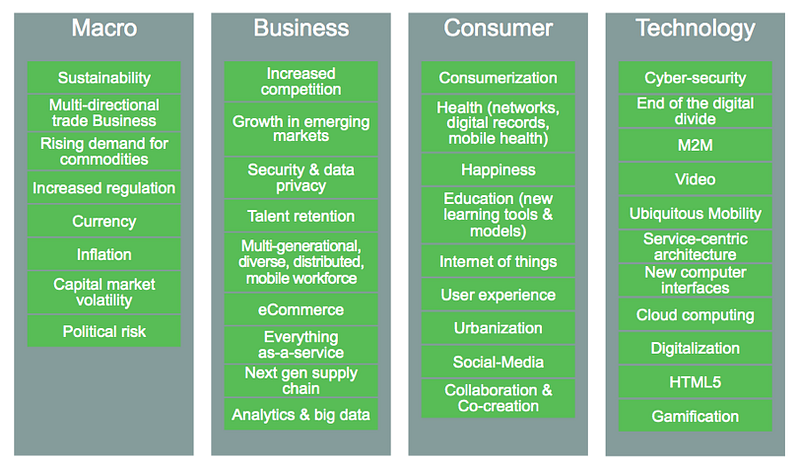
Innovation Indication Levers

Mairesse and Mohnen (2007) capture a range of innovation activities as indicators. Inputs like R&D expenditure, patent acquisition, product design, and investment in human capital through training and development.

Also, output indicators include organizational change or business transformation and marketing innovations, measured in part by new product sales or market share and the percentage of sales from existing and new products.

Final Thoughts

Innovation audit programs and indicators can improve innovative evolution, in terms of new products, processes, services, business models, marketing or new technologies.

From a business perspective, innovation should be evaluated by the impact it has on performance, like reduced costs, social impact, or revenue growth.

One problem is that many of the effects on performance are only evaluated post-implementation. The solution is to deploy data analytics from the outset.

The Lean Startup model in one strategy whereby Build-Measure-Learn iterations ensure regular feedback occurs at a low cost.

The fact is innovation is not a singular process, nor is it a stand-alone pillar, it requires connection across an array of indicators and business verticals to map the steps that innovators must navigate.

There is no one framework or approach to measuring innovation that fits every company or sector, as metrics can vary. That said, the methods described above offer a great starting point to create the world of tomorrow.

References

Aarikka-Stenroos, L., and Sandberg, B. (2012). From new product development to commercialization through networks. Journal of Business Research, 65(2), pp.198–206.

Armstrong, J. (2016). Guest Article by Reuben May “The Man behind Ryanair's Digital Marketing Transformation. [online] Irishtechnews.net. Available at: http://irishtechnews.net [Accessed 4 Feb. 2016].

Baumol, W. (1990). Entrepreneurship: Productive, Unproductive, and Destructive. Journal of Political Economy, 98 (5, Part 1), pp.893–921.

Burn-Callander, R. (2014). Ryanair’s Michael O’Leary: ‘I was wrong; the customer is always right’. [online] Telegraph.co.uk. Available at: http://www.telegraph.co.uk [Accessed 4 Feb. 2018].

Department of Jobs, Enterprise, and Innovation, (2014). National Policy Statement on Entrepreneurship in Ireland. Dublin.

McCraw, T. (2007). Prophet of innovation. Cambridge, Mass.: Belknap Press of Harvard University.

O’Reilly, B. (2014). I’ve always been warm and cuddly“ Michael O’Leary on Ryanairs image — Independent.ie. [online] Independent.ie. Available at: http://www.independent.ie [Accessed 4 Feb. 2017].

Taylor, C. (2015). Ryanair shares at an all-time high after airline raises full-year guidance. [online] The Irish Times. Available at: http://www.irishtimes.com [Accessed 4 Feb. 2018].

Thiel, P., and Masters, B. (2015). Zero to one. London: Virgin Books. pp.59–62

Tidd, J., and Bessant, J. (2013). Managing innovation. 5th ed. Chichester: Wiley.

Innovation
Business
Inspiration
Future
Creativity
Recommended from ReadMedium