Managing and Communicating Innovation in a Startup
Capturing, nurturing and executing innovation is the lifeblood of fledgling businesses.

The Achilles of innovation in a Startup heel is evident through internal and external communication. This is an obstacle that, if left unattended, could impede growth and arrest the ability to implement an effective innovation strategy.
“Innovation — any new idea — by definition will not be accepted at first. It takes repeated attempts, endless demonstrations, and monotonous rehearsals before innovation can be accepted and internalized by an organization. This requires courageous patience.”
— Warren Bennis
Communication is what Bennis alluded to. “Repeated” communication in order for a new idea to be “accepted”.
This article will discuss an innovation think-tank conducted by the Author with an online retail business last year. In the end, a communication model was recommended with a two-fold benefit.
The model aimed to devised a culture that:
- Empowered all employees and business partners to participate in the organization's future, and
- Facilitate stakeholders to communicate, record, manage, maintain and monitor the progress and development for every idea
Ideation
The concept became known as the ‘Business Ideas Bank’ (BIB).
The mechanics of BIB follows a simple three-stage process. Each step along the value chain moves along a funnel (see below) to capture every idea (A) at conception. Qualify those deemed worthy (B) and appropriate ideas (within budget) eventually make it to the final stage (C).
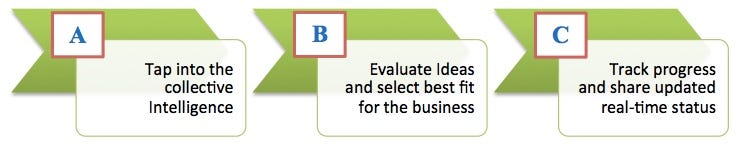
Also, ideas are evaluated (B) in a peer-to-peer fashion whereby a minimum of 3 approvals/votes, from a panel of 5 participants decide the fate of that idea to ensure unbiased transparency.
To facilitate the immediate execution of BIB, existing tools like MS Excel and MS Access were used to build the initial database during its infancy.
Soon the BIB database will migrate into a cloud-based tool to improve the value and accessibility of BIB by extending it beyond its original audience i.e. including supply-chain partners and indeed customers.
By tapping into the collective-knowledge the impact could be exponential.
“Some manufacturers let their customers develop and produce by handing over customer support to enthusiastic users. It’s called crowdsourcing and involves getting users to help solve corporate tasks and problems.” (Beckmann 2013).
In fact, Apple’s App concept is based on crowdsourcing, adding huge value to the company in the last decade.
Knowledge Transfer
The innovative competency in this online retail business was evident from the outset. The next phase was to transfer proven ability and channel this into other aspects of the business to achieve similar progress.
During a focus group gathering, a number of projects were identified as ‘low-lying fruit’ opportunities.
The ideas that emerged during this exercise are summarised as follows:
- Book Rental (Used books)
- Online educational tutorials/grinds
- WhatsApp Group sharing to make it easy for other customers to order (this enhanced a business KPI — Conversion)
- eBooks
- Communication App for Parents
On the surface, these ideas are not particularly ground-breaking, which is true, but from a domestic niche market perspective, the potential value is quite valid.
The online market in Ireland has in the region of 8–10 players in the education sector, all of whom compete directly with one another selling the same product and service, more or less.
From the company’s perspective, there is little in terms of differentiation. While the Brand has proven customer loyalty with a fulfilment capacity advantage over competitors, it does not translate into added-value for the consumer.
To equalize this imbalance the company devised a way to harness their operational prowess and convert this into added-value for the customers.
Competitive success depends on transforming key processes into strategic capabilities to deliver superior value to the customer
Analysis
A PESTLE analysis highlighted prominent factors that can impact the market going forward. Political, economic and technological changes will create challenges, increase risk but also present opportunities.
The book rental scheme, for example, a government-funded scheme, is a threat to online schoolbook companies. The opportunity, however, is that by innovating a rental or second-hand schoolbooks service the organization can extract high value.
This is a “blue ocean” in the online school books market in Ireland. Other benefits include customer retention (voucher credit), customer savings plus higher margins for the client (Kim et al, 2015).
The second-hand schoolbooks idea arose from the refinement model below, formulated around the school books business. This model marries the existing Internal Processes along with Blue Ocean as the primary innovation seeds, driven by culture, ecosystem plus research and development (Kim et al, 2015).
Innovation flow
Strategic initiatives and new opportunities align all drivers progressively. This alignment became obvious when the possibility of a book rental initiative (second-hand books) emerged.
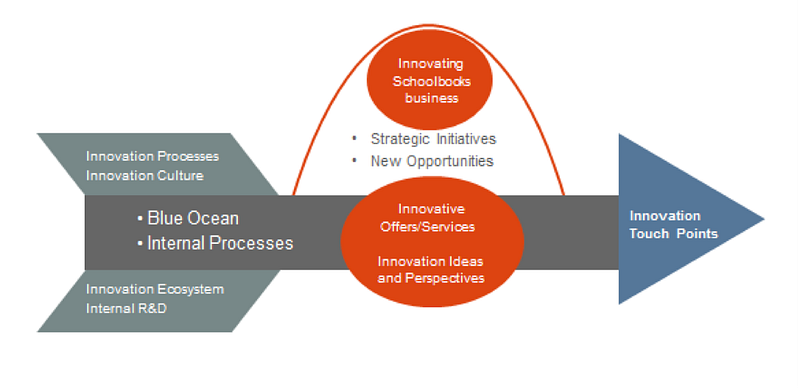
At the core of this model, a more detailed Business (6-phase) Process (B6P) was proposed. Designed to evaluate the critical path embedded in the Business Ideas Bank (BIB) discussed above.
The first phase is crucial in establishing the ‘Why’ by identifying unmet or unarticulated customer needs that complement the organizations' competencies. Further refinement through the Growth Platform and Venture Development stages assist an ideas’ potential. `
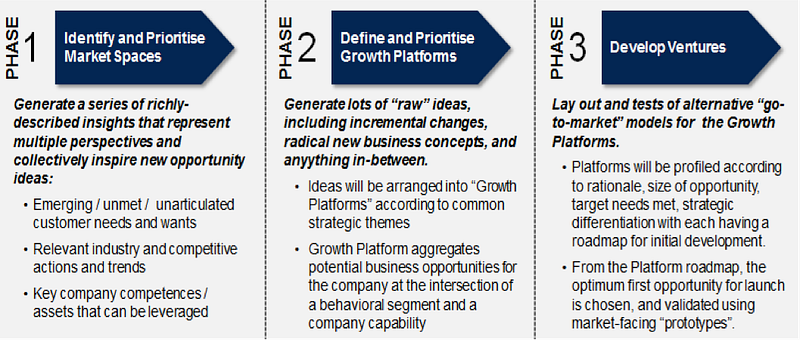
6-phase Innovation Process (B6P) by the Author — 1 to 3The latter stages are more fluent because at this point the concept has met the final stage of BIB and gathered momentum.
Following that, a general target market (GTM) was defined and Business Planning outlined at which point additional resources are allocated to ensure successful implementation.

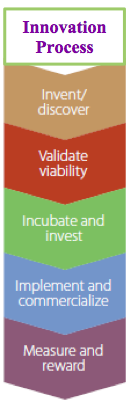
Both the BIB and B6P models reflect the traditional Innovation process. As illustrated above, the innovation process designed for this online retail business is segmented by phase. In order to navigate from one phase to the next, each idea has to pass certain filtration criteria. Each filter opens a decision gateway which it must pass in order to be resourced.
Ideas don’t have to be something radical, they may simply involve applying an idea which has been tried in one area or another or in another company for whom the concept is new — innovation is relative.
Also, ideas must be put into action. Innovation is more than just a good idea; it is a good idea that is brought to fruition — which is often the most difficult challenge. If a new idea doesn’t generate a successful outcome, then it doesn’t qualify as innovation. But the path to innovation success will always be littered with failures — these are learning opportunities but will likely contribute valuable IP as well.
Stealing old or copying and refining existing ideas is innovation with a vision, not everybody sees the same potential in certain products or services. Apple applied this model and turned dormant ideas, like GUI (User Interface) and the mouse (from the obscurity of the Xerox PARC lab), leveraging commercial value from both — value-add innovation.
Innovative Culture
Innovators have to be open-minded. They have to imagine things that others cannot while challenging their own preconceptions. They must also have discipline and persistence to see their ideas through to fruition.
Innovators must, therefore, be disagreeable and willing to take risks, social risks, to the disapproval of their peers. This is not easy. All human beings are hardwired to seek social approval but society frowns upon such disagreeables, which is logical given that society is largely based on conformance. But radical and transformational thought cannot advance without those who are willing to challenge convention.
Psychologist, Jordan Peterson, proposed that innovators are revolutionaries. He argued that:
“if you worry about hurting other people’s feelings and disturbing the social structure, you’re not going to put your ideas forward” — Jordan Peterson
Playwright, George Bernard Shaw, profoundly put it:
“The reasonable man adapts himself to the world: the unreasonable one persists in trying to adapt the world to himself. Therefore all progress depends on the unreasonable man” — George Bernard Shaw
Contrastingly companies make rules and reduce risk whereas creative innovators break rules and take risks. When Thomas Edison’s’ assistant asked him “what are the rules around here?” Edison responded:
“Hell, there are no rules here — we’re trying to accomplish something” — Thomas Edison
This quote from the foremost inventor of his generation resonates with the essence of Innovation. From a cultural perspective, however, with respect to organizations, this conflict represents a huge challenge. That said it is vital that organizations find a way to merge corporate necessities with an innovative ethos. Apple achieved it and proved how valuable it can be.
Businesses must take risks. They must innovate more to stay ahead of the curve. Be unbound by risk-averse rules.
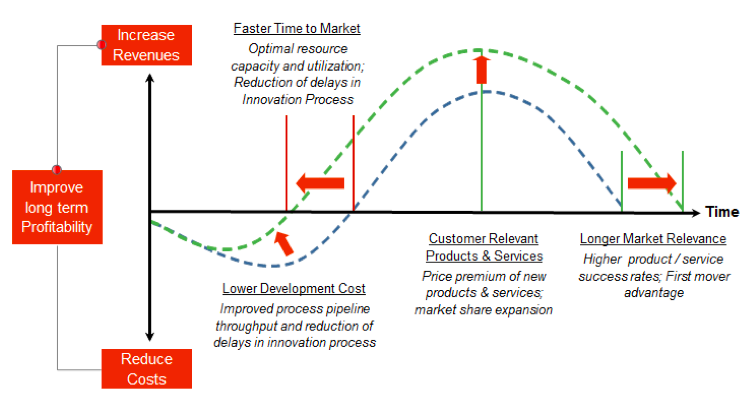
To begin with, the company has listed key performance indicators which it intends to nurture at a cultural level:
Improve long term profitability
- Reduce costs
- Increase revenues
Innovation
- Faster time to market
- Lower development costs
- Customer relevant products and services
- Extended market relevance
A fragmented culture is more common in the age of remote working. Although this type of culture is low in solidarity and sociability, “the freedom given to individuals in these cultures can generate substantial benefits” (Goffee et al 2006).
The autonomous feature promotes creativity. But there are risks, like the abuse of freedom, “even simple attempts to cooperate — meetings, for example — can be undermined by too many individuals driven by their own agenda” (Goffee et al 2006).
That said future generations will work in this fragmented fashion, an innovative approach in its own right rising rapidly today.
The biggest opportunity for companies is to redefine marketplaces, market boundaries. Cultural innovation, implementation, and blue ocean execution foster creative destruction (Kim et al, 2015).
While employees are not discouraged, they are not actively encouraged to innovate, at least not consistently. To realize business goals set out above a company-wide effort was proposed. A culture in which the Human Capital energy is harnessed dynamically to challenge convention at every opportunity.
Final thoughts
To increase innovation capacity, exploit market trends whilst taking advantage of emerging technologies innovation must be entrenched at a cultural level, first and foremost.
“If every organization started with WHY, decisions would be simpler. Loyalties would be greater. Trust would be a common currency. If our leaders were diligent about starting with WHY, optimism would reign and innovation would thrive” (Sinek, 2011).
Below are four takeaways to enhance innovation capacity.
1. Strategy
A collective strategy reinvention can re-energize organizational cultures. Big companies that behave like small start-ups benefit in two ways:
- Accelerate innovation, similar to an incubator-style model
- Grow internal businesses by building teams with an outside-in approach, a sort of reality-check typical in advisory boards, angel investors or VC’s
By creating incubation teams with innovation champions, a cluster of groups can thrive interdependently.
2. Projects
Projects should be conceived from the consumers’ perspective. To gauge how things are working, or indeed not, Startups must step into the real world, and often.
‘Knowing thy customer’ should be the first commandment.
A realtime submersion offers practical insights that might otherwise take months and unnecessary failures through traditional research.
A consumer-driven vertical integration approach (like BIB) is invaluable in understanding a market, this is itself innovative.
Insular thinking is the death knell for a team or an organisation.
Sometimes problems and opportunities just need a jolt from external insight.
3. Culture
Steve Jobs once said: “stay young, stay foolish” which translates into — have fun no matter what you do. Work is supposed to be fun, not endured. A passionate workforce will outperform that of another lacking this key ingredient.
“Here’s To The Crazy Ones. The misfits. The rebels. The trouble-makers. The round pegs in the square holes. The ones who see things differently. They’re not fond of rules, and they have no respect for the status-quo. You can quote them, disagree with them, glorify, or vilify them. About the only thing you can’t do is ignore them. Because they change things. They push the human race forward. And while some may see them as the crazy ones, we see genius. Because the people who are crazy enough to think they can change the world — are the ones who do!” — Apple Computers
A culture abundant in recognition, promoting self-actualization is rewarding for everyone involved. Simply being part of it is a reward in its own right.
It's important to have fun — organize random events, off-site meals, workshops, think-tanks to push the boundaries through relationship.
4. Leadership
Innovative leadership plays a key role, as discussed in the article below:
There is an emergence of a new leadership style — Anticipatory leadership. A style of leadership incubated within the Ecommerce and Digital industries. The tipping point was most likely ignited by the global financial collapse, after which future leaders chose to “leave the relative security of their established early market and go out in search of a new home” (Moore, 1999).
Conclusion
The next chapter for any business is unwritten. Its destiny is truly in its own hands as it navigates unchartered territory. With the right focus, mindset, and people a Startup can revolutionize industries.
“Do not be conformed to this world, but be transformed by the renewal of your mind” — The Bible, Romans 12:2
The key ingredient of innovation is to dispel fear:
“Our deepest fear is not that we are inadequate, our deepest fear is that we are powerful beyond measure. It is our light, not our darkness that most frightens us” (Williamson 1992).
By unshackling the chains of fear the human spirit can achieve the impossible.
References
- George Friedman (2010) “The next 100 years — A forecast for the 21st Century”. Allison & Busby; POLS edition (p. 325–350).
- Malcolm Gladwell (2013) “David and Goliath”. Allen Lane (p.1–50)
- Kim, W. C., & Mauborgne, R. (2015). Blue ocean strategy: how to create uncontested market space and make the competition irrelevant. Expanded edition. Boston, Massachusetts: Harvard Business Review Press.
- Nonaka, I. and Takeuchi, H. (1995). The knowledge-creating company. Oxford: Oxford University Press.
- Michael Porter (2008) “The Five Competitive Forces That Shape Strategy”, Harvard Business Review (January) (pp. 79–93)
- Michael Porter (2008) “Five Forces”, Harvard Business Review (February) (pp. 2–8)
- Simon Sinek (2011), Start With Why: How Great Leaders Inspire Everyone To Take Action. Penguin
- Tidd, J. and Bessant J. (2009). Managing innovation: integrating technological, market and organizational change. (4th edn). Hoboken: John Wiley & Sons.
- Marianne Williamson (1992), A Return To Love: Reflections on the Principles of A Course in Miracles, Harper Collins, 1992. Chapter 7, Section 3 (Pg. 190–191).