
Infula
The Spelling Bee acted all high and mighty by rejecting this word

Today’s New York Times Spelling Bee letters:
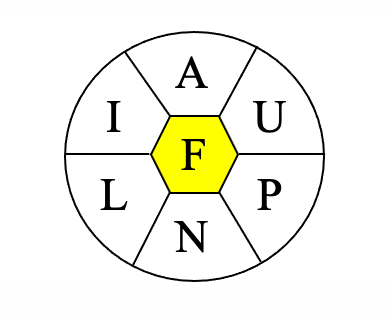
A, I, L, N, P, U, and center F (all words must include F)
Merriam-Webster says…
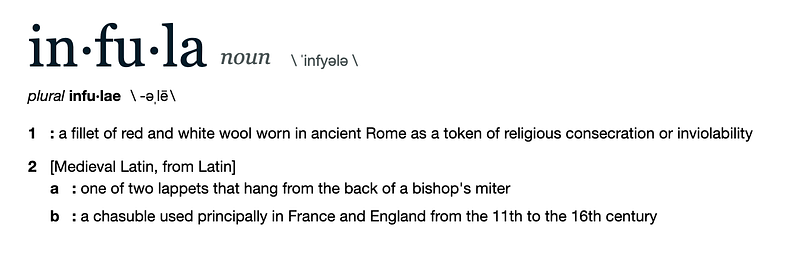
Silly little dictionary! Don’t you know that infula can’t possibly be a word if the New York Times says it ain’t?
For further fascinating facts, check out the Spelling Bee Master.
What’s your favorite dord* from today’s puzzle?
My Two Cents
First things first: UNPAINFUL is a word, Spelling Bee editors!!! It. Is. A Word. And it’s not a new word, either; according to our faithful friends at Merriam-Webster, it’s been in use since the 15th century.

It’s also a pangram (word with all seven letters of the puzzle), which means you not only decided this word was a dord*, but you wiped out 16 points, too.
Anyway, just wanted to do a quickie-rant.
Now that I’m done with that, I have a question for the dictionary people: how is unflap (verb) not a word?

Now, flap is a word (both as a noun and a verb), and if you add suffixes to unflap you get valid words: unflapped, unflappable (both adjectives), and unflappably (adverb).
Yet unflap… denied!
I don’t get it. If you can flap something or someone, why can’t you unflap them. And if you can be unflappable, don’t you have to unflap yourself to be so?
Michael J. Fox made a good point about this grammatical anomaly when he made a guest appearance as Dr. Kevin Casey on the TV show Scrubs.
J.D.: You are unflappable! Dr. Casey: It’s true. I can’t be flapped.
Okey-doke, done with the rants and existential grammar questions. On to our daily dord*…
In English
Today is just one of those days when you run into all sorts of trouble with words. Merriam- Webster has this to say about the origin of infula: “Latin; perhaps akin to Latin redimire to tie, wreathe, geminus twin”.
This didn’t jibe with my Spanish.
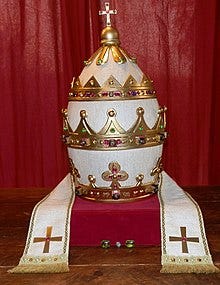
Well, okay, the twin thing makes sense in regard to the second definition of a pair of lappets hanging from a bishop’s miter. And, since a picture’s worth a thousand words (or about half a dogecoin), this one might help explain the previous sentence:
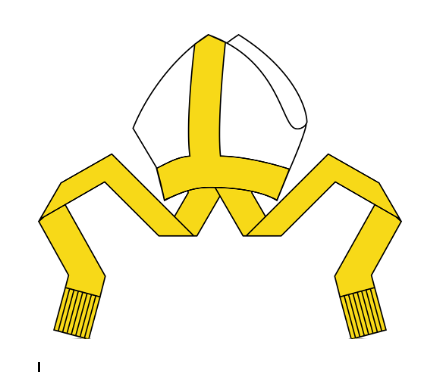
The white part with the decorative gold is the miter, a traditional, ceremonial headdress of bishops and certain abbots in traditional Christianity. They are still in use by several denominations, among them the Catholic, Anglican and Orthodox communities.
The gold-colored flaps on either side are the lappets, also known as the infulae. Hmmm… if we remove them, wouldn’t we unflap the miter, then? Unflap! Unflap! It needs to become a word!
And that tiny mark on the bottom left? It’s a computer cursor, frozen in space and time as the screenshot was taken. I really need to have a talk with Iva Reztok about the quality of the work being delivered.
Infulae are not only used as religious gear and are older than the Christianity. Lappets were a common feature of women’s headgear until the early twentieth century, and were featured on the nemes headdress of the kings of ancient Egypt.
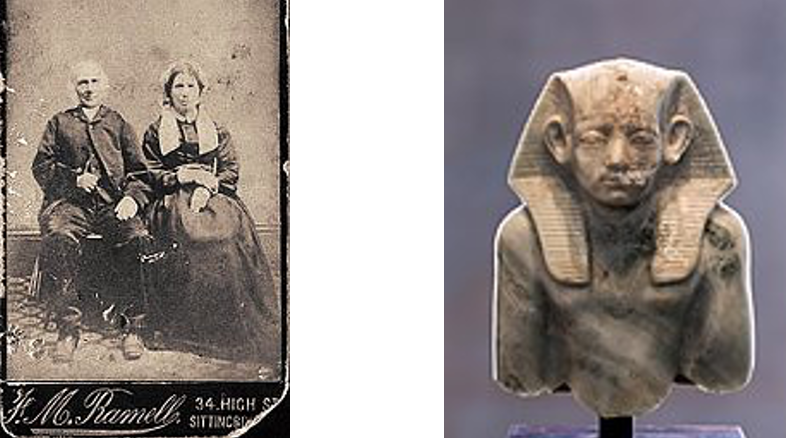
As you can see, there’s no computer cursor in the above screenshot. Docking Iva Reztok’s salary worked.
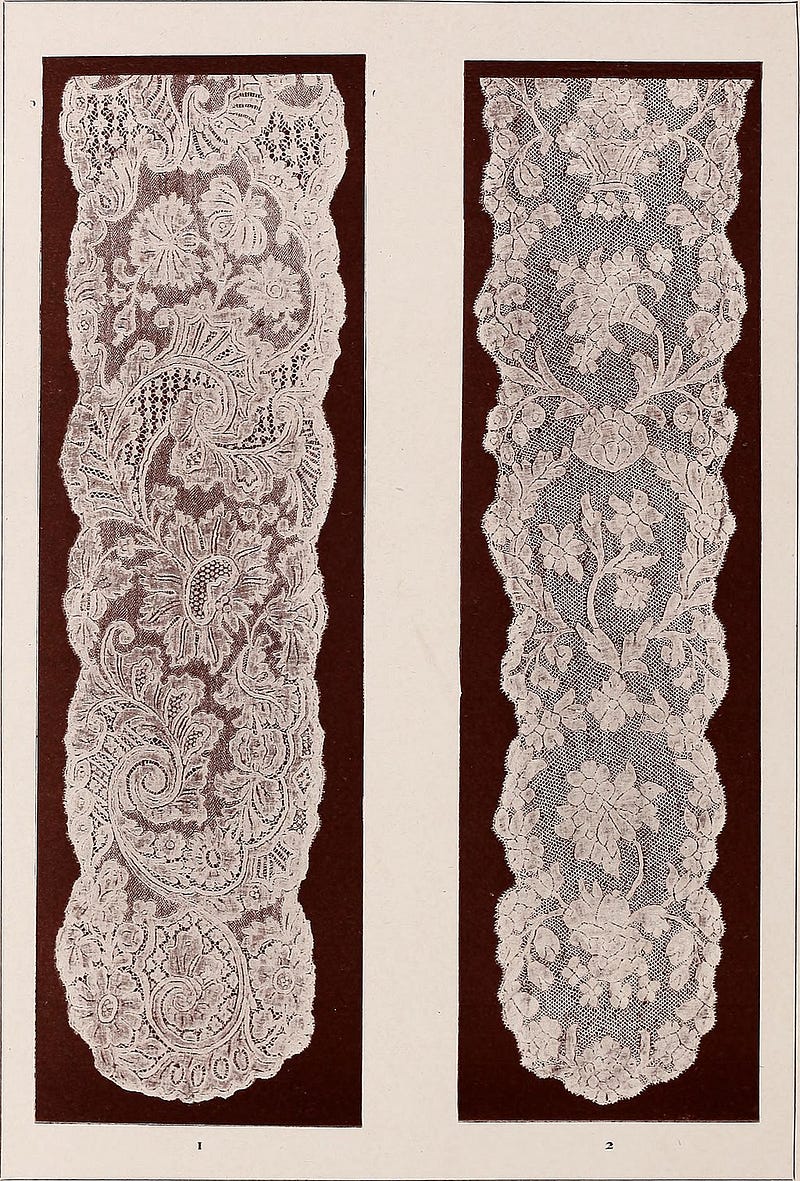
Here is a picture of a pair of 18th-century lace lappets, just because I happened to think they are pretty:
In the animal kingdom, lappet is a term that also refers to certain anatomical features that resemble… well, lappets! Also known more commonly as wattles. Although in that case, infula does not apply as a synonym. You’ve been formally warned, so don’t blame me if you say, “that rooster has a nice pair of infulae” and someone thinks you’re a perv.
The papal tiara, which hasn’t been used by popes since Paul VI’s coronation in 1963, also has traditionally incorporated infulae. Like the ones on the bishop miters, their origins are unclear, although possibly inspired by them. One theory holds that they symbolize the catechism of the Church, which is based on both the Old Testament and the New Testament. Another one posits that they represent the Sacred Tradition and the Bible.
A practical explanation for the papal infulae claims they were added to the tiaras as a form of sweatband that include an inner cloth to prevent popes from sweating too heavily during ceremonies in those hot Roman summers.
Here is the papal tiara of John XXII, an Avignon Pope who was head of the Catholic Church from 7 August 1316 until his death in 1334.
Now, as I mentioned earlier, Merriam-Webster’s explanation of the origin of infula made my Spidey sense tingle. So I looked it up in other English dictionaries and also in the official Spanish-language one, previously known as Diccionario de la Real Academia Española (Dictionary of the Royal Spanish Academy), or DRAE.
Which brings me to…
En español
The Spanish dictionary tells us that ínfula comes from the Latin infŭla, and dictionary.com seems to support that, explaining that the word comes from the Medieval Latin, in turn from Latin, meaning “band, priest’s headband”. So two against one as far as that origin is concerned.
That makes more sense to me, considering Spanish is a Romance language evolved from the Vulgar Latin, or commonly spoken Latin that was used starting in the Late Roman Republic. Other languages in that Romance — or Neo-Latin — family are Italian, Portuguese, French, Catalan, and, believe or not, Romanian.
Not part of the Romance languages: English.
Yes, I know Merriam-Webster claims the origin of infula is Latin, but the etymological root they offer is redimire (to tie, wreathe), from geminus (twin). I just don’t see it, though. Logic would indicate the Latin infula as a more likely and direct influence.
But as the most recent pandemic has proved, logic is not always logical. Especially when it comes to human beings. And since Merriam-Webster has a feature allowing you to write to them about possible mistakes, I plan to inquire about infula and their version of the story. If I hear back, I will update you, my dear reader.
Now, here’s an interesting tidbit for those who don’t speak Spanish, or even those who do but may not have a native grasp of the language. The word ínfula (usually used in the plural form ínfulas) means “vanidad pretenciosa” or, literally, “pretentious vanity”.
When one is acting with ínfula, one is putting on airs, a false front. Acting all high and mighty. That’s how today’s story arc swings back to the subtitle of this article. And, so you don’t have to scroll back up, here is that subtitle: “The Spelling Bee acted all high and mighty by rejecting this word”. (Cue the aha! moment, and I take a bow.)
Why that homonymic meaning? I’m not sure, but perhaps it has to do with the fancy headgear, maybe even going back as far as the Egyptian pharaohs, who usually acted all high and mighty.
What I am sure of is that despite the widespread and historic use of the infula, the editors of the Spelling Bee decided that this word is a dord.*
You can check out my previous entry on another dord* here:
*What the heck is a dord, you ask? Here’s the answer: