
Guan
Look! It’s a bird! It’s an instrument! It’s a dord!
Today’s New York Times Spelling Bee letters:
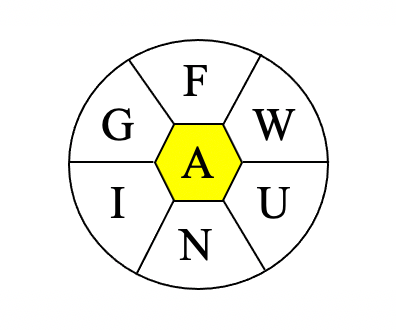
F, G, I, N, U, W, and center A (all words must include A).
Merriam-Webster says…
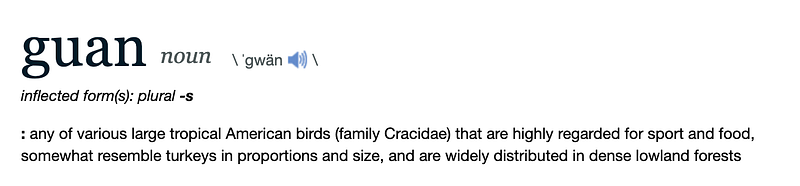
Silly little dictionary! Don’t you know that guan can’t possibly be a word if the New York Times says it ain’t?
For further fascinating facts, check out the Spelling Bee Master.
What’s your favorite dord* from today’s puzzle?
My Two Cents
The word guan has several meanings, although the dictionary shows us only one. With a capital G it can refer to an ancient city-state in central China, now present-day Henan. Or the name of three different counties in modern-day China. Also, and sometimes romanized as Kwan or Kuan, Guan is a common Chinese surname, number 394 in the Hundred Family Surnames list.
Guan with an uppercase G is also the name of an ethnic group believed to be the first settlers in what is today Ghana.
All of the above would obviously be rejected by the Spelling Bee game because the rules of the game clearly state that proper nouns are not included. Which makes sense; if they were, the list of words each game would go on forever.
But there are two meanings of the word guan with a lowercase “g”, which was not included in today’s list of accepted words.
No pit stop for this Penelope
Penelope and Penelopina are two subfamilies in the family Cracidae, which includes chacalacas, guans, and curassows. The latter should not be confused with Curacao.
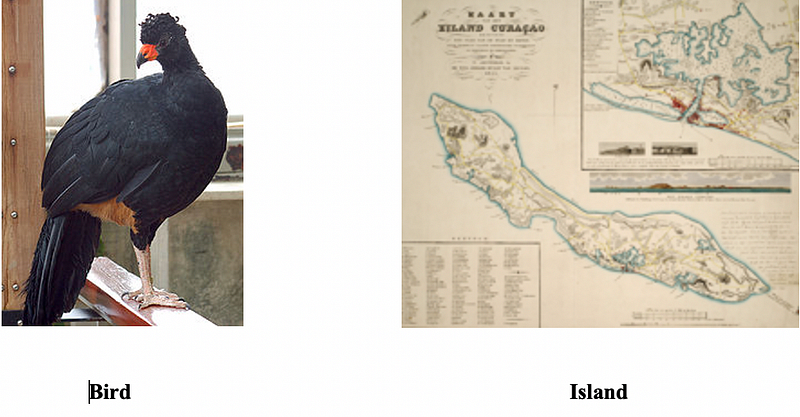
Guans are distributed mostly across the southern parts of Central America, the northern portion of South America, and a few Caribbean islands. But I’m not sure if you can find a guan in Curacao. Or a curassow, for that matter.
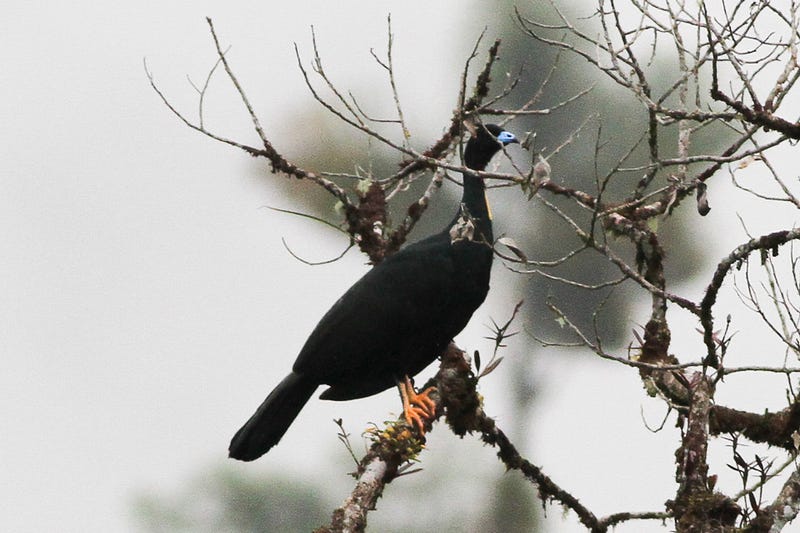
The photo at the very top of today’s article shows the wattled guan, distinguished by the reddish-yellow or yellowish-red wattle dangling from its throat. Although, to be fair, the photo I used does not show it very clearly. It looks like someone just drew a thin line in yellow highlighter right where the neck and chest meet. Here’s a better view:
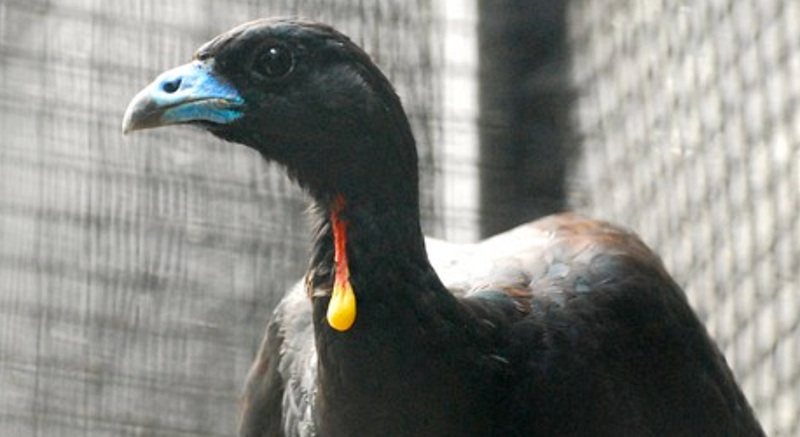
You would be making that face, too, if you had a yellow bugger dangling from your throat all day.
Or perhaps that face has nothing to do with the goober. Look, here is the black guan:
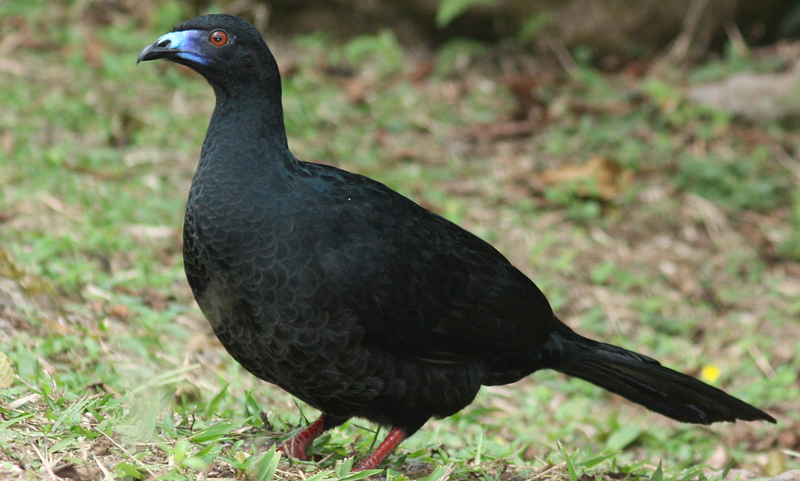
No wattle, but this guan still seems upset.
Guans tend to be rather big birds, and a lot of the species live in Venezuela, where I grew up. To be honest, though, I hadn’t heard about most of them until I started doing my research today. But the guans have inspired many an artist to paint their portraits, which are actually quite pretty:
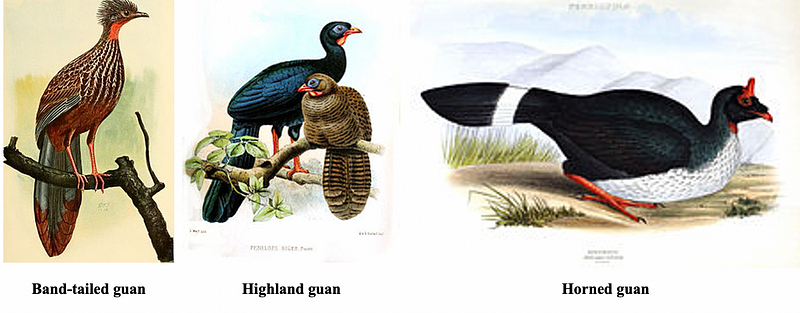
The one on the right, Mr. Horny Guan, is a faker, though. He’s not a true guan, he just plays one on TV. This species (Oreophasis derbianus), evolved completely independently from the other subfamilies. In other words, it belongs to the same family (Cracidae) but a different subfamily (Oreophasinae).
As an FYI, the highland guan art shows a male (blue-black) and female (brown).
Double the pleasure
The other guan is described as a double-reed wind instrument typically made from bamboo or hardwood.
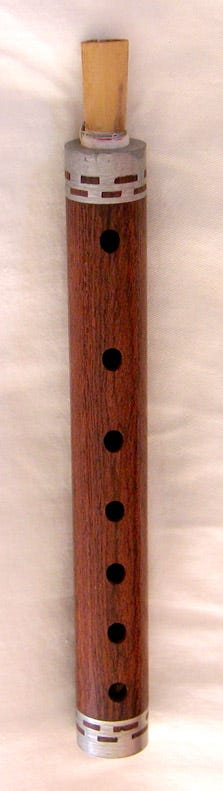
Now, the Western double-reed oboe, for example, has a conical bore, or interior chamber. The guan’s insides are cylindrical, which produces a more mellow tone. Its melodic qualities vary according to the region where it is crafted.
In southern China, in the Guandong region, the instrument is made from bamboo and is known as the houguan (“throat guan”). It was used mostly in popular music, but about one hundred years ago it was incorporated into the Cantonese opera orchestra, and now comes in three sizes.
In northern China, the guan is made of hardwood and requires a harder double reed. But it has one big advantage over its southern bamboo counterpart: it can be overblown, which allows the player to get a range of two and one-half octaves, as opposed to the one octave the houguan gives.
Overblowing is a technique by which a wind instrument player manipulates the instrument in a way that allows the sound to jump to a higher pitch or octave. This can be done by blowing harder, for example, or by changing the way the player uses their lips, tongue, teeth, and throat.
Now, according to Wikipedia:
“In the 20th century, modern versions of the guan were developed in China. These modernized guan, which may be as long as a Western clarinet, have more tone and key holes and are fitted with metal keys to provide a wider and fully chromatic range. Such instruments are used primarily in large Chinese orchestras. These modern keyed “guanzi” are typically used for tenor and baritone ranges respectively.”
In other words, this musical instrument that may have started as a way for street vendors to call attention to themselves has certainly come a long way.
And yet, despite that achievement, and despite also being a bird both surly and beautiful, the editors of the Spelling Bee decided that the word guan is a dord.*
You can check out my previous entry on another dord* here:
*What the heck is a dord, you ask? Here’s the answer: