
Dequeen
How debees dethrone deruler of dehive
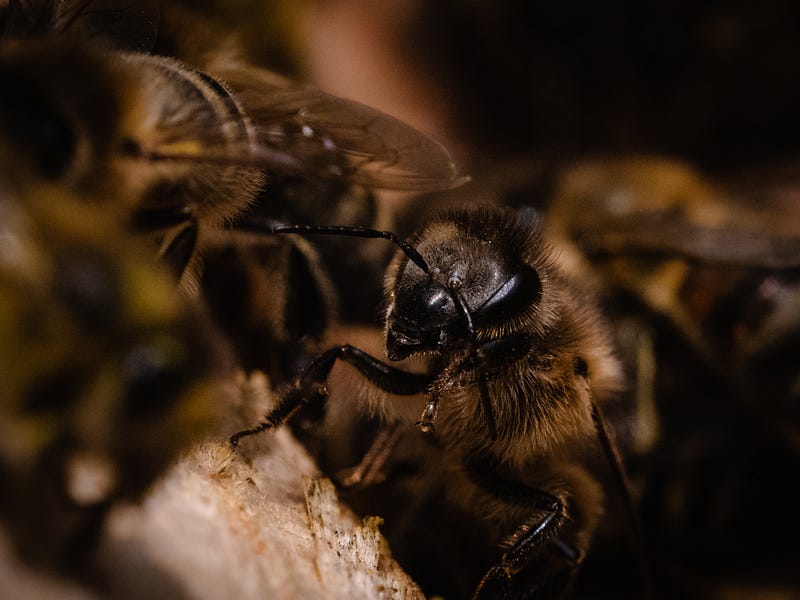
Today’s New York Times Spelling Bee letters:

A, D, E, L, Q, U, and center N (all words must include N).
Merriam-Webster says…

Silly little dictionary! Don’t you know that dequeen can’t possibly be a word if the New York Times says it ain’t?
For further fascinating facts, check out the Spelling Bee Master.
What’s your favorite dord* from today’s puzzle?
My Two Cents
I confess I’m slightly proud of myself today for finding the word dequeen on my own while playing the game. It’s not even on the list of rejected words provided by my trusty Spelling Bee Master page. But it’s a word! At least according to Merriam-Webster, which is good enough for me.
Apiphobia
Arachnophobia is the fear of spiders, a term that became popular in 1990 after the mediocre film by the same name came out. Produced by Spielberg and directed by Frank Marshall (in his debut at the helm), the first scenes were filmed in the jungles of Venezuela.
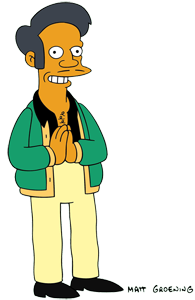
Apiphobia is the fear of bees. Not to be confused with apuphobia, the fear of a now-controversial Simpsons character.
Between the ages of eight and well into my late teens, I was terrified of bees. I couldn’t see one hovering around without panicking. There were two big reasons for that. One was getting stung by a bee in a swimming pool, of all places. The bee was floating in the pool, still alive, when a kid actually splashed the water towards me, intending to hit me with the bee. Well, he succeeded. I was by the pool edge and the pissed-off bee landed on my knee, stinging me.
It was a horrible experience both because of the sting itself and because I realized other people could be really crappy and get away with it. But I did get a grape-flavored popsicle out of it.
The other cause of my apiphobia was this:
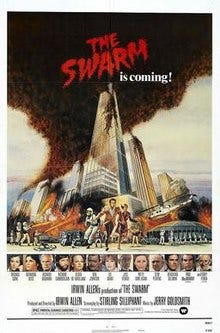
Irwin Allen, well-known for making popular disaster-horror flicks featuring star-studded casts in the 1970s. The Poseidon Adventure and The Towering Inferno came before the movie in the poster, 1978’s The Swarm, about killer bees that terrorize an entire city in Texas.
I don’t know if it was that year or the next (I would have been around eight years old), but my family was staying at the beach in an apartment that belonged to my dad’s friend. The place screened movies outdoors at night, right beside the sea. So one evening my parents decided to take me and my younger brother to enjoy a film. They had no idea what was being shown.
It was The Swarm.
The movie starts with two helicopters — yes, helicopters !— being knocked down by bees. Yes, bees! A huge, thick swarm, but still. The scene right after that involved a family at a picnic getting murdered by (presumably) the same bees. In my young, naive eyes, the scene was gruesome. The teenage son manages to escape and reach the town.
My parents weren’t quick enough to react, so it took until that second sequence for them to decide that perhaps my brother and I were too young to watch these horrible things. We left despite my dad’s protests. I think he wanted to stay and watch it, probably because the movie included actors like Michael Caine, Richard Widmark, Richard Chamberlain, Olivia de Havilland, Ben Johnson, Lee Grant, José Ferrer, Patty Duke, Slim Pickens, and Henry Fonda.
Despite that, the movie was a box-office flop and currently holds a 10% score on Rotten Tomatoes. Horrible things happen in that film. Kids die. Nuclear power plants are destroyed. An entire town is wiped out.
But the trauma stuck. I was deathly terrified of bees for many, many years after that. I remember once I had a terrible nightmare in which we were watching the news and the anchor said the bees were coming to our city, Caracas. Seconds later a swarm arrived and covered the outside of our apartment window. Somehow they managed to open the window, which is when I woke up in a cold sweat. I was so scared, it took me all the courage I could muster just to cross the hallway to parent’s bedroom to feel safe again.
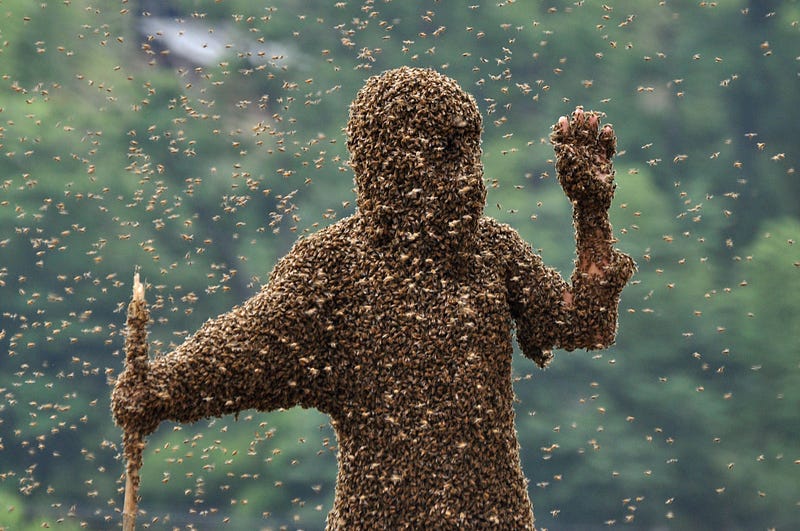
My phobia eventually disappeared, although I never got around to watching The Swarm in its entirety. Also, this still creeps me out:
Now, onto our daily dord.
The queen is dead; long live the queen
As most people may know, a beehive colony is made up of three types of bees:
- a queen bee, usually the only breeding female in the colony
- the worker bees, female, typically 30,000–50,000 in number
- a number of male drones
The worker bees and drones are all offspring of the queen which can live up to three years. (Yes, I can hear Her Majesty Elizabeth laughing out loud as she reads this.) Worker bees “create” a queen for their hive from a normal worker egg by feeding it royal jelly, a honeybee secretion equivalent to steroids in humans.
Once the queen develops and is crowned, she uses her powerful, steroid-infused pheromones to suppress the development of ovaries in all the female worker bees in the hive. This prevents them from laying eggs and condemns them to a regular 9-to-5 job at the hive with two weeks’ vacation and benefits.
But as the queen ages, her pheromone output diminishes. She may also lose her incredible fertility prowess of laying some 2,000 eggs a day. When the queen becomes old, sick, or unable to perform her duties, the worker bees, now free from her hypnotic pheromones, conspire to overthrow her.
This procedure, in which the worker bees dequeen their, um, queen, is known as “supersedure”.
In domestic or controlled beekeeping, the beekeeper can accelerate the dequeening process. One way to do it is by snipping one of the queen’s middle or rear legs. The queen then is unable to place her eggs at the bottom of the brood cell; the worker bees notice this and start looking for a replacement.
But they’re smart about the process. They won’t dequeen their current ruler without having a new one waiting in the wings. Now, when a new queen becomes available, the workers kill the reigning queen by “balling” her. That is not as dirty as it sounds… especially since bees don’t have testicles. Or do they?
What the worker bees do is throng around their ailing queen. This raises her body temperature; she fries and dies.
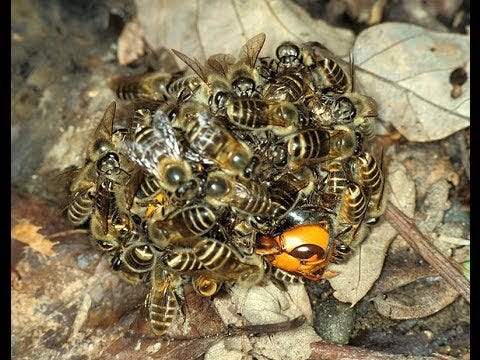
In cases where the queen dies unexpectedly, two things happen. (1) The worker bees get deprived of the sadistic pleasure of killing their matron, and (2) They are forced to create an “emergency queen” by selecting recently- emerged larva and smearing it with royal jelly. This works, but produces a much smaller and less fertile queen.
As you can see, dequeening is an important part of hive maintenance. Yet despite that, the editors of the Spelling Bee decided that the word dequeen is a dord.*
You can check out my previous entry on another dord* here:
*What the heck is a dord, you ask? Here’s the answer: