
Damiana
Just in time for the weekend… an aphrodisiac!
Today’s New York Times Spelling Bee letters:
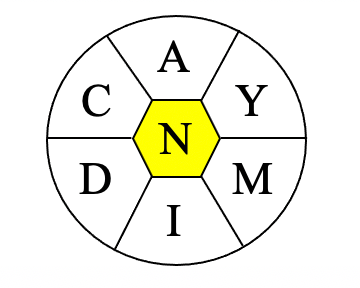
A, C, D, I, M, Y, and center N (all words must include N).
Merriam-Webster says…
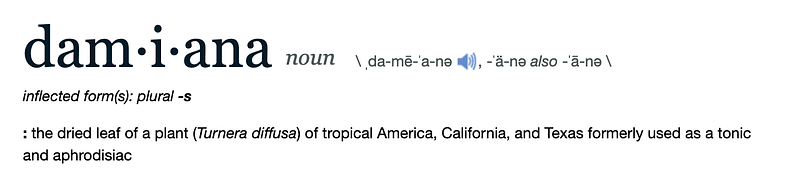
Silly little dictionary! Don’t you know that damiana can’t possibly be a word if the New York Times says it ain’t?
For further fascinating facts, check out the Spelling Bee Master.
What’s your favorite dord* from today’s puzzle?
My Two Cents
The turner diffusa, or damiana, belongs to the family Passifloraceae. And that family has hundreds of other species. Two, however, stand out. One is the passion fruit (passiflora edulis), known to many and loved by a handful. The other is the maypop (passiflora incarnata), known to Texans and Adrian Holman, who read my article about it last month.
Now, if you want to know why these plants have the name “passion” in them, be like Adrian and read my article about them.
Okay, okay, enough shameless self-promotion.
Let’s get on with some shameless snake-oil selling.
Oh, baby, you turn me on!
The fancy-pants scientific name for the damiana — turnera diffusa — may have come from honoring English natural historian and herbalist William Turner, and describing some characteristic of the plant related to being extended or extensive or spread out.
Yeah, it’s Friday afternoon and I’m not feeling too keen on research. So, here’s Wikipedia’s description:
“Damiana is a relatively small, woody shrub that produces small, aromatic flowers. It blossoms in early to late summer and is followed by fruits that taste similar to figs. The shrub is said to have a strong spice-like odor somewhat like chamomile, due to the essential oils present in the plant.”
According to traditional Mexican medicine, the damiana:
- has stimulating and aphrodisiac properties
- is a mild laxative
- acts as a tonic for the nervous system, like strychnine but without its toxicity
- stimulates urination, erection, and ejaculation
- can be used to cure male impotence and female frigidity, especially if they are due to psychological causes
- is a powerful antidepressant, depending on the dose
More about these miraculous properties in the next section, but I wanted to add that damiana is one of the ingredients of a Mexican liqueur:
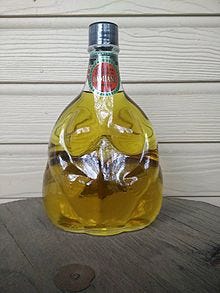
That liqueur is used to make margaritas in Los Cabos, Mexico. So… we have an aphrodisiac spirit. Great news for a Friday night!
Coca-Cola + wine + damiana = panacea
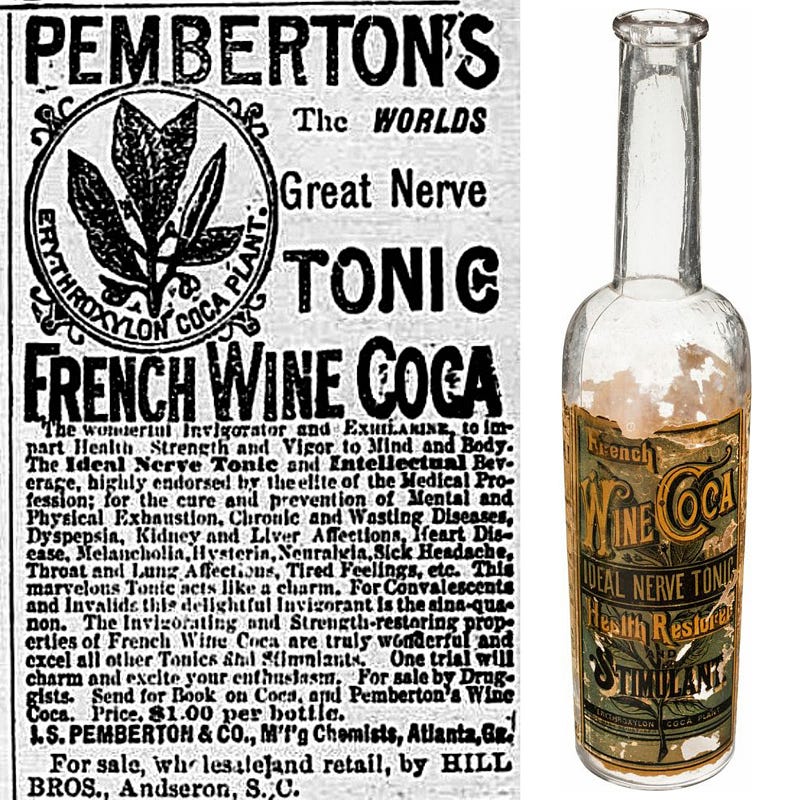
The above seems to be the formula for good mental and physical health. At least according to John Stith Pemberton, the inventor of Coca-Cola. He probably read my article and noticed all those health benefits of the damiana that I listed earlier.
And so in the late 1860s this morphine-addicted Civil War veteran druggist in Atlanta decided to take inspiration from the “Vin Mariani” (a Coke and wine combo invented in Paris a few years earlier) and added some kola nut and a sprinkle of damiana. He figured the cocaine and caffeine would help him snap out of his stupor and the damiana would assist him in getting laid.
Pemberton marketed this concoction as a patent medicine, a euphemism for snake oil, and convinced millions of the wonderful properties of his French Wine Coca. It was advertised as a cure-all for almost any ailment, including nerve trouble, dyspepsia, mental and physical exhaustion, gastritis, wasting diseases, constipation, headache, and — of course — impotence.
Check out the advertisement in the main photo at the top of the article.
How famous did French Wine Coca become? Enough that former President Ulysses S. Grant drank it to fight a painful throat cancer while he was writing his memoirs. Perhaps that’s why he ended up not being buried in Grant’s Tomb.
Now, in 1885 Atlanta enacted dry laws prohibiting the consumption of alcohol. So Pemberton scrambled to adapt his panacea beverage and came up with… Coca-Cola. Interestingly enough, those who were against people drinking whisky and rye didn’t care as much about them consuming cocaine.
Pemberton marketed his new invention as “Coca-Cola: The temperance drink”, and history was made. Or born. Whatever. Soon after Old Coke hit the market, John Sith fell ill and ended up on the edge of bankruptcy. He began selling the rights to his formula. Eventually tycoon Asa Griggs Candler bought the formula for $1,750 and founded the Coca-Cola Company.
If you think that amount of money was a lot back then… you’re sort of wrong. In 2020 dollars it’s about 47 grand.
Millionaire Candler became even millionaire-er, and Pemberton died poor, addicted, and stricken with stomach cancer.
Candler tweaked the formula, dropping the damiana and eventually the cocaine. Just think: we should be drinking a caffeinated, carbonated, cocaine-ated, viagra-ated beverage if it hadn’t been for Candler.
Damn! Now that’s a drink I would love to try at least once in my life.
In any case, and despite its fascinating history as part of one of the most popular drinks in the entire world, the editors of the Spelling Bee decided that the word damiana is a dord.*
You can check out my previous entry on another dord* here:
*What the heck is a dord, you ask? Here’s the answer: