
Hammam
Come into this Turkish bath to relax… or fight to the death
Today’s New York Times Spelling Bee letters:
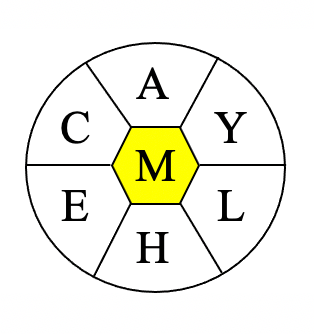
A, C, E, H, L, Y, and center M (all words must include M).
Merriam-Webster says…
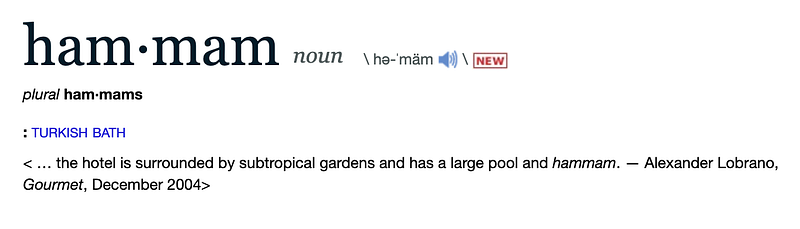
Silly little dictionary! Don’t you know that hammam can’t possibly be a word if the New York Times says it ain’t?
For further fascinating facts, check out the Spelling Bee Master.
What’s your favorite dord* from today’s puzzle?
My Two Cents
Okay, well, I must admit the definition given above by Merriam-Webster is helpful only if you know what a Turkish bath is. In case you don’t, here is the meaning of that term:

That makes things clearer, doesn’t it? Or maybe not, considering all the steam.
You say sauna, I say hamman
The word hammam derived from the Turkish hamam, meaning “bath”, from the Persian hammām (possibly meaning the same), originally from the Arabic ḥammām (حَمَّام), a noun meaning “bath”, “bathroom”, or “bathhouse”. Note the dot under the “h” in the Arabic transliteration. That indicates a hard sound when pronouncing the word, like the Spanish “j” in jamón.
Hammams may have developed or been inspired by the Roman thermae, large public complexes designed for bathing and socializing. The hammam was and still is an important part of Muslim culture, a key part of the religious requirement of ablutions, or cleansing done before prayers and certain rituals.
Today one can find historical Muslim bathhouses across the Middle East, North Africa, Spain, Portugal, Central Asia, the Indian subcontinent, and in central and Eastern Europe.
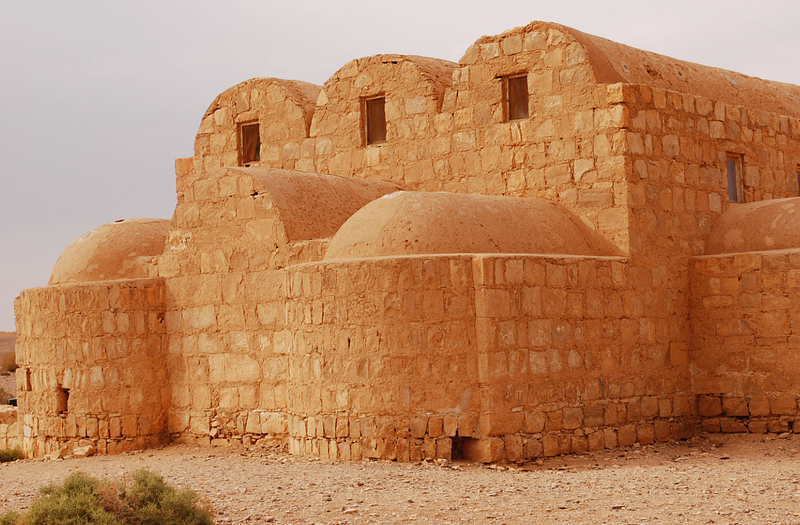
The earliest hammams were built between the 7th and 8th centuries. This one, for example, is the Qusayr ‘Amra in Jordan:
Hammams were a vital element of public life in the Muslim world until about a hundred years ago, when the use of modern indoor plumbing spread to private homes. Despite a big decline in the use of hammams, they have survived in certain regions due to local religious practices.
People sometimes confuse Turkish baths with saunas or use the words interchangeably. Despite having many similarities, there are a few noticeable differences.
▹ We’ve discussed the origin of the hammam, but the Turkish bath as we know it today may have developed and grown in popularity during the later years of the Ottoman Empire (1299–1922), which included Turkey, of course. The sauna, on the other hand, came from Finland… and for different reasons. Finns would toss water on hot stones inside their homes to generate steam and warm their houses. From about minus-gazillion degrees to a balmy minus-million degrees.
▹ Saunas work by creating really high temperatures coupled with dry heat and low humidity. Sort of like summer here in Madrid, Spain, where I live. Hammams, on the other hand, offer lower temperatures than a sauna, combined with high humidity. Sort of like summer in New York, where I used to live.
▹ Saunas tend to be smaller, less lavish, less ornate spaces than Turkish baths. People even have saunas installed in their private homes. On the other hand, you could probably install a private home inside a large Turkish bathhouse.
This is a typical sauna:
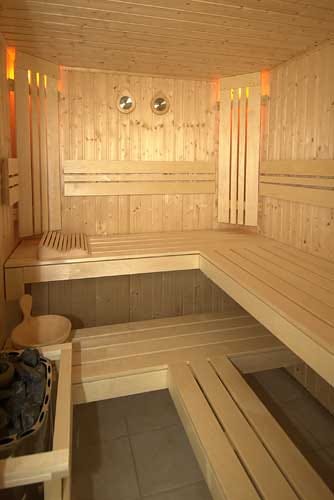
Sold in IKEA, assembled by you!
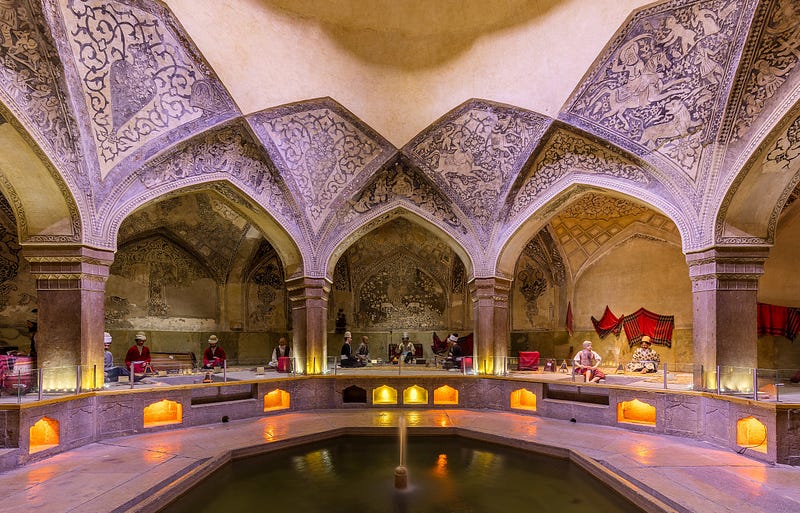
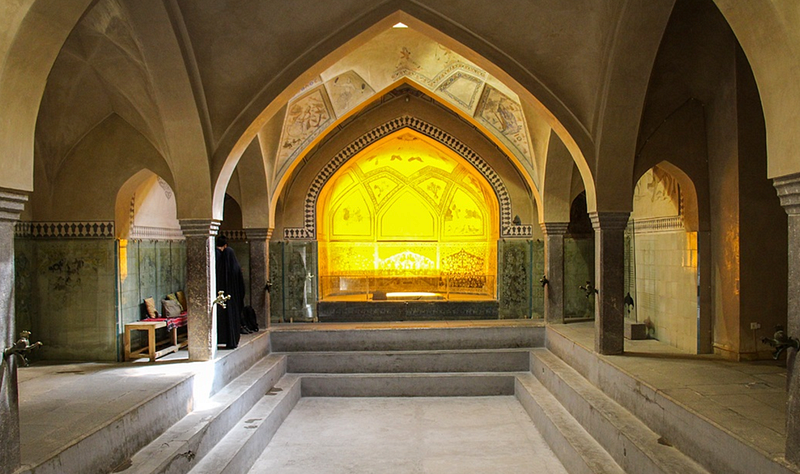
Here are some stunningly gorgeous hammams (also the photo at the top of the article).
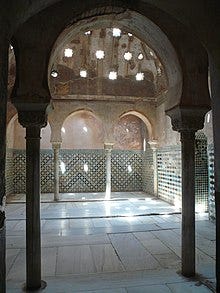
The photo above is of the 14th-century Comares Baths at the Alhambra in Granada, Spain (which I hope to visit one day).
Below is the interior of the early 18th-century Ali Gholi Agha Hammam in Isfahan, Iran:
A history of violence
If you’re a fan of film director David Cronenberg, a hammam or Turkish bath should bring to mind one thing: Eastern Promises. If you have no idea who David Cronenberg is… what are you waiting for?!? This guy has been making awesome, iconic films since the 1970s: Shivers, Videodrome, The Fly, and the above-mentioned Eastern Promises.
I’m not going to delve too much into the plot so as not to spoil it, but suffice to say that this 2007 gangster movie is worth watching. Look at this star-studded line-up: Viggo Mortensen, Naomi Watts, Vincent Cassel, Sinéad Cusack, and Armin Mueller-Stahl.
Anyone who has seen the movie will surely remember one of the most amazing scenes in it, a fight between Viggo Mortensen and two thugs inside a hammam in London. Because Mortensen’s character was placidly enjoying the Turkish bath, he was buck naked except for a towel. Cronenberg explained that they tried shooting the fight sequence with the towel covering Mortensen’s private parts — G-d forbid anyone in the U.S. see any male frontal nudity! — but the towel wouldn’t cooperate by staying on.
So Mortensen suggested they ditch the towel, and a legendary brawl was filmed and ended up on the big screen…. so people could see Viggo’s three-foot penis.
Here’s the link to that scene below (it requires signing in to YouTube for age verification). You can skip it if you haven’t seen the movie, although it doesn’t really give away any plot spoilers. But it does give away plenty of graphic violence and nudity! Not safe for work… unless your work involves graphic violence and nudity, of course.
Despite the fact that tons of people all over the world use Turkish baths, and even despite Viggo Mortensen’s awesomeness, the editors of the Spelling Bee decided that the word hamman is a dord.*
You can check out my previous entry on another dord* here:
*What the heck is a dord, you ask? Here’s the answer: