
Paca
To agouti or not agouti, that is the question
Today’s New York Times Spelling Bee letters:
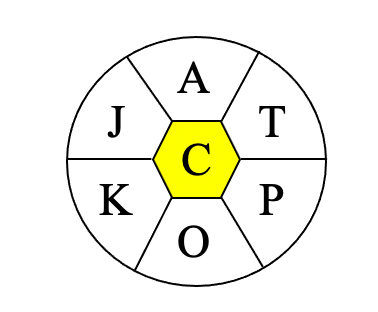
A, J, K, O, P, T, and center C (all words must include C).
Merriam-Webster says…
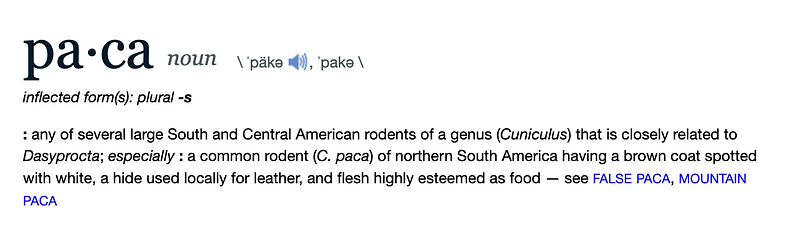
Silly little dictionary! Don’t you know that paca can’t possibly be a word if the New York Times says it ain’t?
For further fascinating facts, check out the Spelling Bee Master.
What’s your favorite dord* from today’s puzzle?
My Two Cents
The paca might be the Jason Bourne of the animal kingdom, considering all the aliases it has: tepezcuintle (its original Aztec language name) Central America and a big chunk of Mexico, guardatinaja in Nicaragua, pisquinte in northern Costa Rica, jaleb in the Yucatán peninsula (southeast Mexico), gibnut in Belize, conejo pintado in Panama, boruga, tinajo, or guartinaja in Colombia, guanta in Ecuador, majás or picuro in Peru, jochi pintado in Bolivia, labba in Guyana, and lappe on the island of Trinidad.
Also, lapa in Venezuela, where I grew up. And where it’s known as the protagonist of several quaint proverbs. More about that later.
Paca-man
The lowland or spotted paca (Cuniculus paca) is often confused with the agouti, sometimes erroneously being called by the other rodent’s name. Oh, yeah, I forgot to mention: they are both rodents. And they also share some of the same habitats. But their commonality ends at the taxonomical rank of Order (Rodentia). They belong to different families and genuses. Genusi? Hmmm…
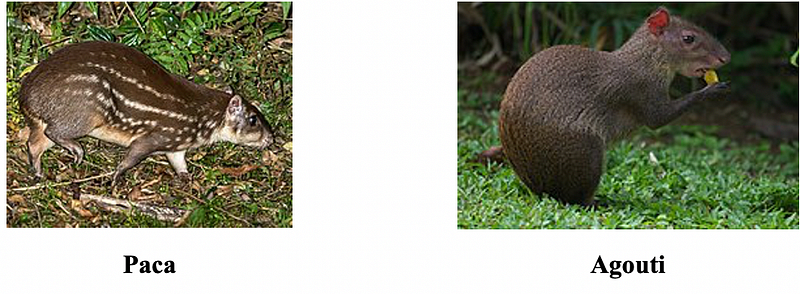
Despite what you see in these two photos, pacas are bigger than agoutis. It’s just that my screenshot guy, Iva Reztok, was kinda careless with his work today.
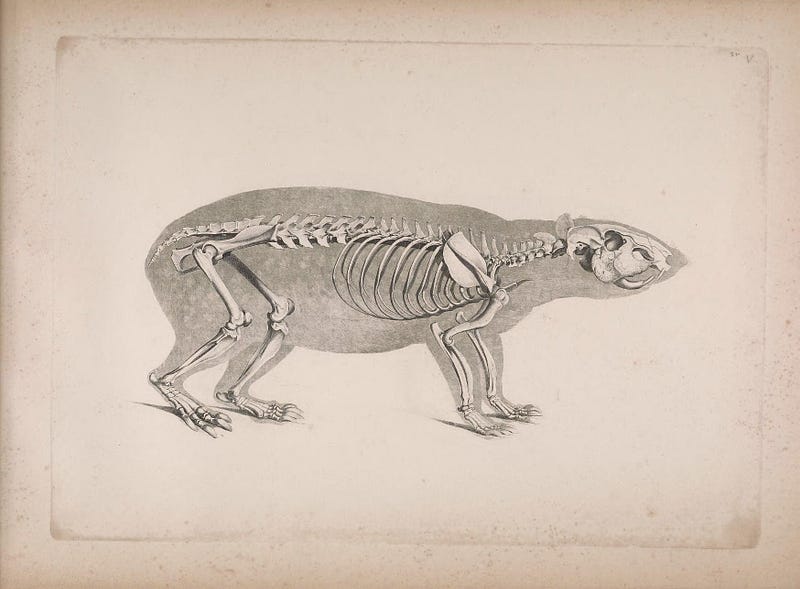
The photo on the left also lets you get a better idea of what pacas look like on the outside, as opposed to the drawing of its skeleton at the top of this article. We aim to please.
This confusion became such a hot-button topic that in 1998 the International Commission on Zoological Nomenclature had to issue a ruling. And with much fanfare and fireworks (I’m told) they declared that Cuniculus is the appropriate genus name for the paca instead of Agouti.
The origin of the word paca comes from Spanish and Portuguese explorers who heard it from the Tupi natives of Brazil. The original Aztec name I mentioned earlier, tepezcuintle, means “mountain dog”.
The lowland paca has dark brown to black fur on the upper body and a lighter color on the underbelly. The fur features rows of white spots on the sides. It has thick, strong legs and a short, hairless tail. An adult weighs between thirteen and twenty-six pounds (6 and 12 kg). After adults mate, the females go through a gestation of about four months before producing one or two young ‘uns. Pacas can live up to 13 years.
These animals are considered agricultural pests and their meat a delicacy, a dangerous combination… for the poor pacas. In Venezuela they were a rare and expensive dish, usually found in rural areas, especially close to the Amazon forest in the southern and southeastern parts of the country. Despite having spent some time in the Amazon, I never got to try one. Though I did eat venison, capybara, piranha, and tapir while I was there.
I’ll wait to write about that the day the Spelling Bee has a letter combination that allows me to form the word danta (sure to be rejected).
That clever lapa
As I mentioned earlier, the paca is called lapa in Venezuela. And aside from being sought after as food, the lapa also appears regularly in colloquial sayings. Here is one example:
Cachicamo trabaja para lapa. Literally, “Armadillo works for the paca.” This expression is used when someone does work or starts a business and someone else enjoys the benefits, usually undeservedly. In the wild, the armadillo digs a cave or burrow, and when it goes out to look for food the paca moves. When the armadillo returns, the nasty paca scares it away by baring its teeth, and then settles in for some comfortable pre-dug digs.
I’m sure there’s an equivalent saying or expression in English; I just can’t come up with it right now. If you can think of one, please add it to the comments section.
Okay, I know I said “several proverbs” earlier in this article. I guess I was exaggerating. By a lot. There’s only the one.
To conclude: despite being such a cute little animal with a nasty home-stealing habit, the editors of the Spelling Bee decided that the word paca is a dord.*
You can check out my previous entry on another dord* here:
*What the heck is a dord, you ask? Here’s the answer: