
In Search of Moral Clarity
Cultivating goodness and confronting evil
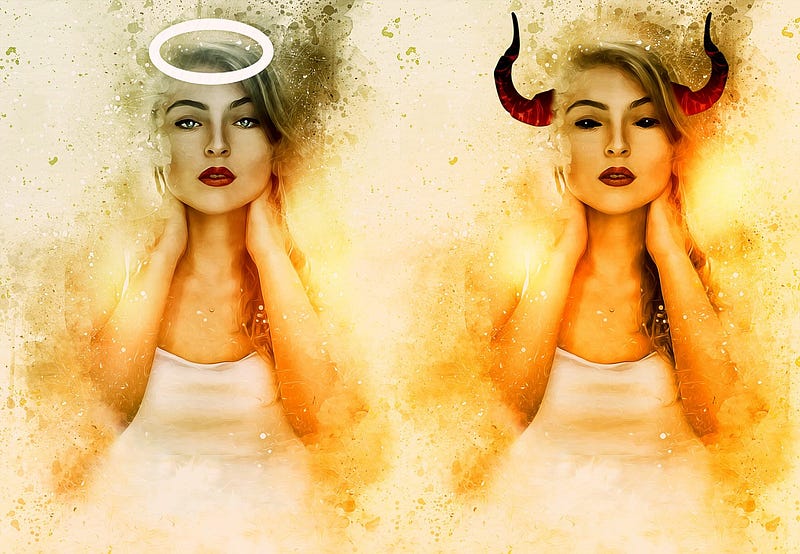
Someone rejected my book because they disagreed with my acknowledgement of evil. According to them, there is no concept of evil, and they believe that anything we perceive as evil is merely a product of our ego.
I never killed my ego and I know nothing at all. The more I know, the more I realize how much I do not know. And how much there is to learn.
I coexist with my ego and got her in the backseat because we’re a team.
Her comments about my teaching of evil challenged me to dig further into the concept of good and evil and to see if my ego is truly in the backseat watching my back.
The ego is wild and sneaky and has a way of getting back in the driver's seat to lead the way. My ego in the back is not allowed to control how I act or react.
To see how my ego was doing back there, I checked into myself.
I had a vision of a world without good and evil and what I saw were moral distinctions that had dissolved into a fog of uncertainty. There was no empathy and people didn’t have a conscience. The norms of society were only a blurry façade. There was no moral compass and people were drifting in a sea of ethical ambiguity doing whatever they wanted.
People had knowledge of good and evil because of what had already happened in the Garden of Eden. They could not go back in time and stop the first humans from biting into that heavenly apple.
Evil had already entered the world and brought so much pain and suffering that some wished there was no evil and we continued to live in peace and harmony with nature. But by not accepting evil and pretending it was all good, chaos and confusion reigned in a place where people rejected evil and others could do whatever they wanted without fear of consequence. I saw that it was not good but thank goodness it wasn’t real.
Goodness follows us and evil continues to live in the minds of people making them do what they wouldn't otherwise do. But despite their differences, good and evil coexist and learn to live together.
Good and evil exist for a reason. They are age-old pillars of human understanding that shape society, our interactions, and our decisions.
How we define what’s good and what’s not is where we disagree.
Defining Good and Evil
Some people see the good in things and acknowledge the evil that lurks in the cover of darkness while others wish it was all good and glorious like it used to be in the beginning.
Some believe everything is one and connected and so if we say something or someone is evil, it means we have evil in us too. Because well, triggers point to the things with us. They believe we must know something personally to acknowledge it.
Some others are skeptical about morality as a whole and do not want to assign labels. Others believe in good, bad, right, and wrong, but not just not evil because it’s too extreme. They believe evil is not force but rather a lack of goodness.
Good and evil have coexisted since the Garden eons ago. If that ancient serpent had been killed, then maybe evil would be gone but to kill is evil and so the serpent lives.
Good and evil coexist because they exist.
Good and evil part ways but they are two sides of a coin and can never see eye to eye. They’re like light and darkness and can’t stand each other.
Good and evil is the yin and the yang — they go together though they do not mix. As yin and yang, good and evil contain seeds of each other.
A good person can do something truly evil and a once evil person can be good.

The Concept of Good and Evil
Good and evil are concepts used to distinguish between actions, intentions, or qualities considered morally right (good) or morally wrong (evil). As a moral compass, it guides individuals and societies in making ethical choices and shaping behavior.
Evil is not a supernatural force but rather a motive or intention that stems from within. It is energy from within the person.
The idea has been explored by various cultures, religions, and philosophical traditions throughout history.
Different societies have developed different moral codes based on their values, customs, and religious teachings about what is good and evil. Individuals and communities have relied on these moral frameworks for making decisions and evaluating behavior.
The work of people like Mother Teresa, who dedicated her life to helping the poor and marginalized, and Oskar Schindler, who saved over a thousand Jews during the Holocaust, exemplify selflessness and compassion which are ultimately good behavior.
Figures like Martin Luther King Jr., who advocated for racial equality through nonviolent means, and Nelson Mandela, who fought against apartheid in South Africa, demonstrated goodness, courage, and a commitment to justice.
Innovations such as the advancements in medical treatments and the exploration of space have done good and improved the lives of countless people and expanded our understanding of the world. These examples are good actions that have helped humanity.
On the contrary, the Holocaust, the Rwandan genocide, and the Cambodian Killing Fields are among the darkest chapters in human history, where millions of innocent lives were systematically exterminated due to hate, prejudice, and political ideologies.
The exploitation and oppression inflicted upon indigenous populations during colonization and the transatlantic slave trade reflect the depths of human cruelty and a disregard for the dignity and rights of others.
Many will agree that these actions are the exact opposite of good. But evil isn’t just the opposite of good. Rather is it just one part of extreme moral wrongdoing.
Tragic events like the 9/11 attacks, the bombings in cities across the world, and extremist ideologies that promote violence and destruction remind us of the capacity for evil.
Today, the concept of good and evil still matters and our legal systems are built upon them because it influences our understanding of right and wrong. It guides our actions and interactions with others, serving as a basis for ethical decision-making.
Interpretations of Good and Evil
Various religious texts, such as the Bible, Quran, and Bhagavad Gita, provide foundational frameworks for understanding good and evil.
These texts often depict divine beings, ethical commandments, and narratives that illustrate the consequences of moral decisions. They explore the origins of evil, the nature of sin, and the pursuit of virtue, offering guidance and moral teachings to their followers.
In Christianity, good is often associated with virtues such as love, kindness, and selflessness. Evil is seen as the absence of good and is associated with sin, selfishness, and moral corruption.
Buddhism emphasizes the concept of karma, where good and evil are seen as the result of one’s actions and intentions. Good actions lead to positive karma and eventual liberation from suffering, while evil actions create negative karma and perpetuate the cycle of suffering.
In Hinduism, the concepts of good and evil are closely tied to the notions of dharma (righteousness) and adharma (unrighteousness). Good is aligned with fulfilling one’s duties and upholding moral principles, while evil is associated with actions that disrupt harmony and go against one’s dharma.
There are many more interpretations of good and evil across cultures, religions, and philosophical traditions and they each offer unique perspectives on morality, ethics, and the nature of good and evil.
The Evolution of Good and Evil
The definitions of good and evil have evolved over time. As societies progress and adapt, their understanding of morality evolves.
The traditional religious perspective presented clear-cut definitions of good and evil with commandments or moral guidelines. Contemporary interpretations, however, may reflect more nuanced and contextual understandings.
Moral relativism has gained popularity in recent years. It implies that moral judgments are subjective and differ across cultures and individuals. It suggests that good and evil can vary across contexts and are not fixed.
Moral absolutism says there are objective and universal standards of good and evil that apply to all situations. It suggests some actions or qualities are inherently good or bad, regardless of context.
Human rights movements and social justice advocacy have also impacted the definitions of good and evil. Concepts of good have expanded to include principles of fairness, equality, and the protection of human dignity, while evil is often associated with oppression, discrimination, and human rights violations.
The concept of good and evil is evolving also because people develop their own personal ethics, which guide their actions and decision-making processes. These ethics are shaped by upbringing, education, life experiences which reflects an individual’s understanding of good and evil.
As a result of these complexities of modern life, we face dilemmas that challenge our understanding of the nature of good and evil.
The Dilemma of Good and Evil
Actions that were meant for good can sometimes have unintended negative consequences, leading to ethical dilemmas. Like a doctor who believes that a specific surgery would help the patient only for there to be an unforeseen complication that leads to the death of the patient. The relatives of the patient may be angry at the doctor and threaten to sue but it doesn't mean that the action taken was evil.
Moral dilemmas often arise when there are conflicting moral principles or values at stake, clashing and making it difficult to determine a clear course of action. It happens due to the interconnectedness of actions and the difficulty in predicting all potential outcomes.
Situations may involve competing goods, where choosing one action may result in sacrificing another, or when actions have mixed consequences with both positive and negative outcomes.
For instance, the principles of autonomy (respecting individual freedom) and beneficence (promoting the well-being of others) may come into conflict in certain situations, such as when making medical decisions for someone unable to communicate their wishes.
Deontology holds that certain actions or intentions are inherently good or evil, regardless of their consequences.
Other theories, like consequentialism, argue that the moral value of an action is determined by its overall impact on well-being, happiness, or the greater good.
When moral dilemmas, gray areas, and conflicting moral principles arise, the nature of good and evil becomes complicated. People may engage in moral reasoning to determine the right course of action when faced with ethical dilemmas.
Moral reasoning applies critical analysis to specific events to determine what is right or wrong, and what people ought to do in a particular situation.
Good and Evil in Human Behavior
Empathy, conscience, societal norms, and personal values shape behavior.
Empathy is the ability to understand and share the feelings and perspectives of others. When people empathize with others, they are more likely to do good by acting in ways that promote well-being and avoid causing harm.
Conscience is an internal moral compass that guides people in making ethical decisions and acting in accordance with their sense of right and wrong. It is shaped by a person’s upbringing, values, beliefs, and experiences.
Societal norms are the unwritten rules and expectations that govern, shape, and influence behavior by setting standards of conduct and defining what is considered acceptable or unacceptable.
Personal values are deeply held beliefs and principles that guide individuals’ attitudes and behaviors. They play a big role in shaping behavior by acting as a moral compass. When people align their actions with their personal values, they are more likely to act in ways that they believe are right and consistent with their own understanding of good and evil.
While empathy and conscience promote ethical behavior on an individual level, societal norms and personal values provide a broader framework within which behavior is shaped.
The Archetypal Characters of Good and Evil
Many literary works feature characters who embody different moral qualities, such as heroes, villains, antiheroes, or morally ambiguous individuals.
Heroes are the forces of good, often displaying courage, selflessness, and a commitment to justice and moral principles.
Villains personify evil, displaying characteristics such as greed, cruelty, and a desire for power or destruction.
Antiheroes are complex characters who blur the lines between good and evil, often possessing both virtuous and morally questionable qualities. For example, Hamlet, the titular character from William Shakespeare’s “Hamlet,” is an example of an anti-hero. In spite of his best intentions, he uses morally questionable methods to ensure that his father’s killer pays for his crimes.
Authors use symbolism, allegory, and character development to examine the nature of good and evil, often blurring the boundaries between them. Popular culture, including films, TV shows, and video games, frequently uses the concepts of good and evil to create narratives and characters. Superhero stories often showcase the battle between good and evil, exploring themes of justice, morality, and the use of power.
Throughout all of these media, good and evil are portrayed and explored because, as I mentioned earlier, good and evil are age-old pillars that cannot be broken down now.
We break these pillars and the entire world comes crashing down and that may not be evil, but it will not be good.
Dealing With Good and Evil
I understand that the nature of good and evil is complex and subject to ongoing debates. To some, evil is so gruesome that if we close our eyes and pretend that it did not exist, then maybe it would all go away, but pretending something does not exist doesn't make it go away. It lurks in the shadows, waiting for the right time to strike.
As we all continue to cultivate goodness, we must not turn a blind eye to evil no matter how difficult and uncomfortable it makes us feel. We must call a spade a spade and confront evil when it looks like it. Then maybe it will go away for good!
Sure, the debates about good and evil may never go away though, but they provide an opportunity for critical reflection and intellectual exploration. They prompt us to question our own assumptions and biases, to consider the implications of our moral judgments, and to engage in thoughtful dialogue with others who may hold different perspectives.
So what do you think? Or what do you believe in?


