In Scrum: Who are Developers? What are their Accountabilities?
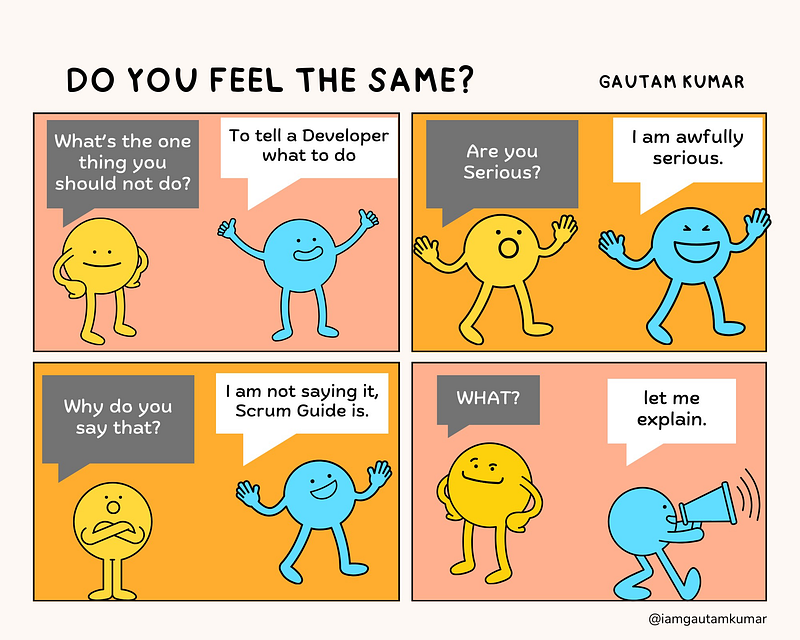
What’s the one thing you should not do?
is to tell a Developer what to do.
You might ask, if no one is telling the Developers what to do, then how will they execute the work?
Glad you asked.
How will the chosen work get done?
For each selected Product Backlog item, the Developers plan the work necessary to create an Increment that meets the Definition of Done.
How this is done is at the sole discretion of the Developers. No one else tells them how to turn Product Backlog items into Increments of value. (Ref. Scrum Guide 2020. Page 8)
Developers — Who are this people?
We use the word “developers” in Scrum not to exclude, but to simplify. (Ref. Scrum Guide 2020. Page 1)
- The term Developers is not limited to technical people, such as, software engineers, testers, architects, and DevOps.
- Anyone and everyone who is part of Scrum Team are called as Developers, they can be from legal, marketing, or operations team.
- There are no titles for the Developers, regardless of the type of work they do.
- Developers are cross-functional, with all the skills as a team necessary to create a product/product increment.
- Developers are the people in the Scrum Team that are committed to creating any aspect of a usable Increment each Sprint.
The specific skills needed by the Developers are often broad and will vary with the domain of work. (Ref. Scrum Guide 2020. Page 5)
Did you know:

The Developers select items from the Product Backlog to include in the current Sprint.
How much work the Developers should do during the Sprint?
Some might say 40hrs since the working week is 40hrs. Developers fulltime job is to develop a product and nothing else, right?
Wrong, fixing the quantity of work can be challenging for most part of the sprint, but Developers can give a forecast of their work if they know about their past performance, their upcoming capacity, and their Definition of Done.
Let me explain. As you are aware sprint is a time-boxed activity in which a team works on a set of tasks.
How do you estimate the work to be done?
Do you agree with me that estimate is a guessing game. To the best of your knowledge and ability, you can come up with a value.
Now to make a prediction how much work team can realistically accomplish in a sprint?
To help with this, developers can use a technique called Forecasting, which involves using data from previous sprints, such as the Velocity which is the number of tasks completed per sprint and the Capacity, which is the amount of time available for work, as well as the Definition of Done which is the criteria that determine when a task is finished.
For example, if a team has a velocity of 25 tasks per sprint, a capacity of 100 hours per week, and if each task takes about 5 hours to meet the Definition of Done.
Then the forecast for the next sprint is going to be 25 tasks. This way, they can avoid overcommitting or underdelivering on their work.
How do Developers work together?
Developers inspect the progress of their work during the Daily Scrum, they adapt the Sprint Backlog if it is deviating from the Sprint Goal.
Daily Scrum is conducted at same time and same place every day, this creates focus and improves self-management.
Did you know: The Product Owner and Scrum Master should participate as a Developer in the Daily Scrum if they are actively working on the items in a Sprint Backlog.
How do Developers achieve their objective?
The primary objective for the Developers is the Sprint Goal, they focus on progress toward the Sprint Goal and produces an actionable plan. As the Developers work during the Sprint if the work turns out to be different than they expected, they collaborate with the Product Owner to negotiate the scope of the Sprint Backlog within the Sprint without affecting the Sprint Goal.
Did you know:

The Sprint Goal is a commitment by the Developers.
The Developers are accountable for:
● Creating a plan for the Sprint, the Sprint Backlog;
● Instilling quality by adhering to a Definition of Done;
● Adapting their plan each day toward the Sprint Goal; and,
● Holding each other accountable as professionals. (Ref. Scrum Guide 2020. Page 5)
This is a part of Decoding Scrum Guide 2020 series.
Article 2 — How does Scrum help to achieve continual improvement?
Article 3 — How to make Scrum Successful?
Article 4 — Why everyone despise scrum theory?
Article 5 — Daily Stand-ups are waste of time.
Article 6 — Let’s get rid of Scrum Master.
Article 7 — Who are Product Owners and what do they do?
Article 8 — Who are Developers? What are their Accountabilities?
Article 9 — The notorious Scrum Team.
Article 10 — Why do we need Sprint Planning?
Article 11 — Is your Scrum Team failing in its commitment.


