
I’m Not #Woke…I’m #Alert
True allies shouldn’t have to announce to the world how phenomenal their allyship is
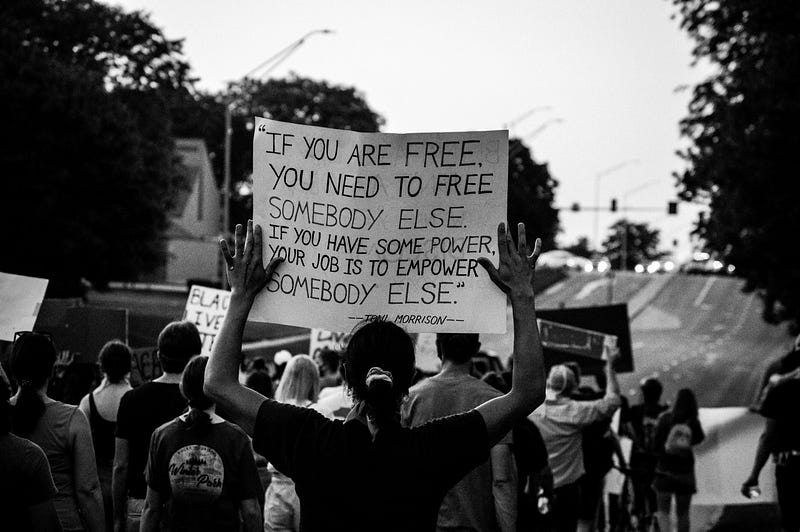
None of us can escape public discourse nowadays without hearing the term “woke” batted around like a toddler’s ragdoll. Florida Governor Ron DeSantis insists it’s a harbinger of evil raining down upon American children. Liberal commentators, such as The View’s Joy Behar, boastfully adorn themselves with the “woke” label like some sacred necklace.
For those of you trying to make heads or tails out of this ongoing battle, let’s put into context where “woke” originated.
Ishena Robinson of The Legal Defense Fund traces the term back to the 1960s, when Black people in the United States used it as a call-to-action for being vigilant and remaining safe against police brutality. She credits Black novelist William Melvin Kelley as one of the term’s earliest promoters.
In subsequent decades, “woke” has been hijacked — mainly by White people — to serve both conservative and liberal narratives (albeit in very different ways).
And it’s for this reason that I cannot bring myself to aspire to identify as “woke.” Nor do I subscribe to wielding “woke,” by itself, as a catch-all insult.
The Right’s Worst Con Game
Long before Ron DeSantis became a household name, conservatives were plotting to redefine “woke” as being synonymous with “political correctness.” As Isabel Dias of Mother Jones reports, activist Christopher Rufo led this effort by merging “wokeness” with an escalated conflict over the notion of Critical Race Theory.
The stigma that has been attached to this nebulous concept of “political correctness” suddenly was extended to “woke” and “CRT.” Of course, the major flaw in this tactic is that there’s no universal consensus on what it means for something to be “politically correct.”
Is it a criticism of those who support multiculturalism and inclusion? This would be a sneaky way for certain people on the Right to maintain patriarchy and white supremacist systems.
Or is it an excuse to reject diverse points-of-view? The tendency to instantly rebut someone when they hold a progressive, liberal, or centrist position — rather than asking thoughtful questions of them.
Does it become an effort to gaslight people if they share firsthand testimonies of trauma and oppression that they’ve endured? Calling it “political correctness” when someone insists on being heard.
I have a very specific definition for “political correctness.” It involves people inflicting actions or rhetoric upon others out of vengeance or a desire to be in total control of social narratives. Hypocrisy, double standards, and asymmetry weaponized on behalf of leftist power grabs.
In my view, “political correctness” overlaps with what conservatives often bash as “wokeness.” Although I pointedly use the term “hyperwoke” to refer to very insidious examples of personal behavior or groupthink that come from some corners of the Left.
The problem, of course, is that partisan Republicans who desire authoritarian control of American government will repurpose “woke” as a dirty word serving as a shortcut to bash Democratic policies.
Intellectual dishonesty with an elephant’s trunk.
The Left’s Worst Defense
Thus, we have a bit of a Chicken-Egg scenario. Leftists began wearing “woke” as a badge-of-honor to counter this deceptive right-wing narrative. However, as flawed as many of their arguments have been, a segment of social conservatives had redefined “woke” as a defense mechanism in response to the guilt trips and preachiness commandeered by liberals or progressives who attempt to steamroll over discussion.
Don’t believe me? Check out a recent op-ed piece for The Good Men Project by liberal Christian author John Pavlovitz, who claims that “woke” is equivalent to “anyone who gives a damn about other human beings or the planet.”
Through his moral sanctimony, Pavlovitz cites things such as fair elections, sexual freedom, bodily sovereignty, police accountability, gun safety, clean air, good health, responsible science, and accurate teachings of American history.
His sleight-of-hand suggests that if you oppose the term “woke” then you also thereby oppose all of those common-sense values.
While Pavlovitz individually has a track record for such manipulation, he largely represents a broader archetype here. This deceptive approach is practiced by folks on college campuses, in corporate workplaces, amongst TV or movie scripts, amidst talk show debates or cable news discussions — and, yes, even in some K-12 classrooms.
It should be noted that it’s usually White liberals — or White people who self-identify as “progressive” or “socialist” — doing this because they want to show what strong “allies” they are to BIPOC communities. Of course, some People of Color also endorse this brand of white guilt (looking at you, Michael Eric Dyson!).
What’s worse is the almost religious fervor with which they lecture others on how to be “antiracist,” as linguist John McWhorter characterizes their behavior. This is how the writings of a reductionist such as Robin DiAngelo currently serve as a lazy guide for so-called allyship — a gold standard of “wokeness.”
Thus, Jane Elliott becomes an inverted mutant of Pat Buchanan.
We’re Way Past “Woke”…
Again, when terminology gets warped with too many different exaggerations and value-judgements, those words may soon be rendered meaningless.
Whose definition of “woke” is more accurate?
Christopher Rufo’s or John Pavlovitz’s?
Who gets to be the final arbiter of that? Who gets to christen the definition as some holy grail of moral clarity?
And don’t say “the people who are oppressed” — because different Americans with Black, Latine, Asian, Indigenous, Oceanic, and/or Middle Eastern heritage can have vastly different opinions on when (or how) “woke” should be used.
Or who should/shouldn’t be able to use it.
Or even if it should be used at all.
Instead of calling myself woke, I would say I’m alert.
I make it a point to be aware of various political actors’ motives.
I study systemic problems, and hone in on the possible solutions for them.
I smack down the tendency of activists from all sides to conflate somebody’s argument with that person’s character.
I distinguish the social and the cultural from the structural and the institutional.
Some people would tell me that those desires of mine do indeed make me “woke.”
Well, then, if I’m so “woke” — then why do extremists from across the spectrum accuse me of “giving comfort” to their enemies?
Earlier this year, I wrote a piece entitled “Why I Don’t Consider Myself an Ally”…
I’m sure there are going to be plenty of people who read my little rant, today, and accuse me of “being one of those White moderates who Dr. King warned us about”…
Well then, I would ask them, with all sincerity: If their goal is truly to get through to people who don’t understand privilege and oppression, then what makes them think that performative self-loathing is going to accomplish that task?
Do you really believe a majority of people will be persuaded when they hear mocking or condescending platitudes?
Are you truly proud of your own “wokeness”…or are you just trying to make yourself feel morally superior?
Click here to subscribe to my stories.


