
WRITER
I’m a Neurodivergent Queer Writer But I Missed the Memo
I was writing for the cishet normative neurotypical reader because *forehead slap*

Neurodivergent Queer Writer — Get it Right!
I recently realized I was a neurodivergent writer trying to write for neurotypicals, but now I also realize I have always been a queer writer writing for the cishet normative reader. We were never going to meet halfway. What the hell was I thinking?
Neurodivergent Writers — Assemble!
It all started when I read a line in a book. A book I wrote. And I thought, ‘what the hell is this dribble?’ Now, don’t get me wrong, I’m a huge proponent of understanding growth and that you can’t know what you don’t know until you expand beyond what you do know. Everything I write expands my knowledge, skills, and understanding and so it makes sense that when I read something I wrote some time ago, I may no longer agree with it. But this… Well, I already wrote an article about it, so if you so desire, you can read that below.
The point is I realized that I’d been writing for a neurotypical audience because, well, I guess I thought I was a neurotypical writer. A little more thought on this and it made so much sense why I was failing at my passion. That’s not supposed to happen, right? Follow your passion and the law of attraction provides… or something.
But I was following my passion through a mask of neurotypical expectation that I could never live up to. I know ‘how’ to be successful. I know the steps I’m supposed to take. I have a Master of Arts in Writing and I’ve almost finished a Bachelor of Media and Communication. I’ve attended the 20 Books to 50K function with successful writers like MD Cooper. I’ve watched countless hours of marketing, advertising, writing, editing, cover design, and book planning videos, trainings, talks, etc. I’ve listened to podcasts, signed up for courses, read the books. I’ve done Masterclasses. I’ve followed authors on social media. I’ve spent ridiculous dollars on all of this plus professional services, printing, book launches, blah, blah, blah. Oh my god, I know how to do all the things I’m supposed to do to be successful.
I know ‘how’ to be successful. I know the steps I’m supposed to take. So why the hell aren’t I ‘successful’?
Because I was trying to follow neurotypical solutions!
Okay, great. Yay, neurotypical, great plan. My brain ain’t gonna let me do that. That ain’t gonna fly over here. My brain is too busy chatting with my characters to be able to listen to you telling me the steps I need to take to be a so-called successful writer. What does that even mean anyway? Wait — hold that neurotypical response, I have a tune in my head that feels much nicer.
Speaking of talking to my characters, which does not seem very neurotypical at all, they talk back. Totally not neurotypical. And they teach me. Here’s just one of my articles in my ‘Character Reflections’ series. Again — no neurotypical anything to be found, anywhere!

Where’s the Queer?
Oh baby, it’s everywhere! That I was a neurodivergent writer was a lightbulb moment, but the queer writer revelation came thanks to an article by the amazing Logan Silkwood. If you haven’t checked out his work yet, you really should. In his article, he shared his own recognition of his ‘queer’ style of writing. Go check out his article here. But remember to come back, because we’re not done yet!
It’s a style built on trauma layered with joy and life. We seamlessly move between hilarious and ridiculous anecdotes into some very heavy themes and back again to beauty without allowing time for breath or pity. Pain is part of life and we don’t have time to dwell on it permanently.
Queer Writing Style— Check!
My First Strike series is fun, hilarious (if I do say so myself), and yet is deeper than the penetration in book four. See what I did there? I considered these books through the lens of Logan’s queer writing style, and bend me over a countertop, I nailed it (puns always intended). Let me walk you through just some of the characters and offer an overview of that seamless flow between beauty and heaviness that Logan mentions.
Oh, and before you ask, no, The First Strike series is not yet available. But soon. Very damn soon. I’m doing all the editing in my newfound neurodivergent way — more on that another time.
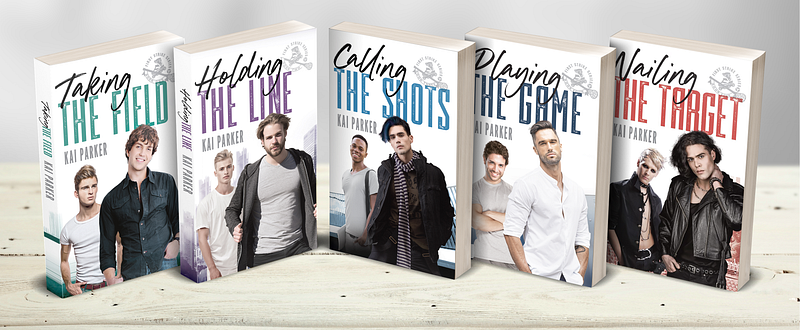
Book1 — Taking the Field
❤ Henley develops a weird relationship with an elevator. 😱Henley is an aged-out foster kid living in his car and desperately trying to find a place to fit in who punches his way out of confusion.
❤ Tanimen is a jerk who ‘teases’ the naive Henley. 😱Tanimen has severe social anxiety and panic attacks. His mother died when he was a baby and he’ll do anything to prove his worth to his absent father.
Book 2 — Holding the Line
❤ Marcus has NO filter and it is hilarious and endearing 😱Marcus is neurodivergent (undiagnosed ASD as a minimum) and has been controlled by a narcissistic mother. At 18, he is on his own for the first time discovering how to ‘people’ as well as learning he is pan-demic (sorry, couldn’t resist — he’s pan and demisexual).
❤ Thor is the master of euphemisms and puns. Everyone loves Thor! 😱Thor was an army brat and struggles academically (undiagnosed dyslexia and probs ADHD). His darkness is not very dark — he is definitely the most well-adjusted and mentally stable character in the series. I imagine much of that has to do with his two awesome army Dads!
Book 3 — Calling the Shots
Oh, book 3! The one that finally cracked my egg!
❤ Jasper really doesn’t care what other people think of him and he’ll tell them that. 😱Jasper has severe anxiety, Tourette Syndrome, a gay younger brother, and a physically abusive mother who tries to ‘beat the gay’ out of them both.
❤ Hunter can’t keep up with Jasper’s wit, but he tries (so cute). 😱Hunter is a gay trans man (enough said).
Book 4 — Playing the Game
❤ Adam is absolutely willing to try anything (cue a Marvel-inspired buttplug) 😱Adam was raised in a religious household and he learned homophobia and transphobia. He dated Hunter before Hunter began his transition and now Adam is confronting his past and his own queerness.
❤ Ethram (who is Tanimen’s Dad) has a stick up his ass and everyone knows it but he’s a hell of a coach. 😱Ethram has kept a huge secret from Tanimen his entire life. (MAJOR SPOILERS ALERT) — He was an unwilling ‘father’ while still a teen but was already building a career. He gave up love for his career so that he could give Tanimen everything, but he paid others to raise the boy. Cue massive guilt, shame, and heartbreak.
Book 5 — Nailing the Target
This one is intense!
❤ Nate is an epic goth nerd. 😱Nate had his dreams within reach until he was severely beaten (among other things) by homophobic teammates but he thinks he has it under control — he doesn’t.
❤ Steele is the quiet broody one who always seems to give good advice. 😱Steele is asexual intersex non-binary. He is medicated for PTSD and anxiety due to (SPOILER ALERT) the suicide of his high school best friend.
So yeah, none of these books targets a cishet normative audience because there are no cishet normative experiences in these pages. I didn’t even realize I write in the exact manner Logan mentioned — bouncing from lighthearted humor to trauma and back. Someone who has never questioned their gender or sexuality is probably going to think any one of these books is so farfetched — but we know better.
Another Sign — The Books I Read
It’s also proven itself to be yet another sign (of my impending egg-cracking queerness) that I didn’t see. I’ve always enjoyed books like this — ones that can be read on the surface and yet have extreme depth. Two books, in particular, come to mind.
The Prison House, by John King
This book is truly amazing with so much depth and so many layers. Sentences that ran for several pages encapsulating the character’s failing grip on his own reality. The light-hearted banter and moments of detailed beauty. The representation of dissociation through character interruptions and shifts. Enthralling! I remember reading a review that said it was boring and all over the place. Yes, it was all over the place, because the character’s mental state was all over the place. It was one of the most brilliant pieces of writing I have ever read. I’m just angry that I made the mistake of lending my copy to someone because I haven’t seen it since.
All for the Game by Nora Sakaovic
Oh my goodness, the levels in the three books of this series are nuts! The well-known slow-burn queer romance between two characters attracts the right audience — us queers. The story is so much fun and so crazy — so much happens, too much to be even considered possible, and yet, I find myself thinking, sure, that all seems legit. Not because of the events themselves, but because of the trauma and the way these two men find each other and save each other when they were both on the edge of being lost forever. It’s beautiful and horrific.
Yes, There is a Point
On the surface, books tell a tale. A series of events. But the writing I like, the books I like to read, are metaphors in their entirety. That makes more sense to me now. I feel like, for many of us queer folx, life itself feels like nothing but a metaphor. For many of us, we grew up being told the facts, the rules, the reality, and because that reality didn’t resonate (even if we — read I — didn’t know it), we dissociated from the expectation thus creating this metaphor of existence where one part of us could be ‘normal’ and the other, could be ‘happy.’ Coming out of the closet is choosing to reconcile those two parts, or to release the concept of ‘normal’ entirely. Is normal/deviant a binary? Or yet another social construct?
Let’s Laugh and Cry and Laugh Some More
So now I know who will read my books because now I know who I am as a writer. No wonder all my books up until now have been failures — I’ve been aiming them at those that could never laugh at the embedded trauma.