
If You’re Going to Get Mad About a Logo, At Least Understand Why You Should Be Mad
An open letter to Luke Trayser
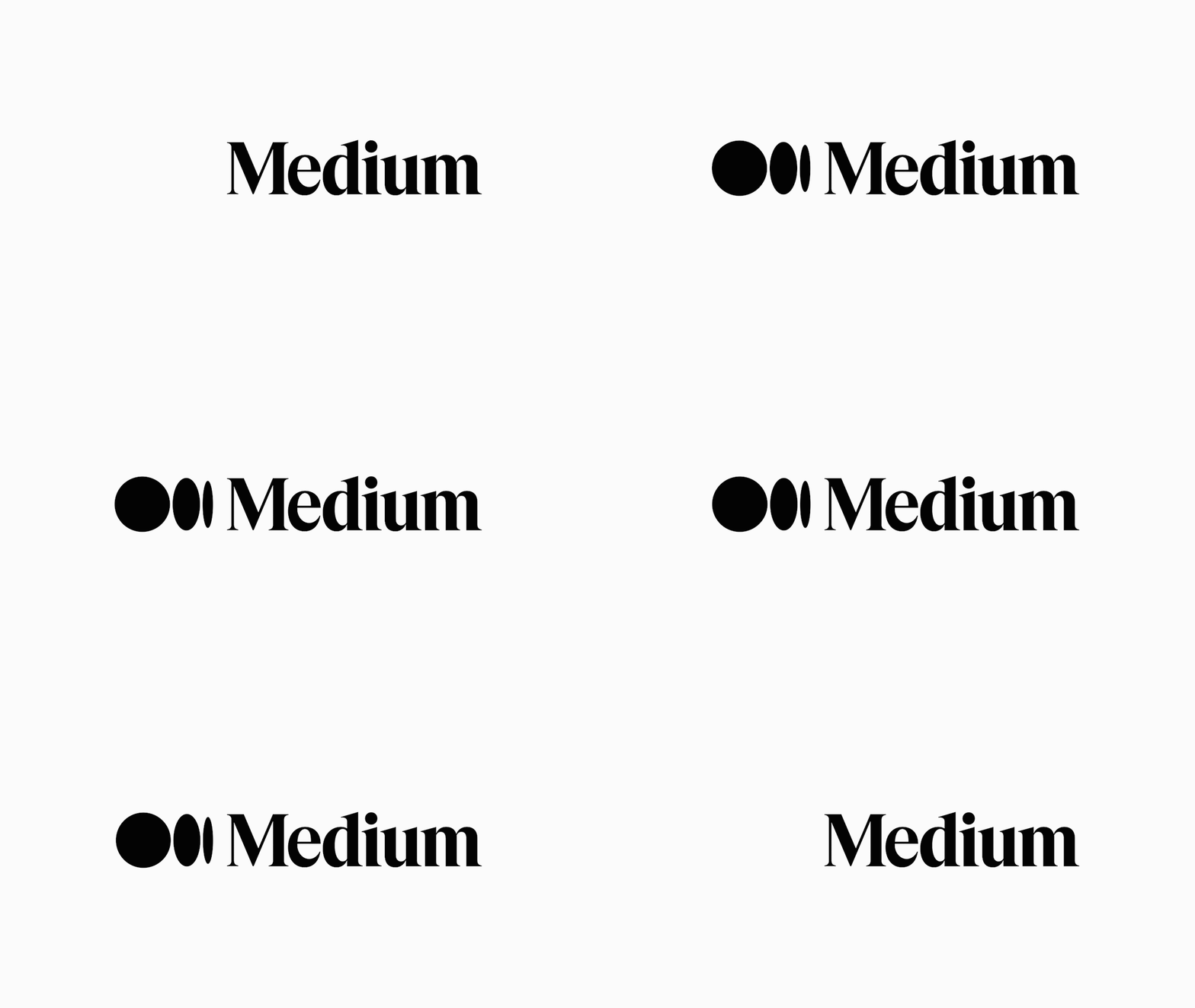
My friend and one-time book collaborator Luke Trayser just wrote a very funny design review about Medium’s new logo, and you should read it as soon as you finish learning about type in this article.
My favorite part of the article is this:
“Important disclaimer: I am still a copywriter who knows nothing about design.”
My second favorite part of the article is his spot-on analysis of the Pros for the new logo:
“Once again, it is spelled correctly. Remarkable attention to detail.”
But Luke wrote something very troubling and I need to address it in another one of those overdone and unncessary open letters. After all, I could have just responded to his article directly, but then I wouldn’t make the 17¢ I so richly deserve for dispensing with my expert opinion as a graphic design professional who has worked for clients such as Disney, Six Flags, Subway, Taco Bell, and Universal Studios.
I always say if you’re going to rant, at least use my scientific method of ranting:
- Angry reaction
- A desire to rant
- Researching to avoid coming off as a complete idiot
- Discovering information that changes my views, and
- Ranting anyway but rationally.
Okay, now back to Luke’s statement. He wrote:
“The font (I’m intentionally not calling it a typeface, which makes designers very mad) is squishier and more compact than before, which means the logo takes up less space.”
Now, this is funny stuff, but don’t worry about making us designers mad. Nobody ever listens to us, anyway.
But I am alarmed.
Our nation suffers from an alarming rate of typographic illiteracy.
And I need to do my part to educate the public on this vital information that might someday help a contestant correctly answer the Daily Double on Jeopardy.
Both “font” and “typeface” have a place in the design lexicon, and each one can be correct, depending on the design
First, a typeface is the name for a family of fonts (maybe I should have defined font first, but whatever, the jokes flow better in this order).
The name of Medium’s typeface is “Noe Text.”
I think that choice was a subliminal message to all writers on this platform that Medium values no text. Curators have a lot less work if all the submissions are pictures.
Second, the word font describes the style and weight attributes of a typeface (regular vs italic, normal vs condensed vs extended, and a weight from very light to ultra bold, depending on the typeface).
In this case, Medium chose the Semibold font, which is also a statement.
You see, when a company hires an agency they pay a lot of money for professional designers to do in-depth research, speak endlessly with clients to learn everything about the business and their vision, and then make a bold statement that impacts the world.
Medium, of course, did not do this. They hired their in-house art department and those people know that their asses are on the line if for some reason the company doesn’t like their work at any point in the future. That’s why the best they can do is make a semi-bold statement. It gives them a little CYA wiggle room as in:
“Well I wanted to be bold, but [fill in name of marketing manager no longer with the company] told me the CEO wanted the design to be a little more reserved.”
Finally, we need to do a deep dive into the qualities of “squishier and more compact than before.”
Based on our analysis above, only a typographic nerd like me would hunt down the font for Medium’s logo. (See that? I could use either font or typeface.)
If you don’t know the exact typeface or font, you might think someone just drew the logo by hand and then painstakingly built it using digital design tools.
But designers are l̶a̶z̶y̶ ̶s̶l̶a̶c̶k̶e̶r̶s̶ industrious, hard-working creatives.
Just like me.
I can’t tell you how many times I have drawn a couple of really cool letters and then tried to figure out which typeface would provide the best digital template from which to design a new logo.
Now, in the case of Medium’s underpaid and overworked in-house art department, they would be excused for skipping the whole drawing part, selecting a particular font, cutting off some of those tiny pointy ends,* and then manually moving the letters together.
Because that’s exactly what they did.
However, we can’t be sure of the reason the new logo letterforms are squishier and more compact than before.
Maybe they found a slightly different typeface because the serifs at the bottom of the letters are angled, not sitting flat along the baseline. Or maybe, they took Noe Text Semibold and used a vector-based illustration tool to adjust and the letterforms and then compress them.
We may never know the new logo’s origin because the designers responsible for the logo are probably suffering from PTSD, given social media’s response to their work.
And that brings us back to Luke’s funny article. Enjoy.
*Tiny pointy ends is the technical term people use for the word “serif.”
P.S.: I didn’t get upset at the designers for the logo. I know what it’s like to work under a deadline for clients whose best creative direction might be, “I don’t know what I want, but when I see it, I’ll let you know.” I have the freedom to run for my life when working for those kinds of fools, but the in-house people do not.