
I Wouldn’t Touch Upwork With a 10ft Pole
Jason Feller February 17, 2023
Hustle culture got the best of me.
I was already working a 9 to 5 and decided to try and make some extra income on the side. Working for yourself and making money on your own time is an exciting idea. Most of us have considered it at some point. In December of 2022, I decided to act on that dream and try my hand at freelancing on Upwork.
Upwork is one of the largest online marketplaces that connects businesses and individuals with freelance talent. The jobs range from writing, graphic design, programming, virtual assistants to media editors — you get the gist.
I listened to haughty podcasts and articles that instructed me on how to earn six figures on Upwork. Sure, I can do that.
Cue the Crickets.
I would look for jobs related to Excel, Google Sheets, SQL, data analysis, dashboard creation, and Power BI. I applied to said jobs at a pace of about 5–10 per day. I kept up this pace for a week or two before the desperation started to set in.
I would browse for jobs outside of my specialty, such as data entry or virtual assistant. Then I got my first bite. This company was hiring multiple freelancers to review their website and leave feedback. The payout? $0.80.
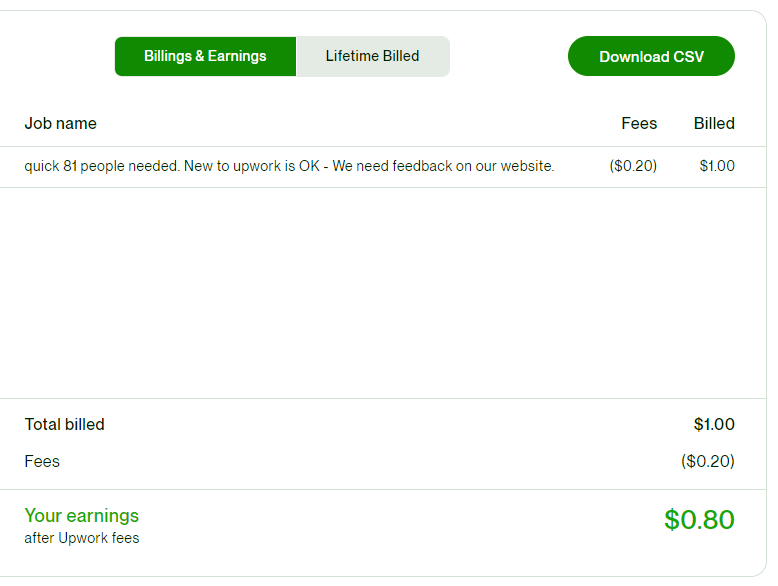
The first glaring issue here is that Upwork takes 20% of the profits, almost as much as Uncle Sam. After Upwork takes their cut, you still need to pay taxes on your earnings. At my tax bracket that $0.80 now becomes $0.60. So for every dollar you make on Upwork, you get about 60% of that.
$100 earned = $60 kept
$1,000 earned = $600 kept
$10,000 earned = $6,000 kept
$100,000 earned = $60,000 kept
I knew what I was getting into before I accepted the job. Unfortunately, this is the most common way that freelancers get their foot in the door. You want to demonstrate that you have completed other work successfully, and tout a shiny five-star review from the nice people who paid you $1. This is the way.

Let’s rewind to the types of jobs I actually wanted. We’ll take Excel as one example. Many companies look for Excel Pros to spruce up their sheets or perform advanced Excel wizardry. The competition for these types of jobs is fierce.
I’m talking 50+ applicants within 5 minutes of the job being posted. When the competition is high, people start undercutting their opponents. How low are you willing to go? The seller has the right to take the lowest bidder, and why wouldn’t they?
People from the United States are both at an advantage and a disadvantage here.
Advantages for U.S. based Upwork freelancers
- Many clients are only looking for US based workers. This is a requirement they can put in their put in their job listing
- Easier communication: Clients who are located in the US may find it easier to communicate with US-based freelancers due to fewer language barriers and time zone differences.
- Access to certain industries: US-based freelancers may have better access to certain industries, such as technology or media, that are more prevalent in the US.
- Familiarity with US business culture: US-based freelancers may have a better understanding of the expectations and norms in US business culture, which can be helpful when working with US-based clients.
Disadvantages for U.S. based Upwork freelancers
- More people are competing for the same jobs on Upwork, and some people will work for less money.
- US freelancers might have to lower their prices to compete.
- Sometimes, clients are in different time zones, which can make it harder to work together.
- Some clients prefer to hire freelancers who live near them.
- Upwork charges fees for getting paid, which can be more expensive for US freelancers.
- The exchange rate for US dollars is higher in certain countries where freelancers would be happy to take lower prices
The other issue I have is how you actually acquire clients.
‘Connects’ on Upwork are an online currency that help freelancers apply and stand out to potential clients. Freelancers are given 10 or 80 free Connects per month (based on your free or paid subscription level). You can earn more through various means, including obtaining certifications and winning interviews. Connects can be used to submit proposals, boost proposals to appear at the top of a client’s list, and turn on an availability badge. Yikes.
They can also be purchased in bundles of 10 to 80 Connects. One Connect costs $0.15, and different jobs cost varying amounts of Connects. A simple, low-paying job might only cost you 1 Connect, while a larger, higher-paying job could cost up to 10 Connects. On top of this, other freelancers can boost their proposals by using more Connects. When does it stop?
In essence, you must pay real money to buy connects in order to make money. If you get crickets after applying for a job, say goodbye to your Connects. It’s not unheard of for freelancers to apply for 10, 20, or 50+ jobs without a single response.
Lets say you sent 50 proposals at an average of 5 connects each. That’s 250 Connects worth $37.50 you have just spent, possibly with no prospect of work yet.
Look no further than r/Upwork to find your fill of both horror and success stories.
One “success” story I saw (if you really want to call it that), was a reddit user that had reached the $20,000 mark over their last two years on the platform. Everyone praised and congratulated them. “How did you do it?”
Now, I don’t know what type of work they were doing or how many hours they put in, but I don’t consider earning $10,000 per year a success.
I’d make more money if I got a second job at a fast food joint (nothing against the service workers). I probably spent just as much time looking for work on the platform than actually working.
The Clients
As with any job, some of the people you work with are alright, while some of them just flat out suck.
Misleading prices are a common trick. They will pay you $600 for a job, but then they will say they want you to do 100 videos for only $6 each!
Many of the people who want you to work for them do not even check back after they post the job, and some of them do not even pay. It’s like they think Upwork is a place to find people for cheap slave labor.
Clients have the option to verify their payment method, so you know they are trustworthy. Throughout my stint on Upwork, I started to see less and less of the ‘Payment Verified’ sticker. I’d say maybe 60% of the offerings were verified.
I worked with a couple of nice respectable clients that treated me well. On the flipside, you will also run into scams, lowballs, cheapskates, bots, and maybe even the devil himself.

Conclusion
Let’s take a step back from being Mr. Grumpy Gills.
Upwork is not all doom and gloom. Many freelancers from around the world find serious success on the platform. There does seem to be a snowball effect of success if you can stick to it. My personal experience does not define the experience of others. Maybe I just don’t have what it takes.
What I do know is that you should trust your gut instinct and go where you are valued. Because of the high competition, low payouts, and Connect system, my gut tells me to run far away. Even though freelancing is technically working for yourself, Upwork clients are ultimately in control here.
- ✔️ Subscribe to my Newsletter
- ✔️ Become a Medium Member
- ✔️Follow me on Medium
- ✔️Follow me on Twitter


