avatarSamantha Kemp-Jackson

Free AI web copilot to create summaries, insights and extended knowledge, download it at here

4512

Abstract

ors continue to question the veracity of our claims.</p><p id="40fa">It’s this inability to recognize the damage done by something seemingly so trivial that drives these types of questions. It’s also the lack of empathy, understanding and <a href="https://readmedium.com/that-word-f26b83477426">lived experience</a> by people of colour that make detractors continue to question the veracity of our claims. Systemic and structural racism is real: just look at the decades-old acceptable practice of labeling bandages and crayons “skin colour.”</p><blockquote id="601b"><p><i>I can just hear it now: </i>“Okay, you’ve got your skin-matching bandages and you even have crayons that are diverse. <a href="https://www.huffpost.com/entry/shonda-rhimes-disney-abc-netflix_n_5f919889c5b686eaaa0f1252">What <b>else </b>do you want?</a><i>Those who never had to experience death by a thousand cuts — literally and figuratively — each time they had a wound that needed covering, will continue to ask these types of questions.</i></p></blockquote><figure id="aa9a"><img src="https://cdn-images-1.readmedium.com/v2/resize:fit:800/1*GJ6WjO-iAxvSWbhg3BmfLQ.jpeg"><figcaption>Pexels</figcaption></figure><h1 id="6696">What took you so long?</h1><p id="aab0">What took you so long, Band-Aid, and why now?</p><p id="4c1f">I appreciate your eventual acceptance of the diversity in this world, but we’ve been here for millennia. Definitely as long as Johnson & Johnson declared your brand as “America’s #1 Bandage Brand.” And yet, no representation.</p><p id="ac6d">Why?</p><p id="e4a9">Your <a href="https://ourstory.jnj.com/first-band-aid-brand-adhesive-bandage">origin story</a> is missing a large swath of your consumer base, not only in the United States, but around the world. Why didn’t we matter?</p><p id="8bf4" type="7">Hey, Band-Aid: Your origin story is missing a large swath of your consumer base, not only in the United States, but around the world. Why didn’t we matter?</p><p id="7593">I remember <a href="https://readmedium.com/i-wish-it-were-1978-just-for-one-day-dbcfc1d6ce21">growing up in the ’70s</a> and singing along with your most infectious, ear-wormy jingle, “I am stuck on Band Aid Brand cuz Band Aid’s stuck on me!” Your marketing campaign was brilliant — catchy, singable, fun — and it was everywhere. You even had those of us who wished and longed for “Band Aid Brand” to acknowledge our presence, extolling your virtues via song. We couldn’t help it. We were excluded, but singing your praises nonetheless.</p><p id="91ae"><b>Case in point:</b> even with <i>actual Black people</i> featured in your ads, it didn’t occur to you that perhaps it might be a good idea to cater to them just a little bit more. What’s a few darker shades of your standard dye lot cost, after all? And yet, I suspect that this reticence to even acknowledge, let alone cater to such a large segment of society wasn’t even a thought, let alone a smart and obvious <a href="https://skempjackson.medium.com/the-best-pitch-advice-i-ever-received-9fc7637513ae">business plan</a> for greater customer acquisition.</p><p id="b257">This ad <a href="https://ptanpodcast.com/retro-memories/tag/Retro+Memory">from the 70’s</a> reveals more about the company than is at first evident. Without a shred of irony or self-awareness, Band-Aid has a little Black girl with a “flesh-coloured” bandage that is about ten shades lighter than her actual skin.</p><p id="073b">Did no one notice this, or, did they notice and just not care? Would the marketers and the powers-that-be at Johnson & Johnson be as cavalier in their attitude about this part of the commercial if the little girl in question was White and was sporting a dark brown Band Aid?</p><p id="9a0b">I think you know the answer.</p> <figure id="e8d8"> <div> <div> <img class="ratio" src="http://placehold.it/16x9"> <iframe class="" src="https://cdn.embedly.com/widgets/media.html?src=https%3A%2F%2Fwww.youtube.com%2Fembed%2FHAsQrngfFLw%3Ffeature%3Doembed&amp;display_name=YouTube&amp;url=https%3A%2F%2Fwww.youtube.com%2Fwatch%3Fv%3DHAsQrngfFLw&amp;image=https%3A%2F%2Fi.ytimg.com%2Fvi%2FHAsQrngfFLw%2Fhqdefault.jpg&amp;key=a19fcc184b9711e1b4764040d3dc5c07&amp;type=text%2Fhtml&amp;schema=youtube" allowfullscreen="" frameborder="0" height="480" width="640"> </div> </div> </figure></iframe></div></div></figure><div id="025c" class="link-block"> <a href="https:

Options

//readmedium.com/cancel-culture-isnt-new-b94f3d94f0aa"> <div> <div> <h2>Cancel Culture Isn’t New</h2> <div><h3>We just called it something else</h3></div> <div><p>medium.com</p></div> </div> <div> <div style="background-image: url(https://miro.readmedium.com/v2/resize:fit:320/1*oXMzDUkPd01ffp4QIc1JFA.jpeg)"></div> </div> </div> </a> </div><h1 id="5f8f">A step into the 21st century, a century too late</h1><p id="4371">In 2020 Band Aid brand got “woke” or at least they acted as such. On an Instagram post heralding their new awareness that “skin colour” included a range of shades, the brand pronounced that they would be coming out with Band Aids that were more reflective of society as a whole.</p><p id="9ce9"><i>“We are committed to launching a range of bandages in light, medium and deep shades of Brown and Black skin tones that embrace the beauty of diverse skin. We are dedicated to inclusivity and providing the best healing solutions, better representing you.⁣”</i></p><h1 id="9f52">Band-Aid’s June, 2020 Instagram Post Announcing a Range of Skin Tones</h1><figure id="37b3"><img src="https://cdn-images-1.readmedium.com/v2/resize:fit:800/1*Fc9wOdkNCjoHRnbta5g_hw.jpeg"><figcaption>Supplied by author</figcaption></figure><p id="5f79">This screenshot of the June 20, 2020 Instagram post by Band-Aid heralds the company’s eventual acceptance, perhaps grudgingly, of people who don’t fit into the very narrow “skin colour.” Following <a href="https://skempjackson.medium.com/the-details-of-the-chauvin-trial-are-too-much-for-many-of-us-3de3a0156b0a">the murder of George Floyd</a> and the outrage by society, the company had to face the music and rip off the metaphorical bandage quick, revealing the painful wound beneath.</p><p id="7d0c">They <i>had</i> been remiss in acknowledging the existence of Black and Brown people in the world, to the pain and detriment of those of us who didn’t see ourselves represented in the most mundane of products — bandages.</p><p id="4d29">They <i>had</i> been complicit in the erasure and <a href="https://readmedium.com/the-unending-exhaustion-of-being-black-d1324c73ca49">complete indifference to the pain</a> that they had caused by this very erasure.</p><p id="777c">They <i>had</i> been complacent, comfortable and unconcerned about the real damage that they had caused the millions of people whose skin didn’t match their “skin colour” bandages.</p><p id="02d8">The company announced support of Black Lives Matter and their new interest in providing diversely-inspired products (read: darker bandages) is reflected in subsequent Instagram posts that showcase a noticeable collection of darker skin hues.</p><p id="bbdc">So what’s the upshot here, anyway? What does this all mean?</p><p id="f1ec">From the perspective of Johnson & Johnson, makers of the Band-Aid brand, it can’t hurt to be seen as a more understanding and progressive company, one that cares about <i>all </i>of its existing and potential customers. But the question still remains: what took you so long?</p><p id="9339">Those of us who have been affected by this century-long erasure are asking ourselves some obvious questions, with the answers fairly obvious, at least from our various perspectives.</p><p id="5410"><i>Is the company’s recent change of tune performative? </i>Perhaps.</p><p id="0e00"><i>Is it overdue? </i>Absolutely.</p><p id="53d7"><i>Does it indicate a real understanding, an awareness of systemic racism and othering through normalizing the erasure of a whole swath of people?</i> Not sure.</p><p id="d8df">Time will tell.</p><p id="b12b">From the perspective of those of us who have been deeply scarred (pun absolutely intended) by the Band-Aid slight since the company’s inception in 1920, 100-plus years is much too long to finally acknowledge that we exist.</p><div id="8b7f" class="link-block"> <a href="https://medium.com/life-unvarnished"> <div> <div> <h2>Life, Unvarnished.</h2> <div><h3>Life, unvarnished.</h3></div> <div><p>medium.com</p></div> </div> <div> <div style="background-image: url(https://miro.readmedium.com/v2/resize:fit:320/1*LudkAbX0GrDUXvehNF-zHw.jpeg)"></div> </div> </div> </a> </div></article></body>

I Still Need a Band-Aid For My Wounds

The pain never really went away
Pexels

Healing time may vary

Some pains continue, despite our best efforts to bandage them.

Sometimes we hope that the old adage, “time heals all wounds” would come true but know that it most likely won’t. We’ve lived long enough and we’re jaded enough to realize that time has passed and here we are, still in pain. But yet hope springs eternal, and we often remain optimistic in the face of both reality and previous experience that tells us that nothing is going to change. What’s life without hope, after all?

I wrote about the very real and continuing saga of something as innocuous as a Band-Aid but the feelings surrounding this mundane item were anything but.

You can read my original piece here:

You’re the exception, not the norm, and not in a good way

TL;DR: You’re the exception, not the norm, and not in a good way. It’s painful when you’re constantly reminded that your skin colour is considered the exception to the very well-established rule about what’s acceptable or not. It’s painful to be reminded, particularly as a child, that “skin colour,” as many bandages (and crayons, for that matter) didn’t include yours.

It’s been an internal wound that I — as well as so many other people of colour — have had to contend with most of my life.

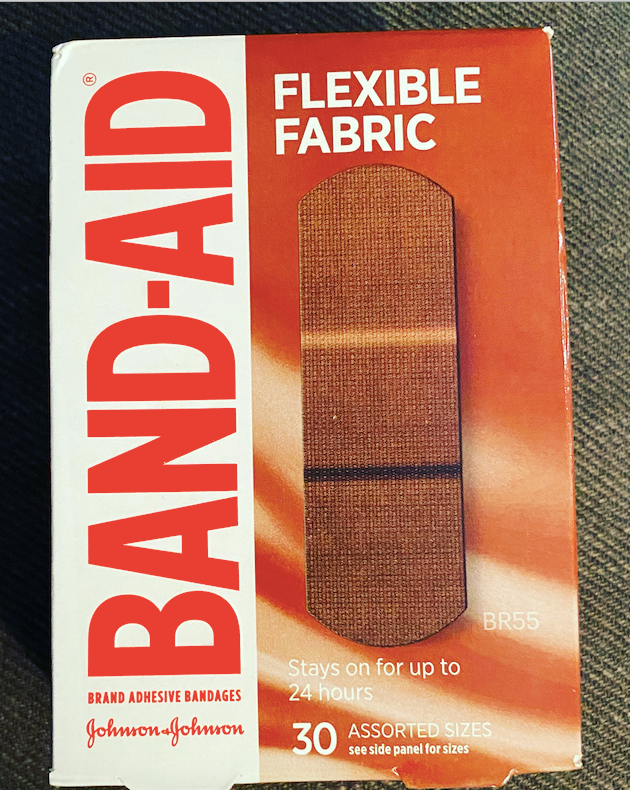
So imagine my surprise during a routine trip to my local supermarket I came across these:
Supplied by author

I did a double-take

I had to look twice, as I couldn’t believe what I was seeing. Now, don’t get me wrong. I’m not so naïve as to think that Band-Aids (or their generic knock-offs) in different colours are only now coming to the fore. I’m well aware that they have been a thing for a while. It’s just that they haven’t been in my neck of the woods and they haven’t been in widely available, easily-accessible general distribution, either.

With no cut anywhere on my body, I snatched them up from the shelf and purchased them immediately. It was almost as if I didn’t buy them then, I wasn’t sure that I’d ever see the likes of them ever again.

Carpe diem.

Not only did I seize the day, I seized both the source and the salve for the pain that I’d experienced for so long.

Finally.

It’s the unwitting acceptance of the status of “other” that is revealed when a situation occurs that challenges that self-perception. One often doesn’t realize that this deeply-buried feeling of one’s “lesser than” status is very real and alive and living in the depths of one’s psyche. It’s only when its existence is undeniable that this status begins to be questioned.

So back to the supermarket.

One would think that this would be it, right?

I can just hear it now: “Okay, you’ve got your skin-matching bandages and you even have crayons that are diverse. What else do you want?” Those who never had to experience death by a thousand cuts — literally and figuratively — each time they had a wound that needed covering, will continue to ask these types of questions.

It’s the lack of empathy, understanding and lived experience by people of colour that make detractors continue to question the veracity of our claims.

It’s this inability to recognize the damage done by something seemingly so trivial that drives these types of questions. It’s also the lack of empathy, understanding and lived experience by people of colour that make detractors continue to question the veracity of our claims. Systemic and structural racism is real: just look at the decades-old acceptable practice of labeling bandages and crayons “skin colour.”

I can just hear it now: “Okay, you’ve got your skin-matching bandages and you even have crayons that are diverse. What else do you want?Those who never had to experience death by a thousand cuts — literally and figuratively — each time they had a wound that needed covering, will continue to ask these types of questions.

Pexels

What took you so long?

What took you so long, Band-Aid, and why now?

I appreciate your eventual acceptance of the diversity in this world, but we’ve been here for millennia. Definitely as long as Johnson & Johnson declared your brand as “America’s #1 Bandage Brand.” And yet, no representation.

Why?

Your origin story is missing a large swath of your consumer base, not only in the United States, but around the world. Why didn’t we matter?

Hey, Band-Aid: Your origin story is missing a large swath of your consumer base, not only in the United States, but around the world. Why didn’t we matter?

I remember growing up in the ’70s and singing along with your most infectious, ear-wormy jingle, “I am stuck on Band Aid Brand cuz Band Aid’s stuck on me!” Your marketing campaign was brilliant — catchy, singable, fun — and it was everywhere. You even had those of us who wished and longed for “Band Aid Brand” to acknowledge our presence, extolling your virtues via song. We couldn’t help it. We were excluded, but singing your praises nonetheless.

Case in point: even with actual Black people featured in your ads, it didn’t occur to you that perhaps it might be a good idea to cater to them just a little bit more. What’s a few darker shades of your standard dye lot cost, after all? And yet, I suspect that this reticence to even acknowledge, let alone cater to such a large segment of society wasn’t even a thought, let alone a smart and obvious business plan for greater customer acquisition.

This ad from the 70’s reveals more about the company than is at first evident. Without a shred of irony or self-awareness, Band-Aid has a little Black girl with a “flesh-coloured” bandage that is about ten shades lighter than her actual skin.

Did no one notice this, or, did they notice and just not care? Would the marketers and the powers-that-be at Johnson & Johnson be as cavalier in their attitude about this part of the commercial if the little girl in question was White and was sporting a dark brown Band Aid?

I think you know the answer.

A step into the 21st century, a century too late

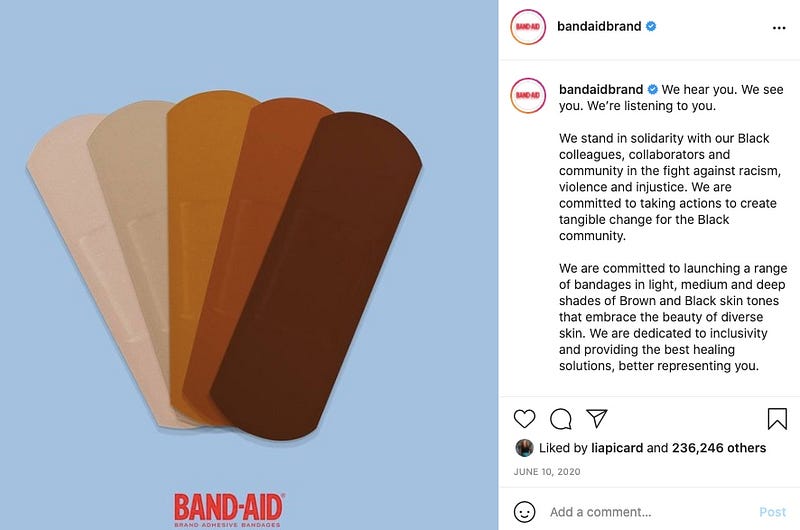
In 2020 Band Aid brand got “woke” or at least they acted as such. On an Instagram post heralding their new awareness that “skin colour” included a range of shades, the brand pronounced that they would be coming out with Band Aids that were more reflective of society as a whole.

“We are committed to launching a range of bandages in light, medium and deep shades of Brown and Black skin tones that embrace the beauty of diverse skin. We are dedicated to inclusivity and providing the best healing solutions, better representing you.⁣”

Band-Aid’s June, 2020 Instagram Post Announcing a Range of Skin Tones
Supplied by author

This screenshot of the June 20, 2020 Instagram post by Band-Aid heralds the company’s eventual acceptance, perhaps grudgingly, of people who don’t fit into the very narrow “skin colour.” Following the murder of George Floyd and the outrage by society, the company had to face the music and rip off the metaphorical bandage quick, revealing the painful wound beneath.

They had been remiss in acknowledging the existence of Black and Brown people in the world, to the pain and detriment of those of us who didn’t see ourselves represented in the most mundane of products — bandages.

They had been complicit in the erasure and complete indifference to the pain that they had caused by this very erasure.

They had been complacent, comfortable and unconcerned about the real damage that they had caused the millions of people whose skin didn’t match their “skin colour” bandages.

The company announced support of Black Lives Matter and their new interest in providing diversely-inspired products (read: darker bandages) is reflected in subsequent Instagram posts that showcase a noticeable collection of darker skin hues.

So what’s the upshot here, anyway? What does this all mean?

From the perspective of Johnson & Johnson, makers of the Band-Aid brand, it can’t hurt to be seen as a more understanding and progressive company, one that cares about all of its existing and potential customers. But the question still remains: what took you so long?

Those of us who have been affected by this century-long erasure are asking ourselves some obvious questions, with the answers fairly obvious, at least from our various perspectives.

Is the company’s recent change of tune performative? Perhaps.

Is it overdue? Absolutely.

Does it indicate a real understanding, an awareness of systemic racism and othering through normalizing the erasure of a whole swath of people? Not sure.

Time will tell.

From the perspective of those of us who have been deeply scarred (pun absolutely intended) by the Band-Aid slight since the company’s inception in 1920, 100-plus years is much too long to finally acknowledge that we exist.

Race
Society
Life
Self
Life Lessons
Recommended from ReadMedium