
I spent 300 Hours Studying Alex Hormozi, the $100M Man — What Empire Are You Moved to Build?
WARNING: This article will probably only resonate with someone seeking wisdom on how to become world class at what they do
Alex Hormozi, together with his wife Leila, has built a massive business empire and went from a broke man to his present net worth of over $100M in ten years flat. But the key to such unlikely success, is in the foundations.

I hated the life my dad wanted me to live. Sometimes your parents dreams have to die in order for yours to live. — Alex Hormozi
In this article, I want to give you my best insights on how you can start to make the pieces come together in whatever pursuit you are thinking about starting, but are perhaps paralyzed by fear due to its scale.
Otherworldly success comes from delving into and exploring the questions that have not yet been asked, or have been widely dismissed as insane.
After reading this, you’ll have a good idea on where to start, but reding the rest of my articles about Alex as well will give you the bigger picture that should make your entire journey much easier —
This one covers what it takes to succeed in business in the internet era. For people more interested in making art like myself, the two most important takeaways were the three core repeatedly observed traits of winners, and the recent shifts in how the global economy operates that you have to understand to market and popularize your work.
The second article is almost entirely based on a live seminar Alex did to help set young entrepreneurs on the right path. It vividly explains the reality of what works when it comes to making lasting progress on your long-term projects and how to do it fast AND effectively (without sacrificing the quality).
This article is my best attempt at making a comprehensive and actionable guide on selling and persuasion; the enviable skill of enticing other to buy what you’re selling. Due to my limited experience in selling, the piece is fully based on Alex’s best content on making killer offers, which is possibly the subject he has covered most extensively so far thanks to his book, $100M Offers.
Let’s not waste any more time and get into what it takes to win.
1. Abandon the need to be instructed
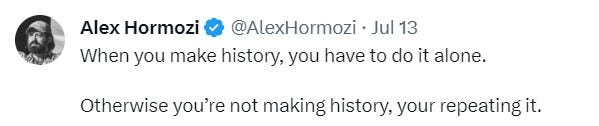
I’m not here to say your dream project will work out, or lay out steps and prescriptions for you to rely on. To be the best in the world at something, you can’t rely on anything or anyone, because by definition, the best in the world has to reinvent the wheel of his industry.
General rules don’t apply to exceptions.
To be the best in any field of human endeavour, you have to figure sh*t out for yourself.
Get obsessed with and learn everything about the traditions and patterns of what came before you in your field like a sponge, but at the same time have the wisdom to reject doing things as “they ought to be done” and start building from scratch, developing and following your own vision as you go.
You come to have many sources and advisors, but ultimately trust only one thing. Your own judgement.
Following Alex’s life has been tremendously significant to my own path, because he has taught me HOW TO THINK about success. The biggest danger to an ambitious person in his early twenties is in my opinion not failing, but rather not setting up the right foudations for later success.
It’s important to note that these are not recommendations, prescriptions, or something you “should” adopt.
Taking any piece of advice on belief alone is always dangerous for someone with big personal goals.
Here I simply want to outline the general frameworks that seem to work the most effectively for a person with, at first glance, overwhelming goals.
I’ll be totally honest, from my experience, no number of articles or self-help segments you can read can by themselves inspire you enough to make this happen, but in case you already are motivated to do it, here is how you can start —
2. Seek knowledge and immersion first

The most important part of the equation is finding The RIGHT thing for YOU to work on. I found that it helps to notice how deeply absorbed I get into the practice when learning something.
The more effortlessly flow states come to me, and the longer they last, the more likely it is this field is one that might be a good fit for me.
Most people rely on temporary wins, external validation or getting paid to maintain their motivation. For those in search of elite performance, this doesn’t go anywhere. We need something more solid to base our confidence on, something that lasts, something that won’t fail us.
The right question to ask is, what is the source of performance?
You should find your own answer, but for me it’s the ability to access those flow states, get absorbed in the process of doing the work by choice, and at any time.
If you can get get into flow states consistently and systematically doing something, you’ve almost already won. The only thing that’s left is to determine if there are any major roadblocks waiting for you in the future —
Ask yourself, will pursuing this path lead to the satisfaction of what I’m looking for?
Do I have the necessary biological requirements to succeed?
In writing you probably do, you just have to find your forte, but if you’re looking at sports or singing, things can be a bit more complicated.
3. Build a strong foundation that is true to you
If you can wait ninety days for the results of your actions, you can win.
If you can wait a year, you can win big.
If you can wait a decade, you can be the best.
If you can wait a lifetime, you can change the world.
— Alex Hormozi
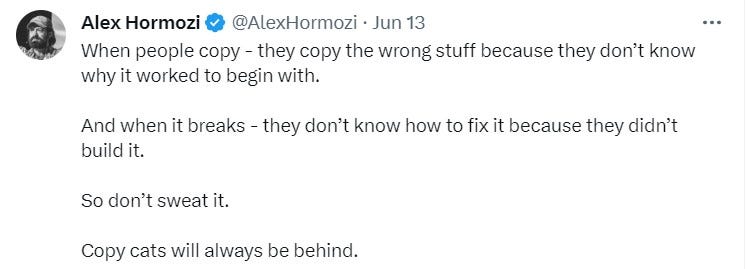
The essence of the mentality a young and genuinely ambitious person would have if he plans to build towards his long-term wins is summed up neatly in one of Alex’s long form tweets —
Two men set out to build a building. One lays the foundation for a 10-story building and finishes the entire building in nine months. The other lays the foundation for a 100-story building and it takes him the entire nine months just to build the first few floors.
The first “being ahead” mocks the second for taking so long. He decides he wants to build his building into a 100-story building to prove how good of a builder he is. So he tries to add stories on top. He gets to 15–16 stories and then the foundation begins to crack. He starts reinforcing things. But no matter what, he feels he can’t put anymore on top.
Over time, the second guy keeps building and passes the first man. Two years later the second man completes his 100-story building despite barely having his foundation finished by the time the first man finishes his entire building.
The first man, goes to a mentor to ask his advice on growing his building taller. The mentor tells him “you need to tear down this building or start another one new” He says “and waste all the time I spent building this one? Can’t I just add it on top if I just knew how?”
The mentor replies “there’s a lesson here: The fastest way to build a 10-story building isn’t the fastest way to a 100-story building. Your desire to grow fast ruined your ability to grow big.”
A lot of entrepreneurs build businesses as though it’s a race. And sometimes they reach their goals. Then they see someone with bigger goals and a bigger business. They then try to build their business into that business. But they can’t. Because the fastest route to a $10M business is often not the fastest route to a $100M business.
Sometimes big things take time. And often that’s what makes them worth pursuing. Don’t compare a sky scraper to a townhouse six months into building.
This anecdote reminds me of how I once heard the Russians used to build roads. They would project how many people will be using them in a hundred years’ time, and then build accordingly.
Build with grateful unknown strangers of the future generations in mind. Timeless pieces of art or infrastructure are all the byproduct of such boldness.
4. Act like a professional
Don’t do your best, do what is required — Alex Hormozi
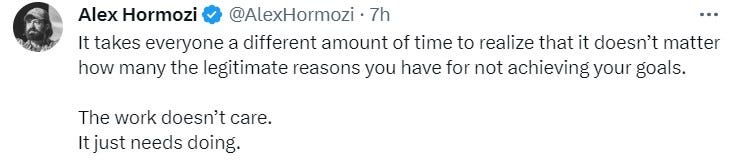
You’ll have to be ruthless with yourself. Stop looking at what you did good and mercilessly examine your deficiencies instead. This applies to any area you’re trying to learn in. Think about it, due to the nature of their field, doctors know it’s unacceptable to do any less than is required — their patients would suffer and die for it.
It’s easier for most to let our dreams die than our patients.
That is the only reason why we accept mediocrity.
Training as a sales person, professional athlete, fiction writer, non-fiction writer… All of them require the same things, that is not in terms of skills, but in terms of having the same self-imposed ruthlessly high standards for yourself.
You’ll have to experiment and find the kinds of discipline and standards that work for you, personally. The root of the word discipline is discipulus, “learner”. In orgin, the word has nothing to do with mindless hard work…
You’ll also porbably find when mixing with others with similar interests as you, that they inevitably won’t be as driven as yourself, and that might hold you back. This is normal. Almost nobody in society genuinely has very high ambitions.
They say it’s lonely at the top for a reason.
If you want to support me, you can join medium using my link.
Good luck.


