
I Studied Alex Hormozi for 250 Hours— Here’s How He Makes Offers His Clients Can’t Refuse
Alex’s genius approach to making offers and closing sales explained in 9 minutes
Alex Hormozi, who started out as a broke gym coach, now helps business owners scale their corporations. Together with his wife Leila, whom he’d married for business, he owns a portfolio of companies which brings in over $200 million/year in revenue.

Though I’ve never met him, Alex has become my mentor through the incredible content he makes and puts out on the internet for free.
His core message is about giving without demanding anything in return.
Paradoxically, everything he or his name touches seems to turn into money. The first article I wrote about Alex made over 200$, keeps getting read, and it’s still making me more money every day —
Since I’m currently working on an eBook/course I’ll have to sell, I revisited Alex’s content to steal his expertise in making offers and closing sales.
Persuasion is clearly one of Alex Hormozi’s strong points, and when he was asked on a podcast what were his greatest strengths he said it was persuading people and prioritizing activities.
The goal of good writing is for people to understand.
The goal of persuasion is for them to feel understood.
In this blog post I’ll explain his process of crafting a good offer and closing deals as concisely as I can manage —
[Disclaimer: The following sales system, if employed, will make you dangerously persuasive, but it doesn’t involve having your friend Luca Brasi (Godfather reference) put a gun to your client’s head and telling them either their signature or their brains are going to wind up on the contract. Sorry.]
In fact, the idea behind it is exactly the opposite.
The person who makes the sale is the perosn who cares the most about the buyer. — Alex
View your client as a good friend who is struggling with making a decision and wants YOU to help him make the right one. You’re not trying to get them to buy, you’re helping them help themselves.
It’s not for you, or about you.
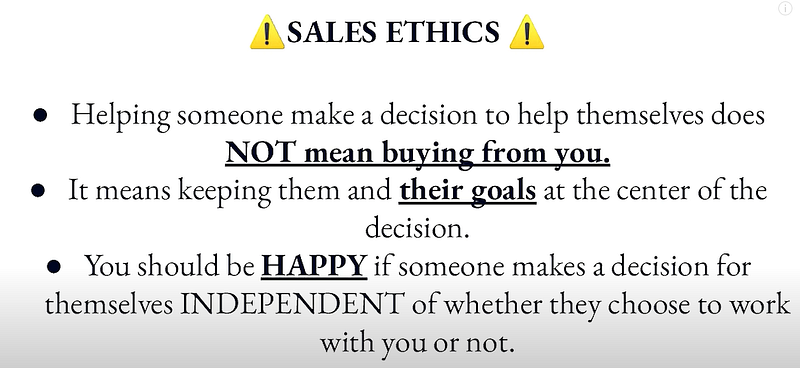
Think of selling as a transference of belief over a bridge of trust.
“At that point you win every time, because you change the metrics you’re measuring yourself by. Because then you don’t care about the sale, you care about the person. And people pay the people who pay the most attention.” — Alex
Start by inquiring on everything about both the client, and the context of the sale.
The first thing you should do is to seek to understand the prospect’s situation. According to Alex, if you can articulate the client’s situation better than they can articulate their situation, the sale is pretty much guaranteed.
The next step is to present them with such an egregiously good offer they’d be foolish to refuse.
In his bestselling book, $100M Offers, Alex systematically explains all of the elements that go into making such an offer.
He calls this framework the value equation.
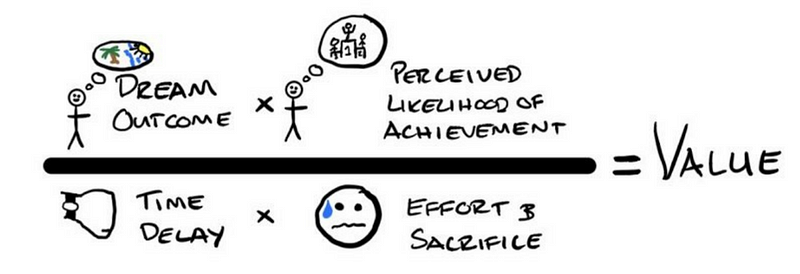
The value equation has four components —
[+] What will happen? (Dream Outcome)
The dream outcome is the gap between the prospect’s current reality and their dreams, the promised land of their mind’s eye. Our goal is to accurately depict that dream back to them, so they feel understood, and explain how our vehicle will get them to the dream outcome they want to get to.
You can contrast your new method with old, ineffective vehicles — for example, reaching out to people with organic content as opposed to using stale and increasingly expensive paid ads.
Tease the prospect with what the realization of their dreams is like, how it might change their life, all the other things it will affect, and how it might feel like to have that vision come true for them.
[+] How will I know it’s going to happen? (Perceived Likelihood of Achievement)
In other words, success rate. We want certainty before we buy something. This is where you present clear evidence to support that you can make the customer’s dreams come true.
As Alex points out, how much would you pay to be a plastic surgeon’s 10,000th patient versus their first? If you’re a normal, sane person, a lot more. Heck, you might even ask them to pay you if you are their first patient ever.
The service is the same, just your level of trust and certainty are different. Essentially, we’re paying extra for the experienced surgeon’s track record.
[-] How long will it take? (Time Delay)
Time delay is the time between a client buying and receiving the promised benefit.
Put simply, the shorter the distance between when they purchase and when they receive value/the outcome, the more valuable your service or product is.
To keep them interested for long enough to get the bulk of the rewards, make the journey itself pleasant and interesting.
[-] What is expected of me? (effort and sacrifice)
This is the part your client has to do to reap the benefits of your product/service.
It’s what it “costs” people in ancillary costs, or “other costs accrued along the way.”
Alex demonstrated effort and sacrifice using the example of fitness versus liposuction as a method for becoming thin —
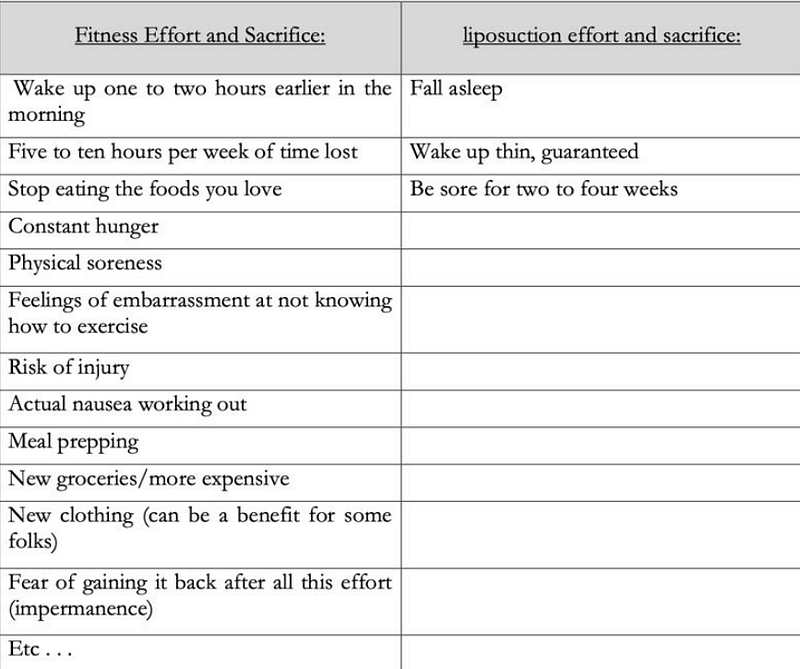
It seems we humans want everything, with no effort required on our ends, and we want it now. Huh!
People are more willing to pay $200 for supplements than they are a $29/mo membership. Taking a pill, or drinking a shake, is so much faster and easier than going to the gym everyday. Hence . . . valued. Crazy world we live in. You can either sit there and make “complain” posts about how people “ought” to be a certain way.
Or you can take advantage of the way people are and capitalize. This book is for those people who want to be victors, not victims of circumstances. You can either be right or you can be rich. This book is for getting rich. If that bothers you, just put this down and go back to arguing against human nature. Hint: You’re not gonna change it. — Alex in $100M Offers
It’s almost always better to spend most of your time optimizing the bottom layer of the equation; focus on making the experience of using your product or service as appealing and effortless for the client as you can make it.
Now we have an understood and receptive client, as well as an irresistable offer. On the off chance everything doesn’t go smoothly from there, here’s Alex’s step-by-step system for handling any commonly made objections that may come up —
The big five reasons people don’t buy
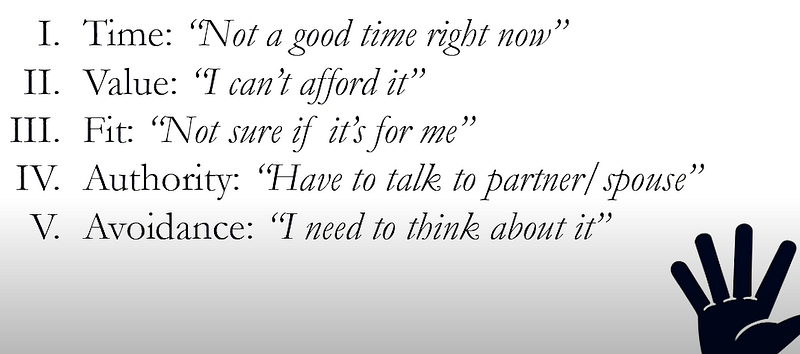
(S) = Salesman (P) = Prospect
I. Time
“I don’t have the time to make use of your product/service.”
P: Your offer sounds great, but I’m too busy at this point in life.
S: Is this something you want for yourself in the long term?
P: Yeah.
S: Do you expect you’ll be busy again at some point in the future?
P: Yeah.
S: Okay. If you want to make this work long-term, don’t you think it would be best if you start now when you’re busy? Life always has busy seasons, and if you can’t make it work when you’re busy it’s not going to last anyway.
II. Value
“The price is too high.”
P: I can’t afford your product/service.
S: I guess this is a lot of money for you.
P: Yes.
S: That’s the exact reason you’ll be successful, because the price you’d pay shows how much it means to you. We vote with our wallets for the things we care about. Would you believe it did what it says for 1/10 of the price?
P: I see. Still, it’s a lot of money.
S: Within the next twelve months, you’re going to spend that money anyway, and it’ll be gone. What better way is there to spend your money than buying other people’s time by taking their lessons to save both your time and the pain it took the person to learn them?
Have you ever had an unexpected bill come up when you had no money?
P: Yeah.
S: You probably managed to get the money somehow, didn’t you?
P: I did.
S: Right. So you do have the ability to be resourceful, at least when someone else needs it. Why not be resourceful for you?
III. Fit
“I’m not sure it’s for me.”
P: I like your idea, but I don’t think it would work for me.
S: If the product/service was perfect, would you buy it?
P: Yeah.
S: What’s the difference between perfection and what we’ve got?
P: Not sure/this thing is missing.
S: If we had this thing, would you buy?
P: Sure.
S: Cool.
IV. Authority
“So and so (person in my life) wouldn’t condone this purchase.”
P: *This person* wouldn’t approve of me buying your product/service.
S: Is your spouse/other authority figure happy that you’re struggling?
P: No.
S: Great, so why would they be against something that’s going to help you fix what they already don’t approve of?
What if the roles were reversed, what if your spouse needed this product or service to make their dreams happen, would you support them?
P: Yeah, I guess I would.
S: Then why wouldn’t they support you? The way I’d explain it to them is that I’m not asking for your permission, I’m asking for your support, because if you don’t let me do this for me, I’m going to end up resenting you, and I don’t want that.
V. Avoidance
“I have to think about it.”
P: This is a fast decision to make. I just met you.
S: How long have you been thinking about fixing your problem?
P: For a while now.
S: Right. So it’s not a fast decision. It’s been in the works for a while now. Now is simply an opportunity to finally do something about it. The question is, what are you most afraid of having happen if you buy?
P: I got scammed in the past. I don’t want to get burned twice.
S: Getting burned twice is what might happen if you get scammed first out of your money and now out of solving your problem.
If you had a bad experience before, why let that stop you from making a good decision now?
Epilogue
The excuses your clients come up with are usually exactly the chains they give their power to and these chains are what is keeping them stuck and in need of your service.
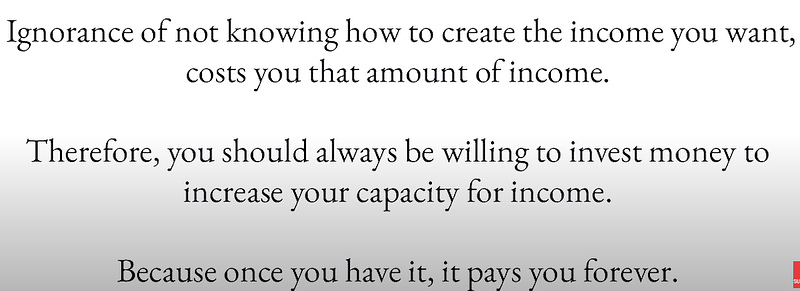
Each decision we make can be either a vote for the person we want to become or a vote for more of the same. Choosing the latter is easier.


