
I spent 200 Hours Studying Alex Hormozi — Here are the top lessons I took from him
Alex Hormozi together with his wife Leila, whom he’d married for business, owns a portfolio of companies which brings in over 150 million/year in revenue.

Alex began as an ambitious gym owner and has since moved on to acquisitions and making online content aimed at budding entrepreneurs. He also wrote a sales book he gives away for 99 cents and became famous for his no-nonsense straight to the point approach, starting off most his videos with the genuine statement “I have nothing to sell you…”
Alex is Pre-suasive
Key points: Alex sells people before he even presents them the offer. He also generally prioritizes his name over making a quick buck.
The charming millionaire
Watching Alex reminded me of something I’d read a while ago; in his bestselling book Pre-Suasion, Robert Cialdini points out that the context and what came before the sale matters just as much if not more than the persuasiveness of the offer itself.
With that in mind, let’s have a look at Alex’s Twitter page —
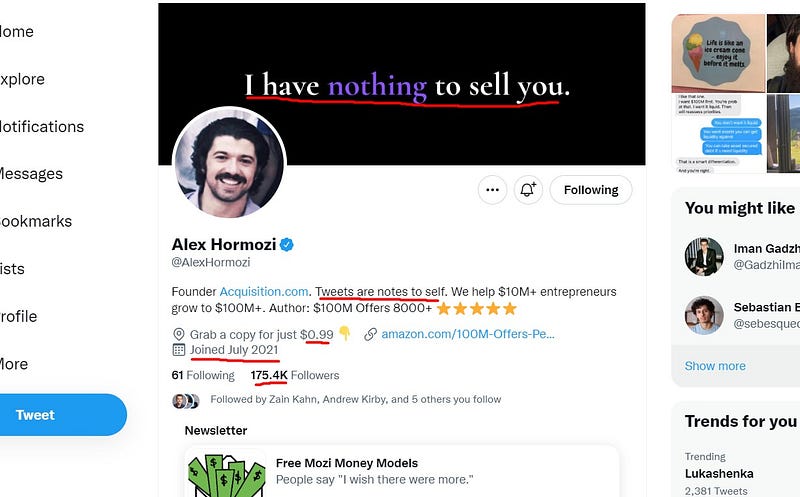
The pre-suasion starts with Alex’s core business philosophy; you should do sh*t first and get some evidence that supports you’re good, then talk about it.
“The stay-at-home teacher saving all of her money could give the same exact investing advice as Warren Buffet, she just forgot to build Berkshire Hathaway.”
— Alex Hormozi
This seems like it’s self-explanatory, and yet people still don’t do it. Judging by a survey Alex did on his site, 88% of the viewers that follow him stated they WANTED to start a business, but aren’t doing the work yet. Do something, then write and make content about it.
The way Alex puts it, when someone makes sure he has plenty of credibility built up in the topics he talks about before talking about them it’s easy to take their word for it, and you don’t need to keep up an extra filter in your mind judging if the information is credible.
I’ve seen the same pattern in how articles perform on Medium; the ones more grounded in personal experience and references tend to do much better than ones full of theory. Schools and unis don’t tend to put enough emphasis on this for most of us.
Reputation plays a key role in his equation
“People say word of mouth is dead because they aren’t getting new customers, when in reality it’s alive and actively sending people to their competition.”
— Alex Hormozi

One of the sales approaches Alex talks about using is that he doesn’t shy away from recommending some items from his competitors to his own clients before closing them on his other products. This gives them a reason to trust him immediately.
Instead of trying to maximize his sales, Alex tries to maximize his credibility.
Mozi cash formula: Goodwill x Offer Quality x # of asks = Amount of money made
“The catch is — the more times you ask, the less goodwill you have, and the longer you can wait, the bigger the ask in the end can be. My preference: undersell your demand. As in, keep more goodwill in the audience than you extract by asking.” — Alex
Prioritizing name over money brings in more money in the long run: fact.
Standard model: GIVE, GIVE, ASK — Alex’s new model: GIVE, GIVE, GIVE.

Attention is the new oil
Key points: If oil was the monopoly to hold in the 20’th century, the battlefield’s now moved onto something new; the minds of the world’s people. According to Alex (or the research he did), successful people tend to share 3 next-to-universal traits.
The newly found most valuable resource
The thing that is being pumped and drilled every day is the attention of the masses. — Alex Hormozi
It blew Alex’s reality when he saw how Kylie Jenner became a billionaire practically overnight (In 2019, Forbes estimated Jenner’s net worth at US$1 billion and called her the world’s youngest self-made billionaire at age 21). It turns out his way of seeing the world, and with it doing business, had been wrong, because until then he didn’t understand the power of brand.
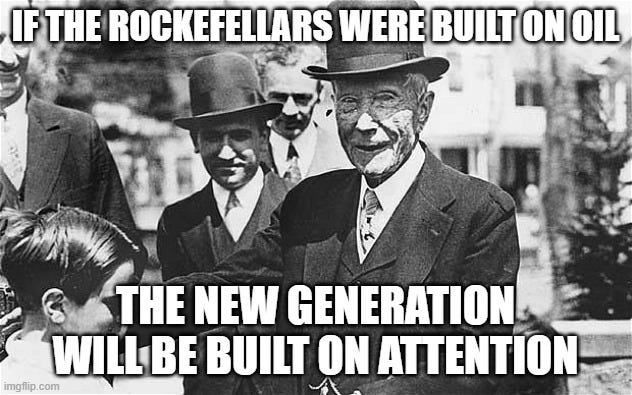
People who manage to fixate the public attention on themselves and build renowned personal brands end up making the biggest exponential leaps in net-worth in the long run, because they can easily partner up and let various companies associate their name with their products. The masses then buy the product for the status of being associated with the name of the celebrity that inspires them.
The attention and importance these people hold in the minds of most everyone with access to the internet IS their biggest asset, and it’s an asset which can be repeatedly transmuted into almost any other form of wealth or even into political influence.
The longer you can wait, the more successful you’re going to be.
— Alex Hormozi
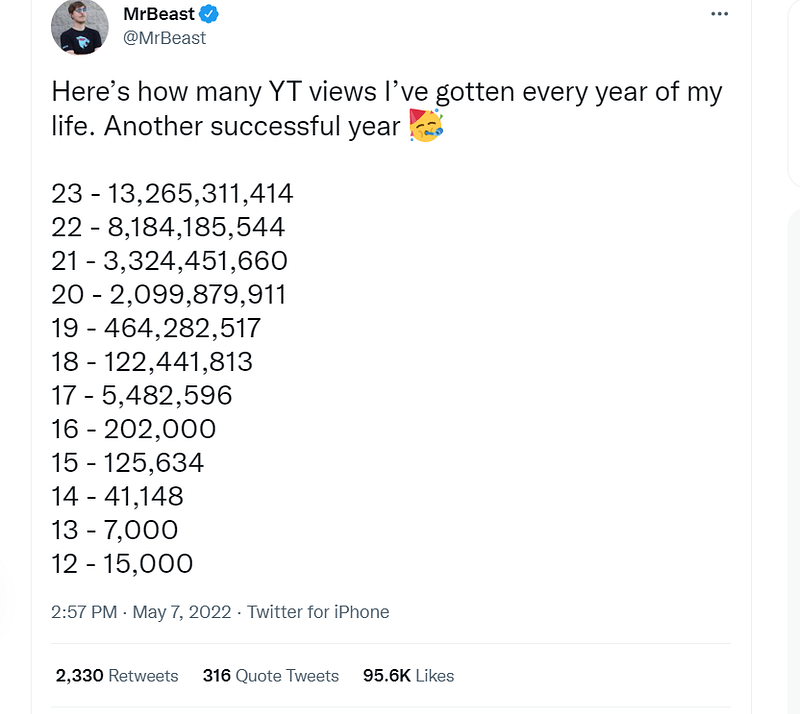
The decisive advantage of attention as the primary currency over old forms of leverage like oil, labor and capital is how fast it compounds when you stay loyal to the brand for years. Take Mr. Beast as an example:
We’re all already chipped

As a side tangent, in a way, the brain chips are already here, we’re all chipped by the persons on the internet we often don’t even know in person but we let live in our heads rent-free, giving them our attention; you see, in our brains, attention and importance are inextricably linked.
Example: Facebook conspiracy theories are likely some of the least important things in the world, but clearly some people think otherwise! Looking at Facebook long enough = eventually growing stupid and believing dumb sh*t like flat earth.
The mechanism isn’t necessarily a bad thing in itself. I willingly spent a large portion of my time and energy studying Alex and Mr. Beast because I felt they knew something important that others don’t, but in this age it’s very easy to forget who we’re giving our attention to and why.
What value does me looking at the news have to me? Upon closer examination it turned out, not much. So I stopped. Ther’re better ways of staying in the loop.
Here’s a fact: as soon as I started to actively audit my attention, where it went and taking back possession of it, my life started to get significantly better.
Back to Alex —
Alex talks about the 3 traits which are supposedly common to most successful people
- Superiority complex (not necessarily in a bad way). Having big goals and/or personal vision and feeling like you deserve to get everything you want.
- Crippling insecurities. Paradoxically, also never feeling like you’re enough, almost like having a raging wildfire closing in behind your heels, constantly spurring you forward. After all, pain, not pleasure, is evolutionarily the strongest motivator.
- Immense impulse control and laser sharp focus. Without this trait, the other two are a sentence to a lifetime of suffering — I got a glimpse of that myself.
Speaking on the trait of impulse control, Alex uses an analogy from the Matrix, the woman in the red dress; distractions come in hundreds of forms, and he says the catch is in that the more successful you are, the more attractive they get and the more self-control it takes to ignore them. Thousands of messages and opportunities you need to say NO to, in order to say YES to the main thing.

Epilogue: Make sure to have the basics down
“Advanced people simply never not do the basics. Most of business success is just doing all the things you know you should be doing, but aren’t.” — Alex Hormozi
“Someone messaged me saying they were struggling to get new clients. I had a minute so I figured I’d see what their funnel and offer was. So I clicked the link in their bio. The link was broken. So many think they’re too advanced to do the basics.” — Alex
Chapters: Intro, The charming millionaire, reputation, the new oil, we’re all chipped, the 3 traits, Epilogue.


