
I Ranked #1 On Google in 2 Hours — New Personal Record
How to quickly rank new content

A few weeks ago, I wrote a story about how I ranked an article number one on Google in 11 hours.
After tweaking my strategy a bit, I recently beat that record by ranking an article at the top of Google search in under 2 hours.
That’s the fastest I’ve ever ranked for any keyword on any website or platform.
Yesterday, I repeated the process on another website with much lower domain authority.
In this article, I want to talk about the three main factors for fast ranking and why I was able to rank in under 2 hours.
The Three Main Factors To Rank Quickly on Google
There are a ton of factors that go into why content reaches the top spots on Google. It would be nearly impossible for me to run through them all in a single article.
In my experience, however, there are three most important factors:
- Competition
- Quality
- Credibility
Let’s quickly run through what each one of these means because understanding the basics will help you repeat my results.
Competition Vacuum
As a Google Ranking factor, competition is often misunderstood. Some people mistakenly believe that they must write articles targeting the highest ranking keywords.
Unfortunately, the more competition there is for a given keyword, the harder it will be to rank for that keyword.
At least, most of the time.
In the early stages of a website’s life, a high level of competition can slow down your growth. What you need is a competition vacuum.
A competition vacuum is a topical blackhole. There is virtually no competition. If there are any other websites that come up in the search results for a specific topic, they are usually niche forums.
Quality Content
The next big ranking factor, in my opinion, is quality content.
When I say, “quality,” I mean a well-written, SEO-optimized, helpful article with original research and hyper-relevance to the keyword/topic. You don’t always need to write an epic, 3,000-word pillar piece of content to rank.
You just need to write a readable article that is on-topic, over 600 words, and brings something new and unique to the table.
Keep in mind, the less competition you have for your topic, the lower quality you need to rank in the #1 spot. You can write a 600 to 800-word article with a few obvious typos and still rank.
In fact, I know many poorly formatted articles with less than 600 words that rank at the top of search results for even a high-volume keyword.
My goal is to always write the highest quality article I can on the topic.
Not only does that nearly guarantee a high ranking, but it also prevents other savvy bloggers from usurping me in search.
Authoritative Credibility
I saved this factor for last but that doesn’t mean it isn’t important.
Google will rank you faster and higher if your website is more authoritative. Once a website has a high enough domain authority ranking, you can rank for almost any topic.
The lower the competition for the topic, the faster you rank.
You earn trust with Google by following the rules, producing lots of high-quality content around a similar topic (called “content clusters”), writing a good “About Me” page with all of your credentials about the topic, and attracting quality backlinks to your content.
The first website on which I ranked #1 in 2 hours has an authority of 94 (out of 100). That’s almost as high a domain score as you can get.
The second time, though, I ranked in under 2 hours on a different website with a domain ranking of 10.
That’s a massive difference in authority and credibility. And yet, I still ranked in the top spot in just two hours.
How?
I’ll let you in on a little secret:
I didn’t use any blackhat methods, private blog networks (PBNs), or shady link-building services. I simply wrote a high-quality article targeting a massively underserved keyword.
And I’m about to tell you one of the keywords.
How I Was Able To Rank in Under 2 Hours
The first keyword I ranked for is, “the invention of blinking.”
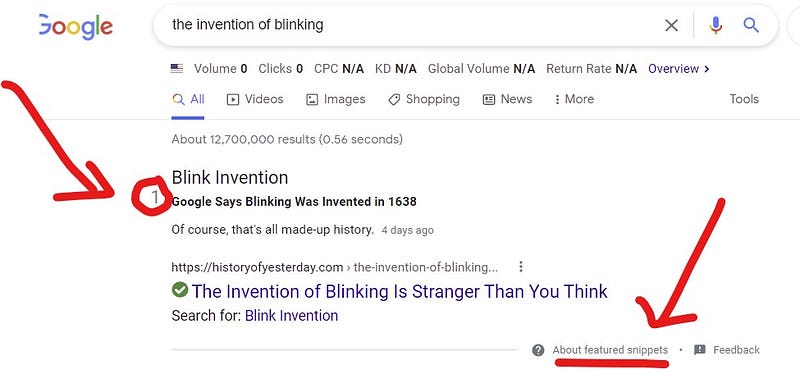
As you can see from the screenshot, not only am I still in the #1 spot (four days later), I also won the Google snippet.
The Google snippet is the small text you sometimes see at the very top of Google search results.
SEO experts and bloggers sometimes refer to the snippet as “Position 0” because you can win the snippet even if your article is not in the #1 spot. Still, the snippet generally ends up getting the largest percentage of the search traffic for a keyword/topic.
In my first article about ranking in 11 hours, my rankings fluctuated over a few days. I think I’m still on the first page but not in the top position. This time, the process worked even better.
I firmly believe that the reason I was able to rank so quickly at the very top of Google was that my keyword had next to no competition. I call these Invisible Keywords.
Mostly, there were forums at the top of Google.
Forums with very little content, made-up content, and irrelevant content. I can rank number one for keywords on even brand new websites when there is no competition.
I think this is the most important factor for me ranking so high, so quickly.
Secondly, I wrote a quality article that was hyper-relevant to the target keyword, “the invention of blinking.”
I don’t find these Invisible Keywords that often, so I knew I needed to strike quickly.
I wrote a 1,000+ word article on the topic of the invention of blinking. I covered the topic from several different angles, included links to credible external resources, and posted the article on a website with high domain authority.
If you Google the term, “the invention of blinking,” right now you’ll see my article is still sitting there at the top.
High authority websites garner deep trust with Google.
The bottom line is that I ranked so high and so quickly because the topic was non-competitive, my article was relevant and high quality, and I posted my article on a website with high authority.
The result was instant trust, instant indexing, and instant ranking.
This is exactly what I repeated with my second article on a much lower-authority website.
How You Can Rank Quickly on Google
If you want to replicate my results, simply find a very low or no competition topic, write a hyper-relevant and quality article on that topic, and then paste the article onto a website or platform with as much authority as possible.
Other than finding keywords manually in Google search, I suggest that you try Ahrefs, Shine Ranker, or Lowfruits.io (not an affiliate link).
These three paid tools seem to help you find low competition keywords the easiest.
Another route you can take is to scour forums like Quora and Reddit. Simply do a Google search for any question asked in these forums. If the top spots for that keyword search are all forums, then you know that you can probably easily win the number one spot for that keyword.
Now, the topic may not get much search volume. But right now we’re more focused on quick ranking.
If you want to rank the fastest, find the topics with the lowest competition, where no other website has written an article directly covering that keyword.
If you can, publish your article on a website or platform that has an 80 or 90 domain ranking.
That’s going to be the fastest way to rank within the first few hours.
If you don’t care about potentially waiting a few days, weeks, or possibly months, you can also use a slower version of this ranking strategy on even brand new websites.
That’s how I build all of my content websites.
Once Google indexes and starts to trust a new website, some of their articles will start to rank in search.
If you wrote quality, relevant content about zero competition keywords, your articles will start to go up in the rankings. You’ll probably end up in the top spot in under 12 months.
With one of my websites that I started last year, I started to see number one rankings within three to four months.
Final Thoughts
I’m constantly experimenting with new Google-approved methods for generating high-quality and high-ranking content on my portfolio of websites.
I hope these tactics help you publish more and rank faster in Google.
You might also like these other articles:
- I Ranked #1 on Google in 11 Hours — This Is How I Did It
- This Is How Many Articles You Need To Make $5K Each Month
- How I Plan to Make Six Figures from Content In the Next Three Years
If you want to support my writing, you can join Medium as a member. If you do, I’ll get a small portion of your fee. Thank you!


