avatarAndrew Gaertner

Free AI web copilot to create summaries, insights and extended knowledge, download it at here

3204

Abstract

a small hole and tap in a metal spout, which will drip sap into the collection bag we hang from the spout.</p><p id="c596">Traditionally, Native American people in this part of Wisconsin tapped maple trees using v-shaped notches on the tree and wooden spouts that dripped into birchbark vessels called “mukuks” (in the Ojibwe language). Later, metal pots and other tools improved the efficiency of sap collection and boiling for the Ojibwe.</p><p id="dbec">Today, maple sap collection and the making of maple syrup and sugar continue to be an important part of the culture for the Ojibwe people in the Upper Midwest, as well as for European heritage people like myself. It is a way to mark the changing of the season and come together with the community around a big project. We also like the end product for our pancakes.</p><p id="db34">Sap collection and boiling technologies have evolved over the years.</p><p id="624b">For sap collection, all of the larger producers use plastic tubing to collect sap, instead of bags or buckets, like the small-time producers like us. Those plastic sap lines are usually connected to a vacuum pump, which gets turned on when the weather conditions are right. The big producers bring the sap to collection tanks and then push it through a reverse osmosis (RO) system, to remove half of the water.</p><p id="328e">Once through the RO, the sap is boiled until it reaches the perfect consistency to make syrup. Too little boiling and the watery sap will ferment, and too much and the hard sugars will precipitate out at the bottom of the jars.</p><p id="89ee">The bigger producers have huge boilers, called evaporators, that live in dedicated buildings called “sugar shacks.” These evaporators will run on wood, gas, or oil. It is amazing to see a sugar shack in full operation because there is one smoke stack for the fire and a second, bigger stack, that is spewing steam.</p><figure id="17cf"><img src="https://cdn-images-1.readmedium.com/v2/resize:fit:800/1*[email protected]"><figcaption>Our mini reverse osmosis system sucking sap out of the middle barrel and dumping pure water out the blue hose and concentrate out the red hose</figcaption></figure><p id="1469">Our small operation of 100 taps uses bags to collect sap, buckets and barrels to haul sap to the evaporator, a small RO to filter the sap, and a wood-fired boiler to turn it into syrup.</p><figure id="e668"><img src="https://cdn-images-1.readmedium.com/v2/resize:fit:800/1*[email protected]"><figcaption>The evaporator we use was made from an old oil barrel turned on its side. Notice the mud from the later part of the season. Once the trees bud out, we have to stop collecting, but there is a little time after the snow melts before the trees bud.</figcaption></figure><p id="2584">On a good day during the peak season, we can collect over 300 gallons of sap. We can process it into syrup at a rate of about 15–20 gallons per hour. This means at least twenty hours of boiling per sap run, and 5 to 10 of those sap runs in a typical season. That is a lot of boiling!</p><p id="1f06">We have children from the school who help drill the holes in the trees and hang the bags

Options

from the spouts. Other children come to help carry buckets and keep the fire going. We involve the whole community. We roast marshmallows and hot dogs over the fire and tell stories. It is the first big event of the year where we need people to help us on the farm, and people like to be of use, especially children.</p><p id="7ce8">Sap extraction doesn’t harm the tree when done in a sustainable manner, and the product is much healthier than cane or beet sugar.</p><p id="758d">Why do I love maple sap season?</p><ol><li>I love being in the woods on a warm late winter day. It could be 40 degrees (Fahrenheit) and it feels much warmer.</li><li>I love the bird sounds. The chickadees and the sandhill cranes especially.</li><li>I love drinking fresh sap straight from the tree.</li><li>I love sitting around a fire with friends.</li><li>I love using functional ways to build my muscles and endurance.</li><li>I love being grateful for food from a tree. I love publicly expressing my gratitude and showing children how to give thanks to the trees.</li><li>I love coming back to the same trees year after year. They are friends.</li><li>I love that there is a distinct beginning and end to maple sap season. It ends just as greenhouse season starts to get busy.</li><li>I love that maple sap flow is unpredictable.</li><li>I love how we can teach about science while doing practical work that is fun.</li></ol><p id="9ca9">Please check out these other writers’ responses to the seasons prompt.</p><p id="8498"><a href="undefined">Angie Mangino</a> writes about spring:</p><div id="1dd5" class="link-block"> <a href="https://readmedium.com/is-nature-calling-you-to-grow-2ad7456ebc3b"> <div> <div> <h2>Is Nature Calling You to Grow?</h2> <div><h3>The season of Spring offers that possibility</h3></div> <div><p>medium.com</p></div> </div> <div> <div style="background-image: url(https://miro.readmedium.com/v2/resize:fit:320/0*xOA7BeMbHGZff-_t)"></div> </div> </div> </a> </div><p id="1561"><a href="undefined">Aarti Tailor</a> writes about seasons in Canada:</p><div id="ad39" class="link-block"> <a href="https://readmedium.com/seasonal-shifts-on-our-ever-changing-planet-4e94b5b3e996"> <div> <div> <h2>Seasonal Shifts On Our Ever-Changing Planet</h2> <div><h3>Nature Prompt- Changing seasons</h3></div> <div><p>medium.com</p></div> </div> <div> <div style="background-image: url(https://miro.readmedium.com/v2/resize:fit:320/0*gFX6vH_VyaZuwrrL)"></div> </div> </div> </a> </div><p id="e6ed">Thank you to <a href="undefined">Sahil Patel</a> and the others on the editorial team at Reciprocal.</p><h1 id="cf35">Changing Seasons</h1><p id="f5c4">Which season is your favorite and what it teaches you about life? When you think of the changing seasons, what feelings come to mind? Share your thoughts, experiences, and tales about the seasons.</p></article></body>

I Love Maple Syrup Season

One of my favorite times of the year
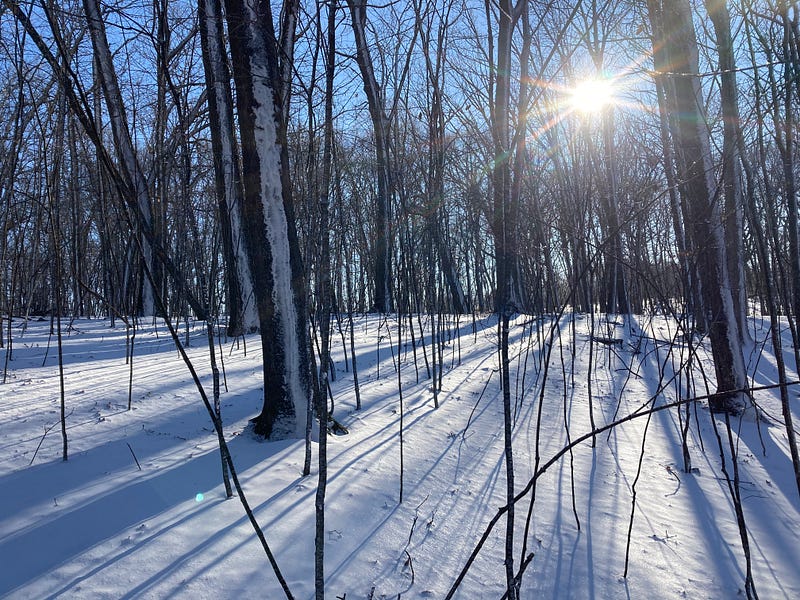
All photos by the author

My favorite season is the one I’m in right now. That will also be true at every other time of the year, but I do love this one especially.

I live and work on a farm that is owned by a Montessori school, and much of my life is spent outside on the land caring for animals, raising gardens, and exploring the fields and forests of this 160-acre farm.

We are in Northwest Wisconsin, which is in the Upper Midwest of the United States, and because of our location in the north, we can get very cold winters and very warm summers. That means that get all the traditional seasons.

In my daily connection with the land, I know that there are seasons within seasons. I love them all. We are coming into one of those nested seasons. It is about to be maple sap season.
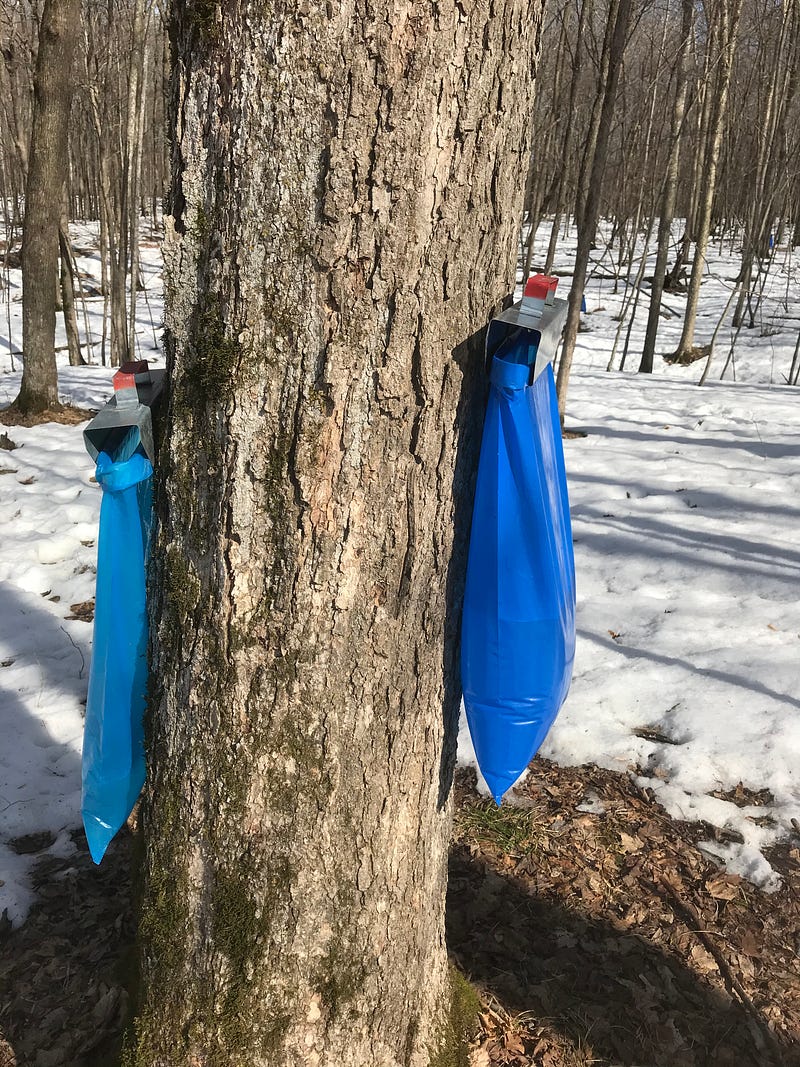
Sap bags hanging from the spouts, filling up on a sunny day

In the late winter, when the daytime temperatures climb above freezing, and the nighttime temperatures dip back below freezing, the sap flows in the maple trees in the forest on our school’s farm.

The sap is actually always there, but there is something about the freezing nights that builds pressure up inside the tree. As the sun warms the tree during the day, that internal pressure will push thawing sap out of any open wound on a maple tree. Once the tree thaws all the way, the sap will stop flowing, because the pressure will equalize between the outside of the tree and the inside. At least that is how I understand it. I think there is actually more to it.

But we do know that sap will only flow when it freezes at night and thaws during the day. In our area, those conditions happen mostly in November and in March. The sap in November is not very sweet. It would take about 120 gallons of November sap to make 1 gallon of maple syrup. Something happens in the tree over the winter to concentrate the sugars in the sap. By March, the ratio of sap to syrup is about 45 gallons of sap to one gallon of syrup. Much better, considering we have to boil off all that extra water in order to turn sap into syrup.
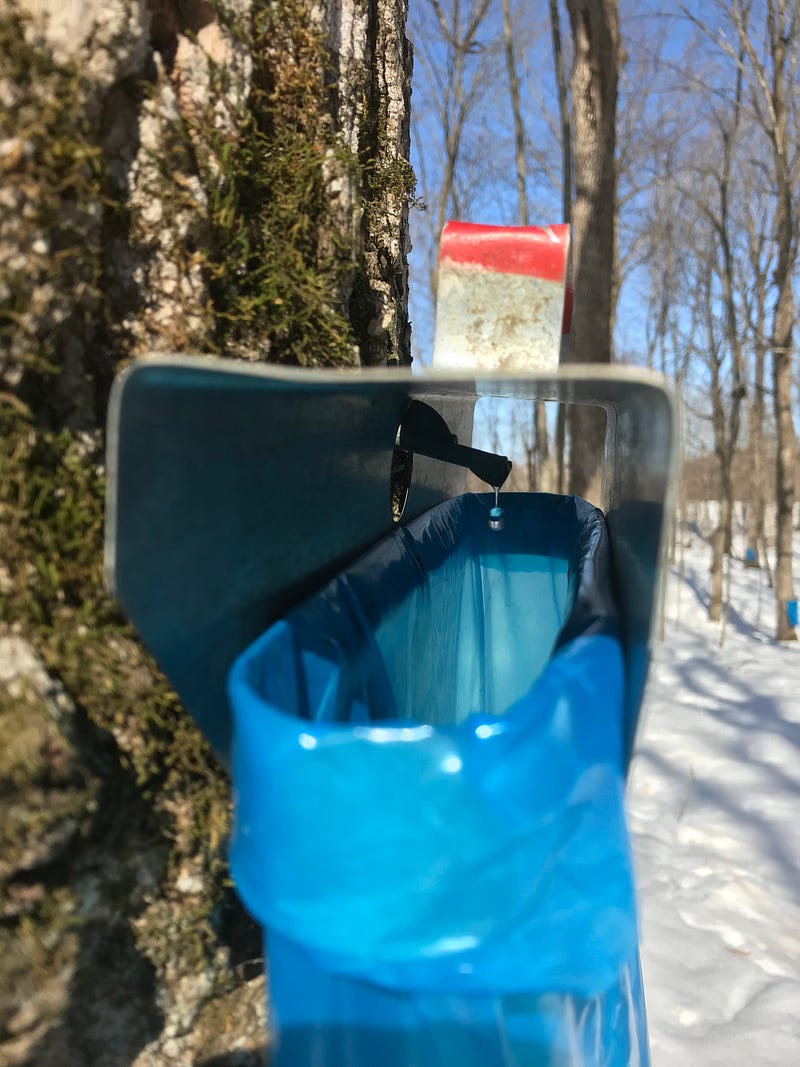
Caught in the act! Drip. Drip. Drip. A big tree can give about 25 gallons of sap over the course of a typical season, but it can vary significantly based on the weather and size of the tree.

I have seen maple sap flow out of the tips of branches that the deer have eaten. It just falls out onto the ground, until the tree heals over the wound. But if you want to collect the sap, it helps to be deliberate about how you make the wound on the tree. We drill a small hole and tap in a metal spout, which will drip sap into the collection bag we hang from the spout.

Traditionally, Native American people in this part of Wisconsin tapped maple trees using v-shaped notches on the tree and wooden spouts that dripped into birchbark vessels called “mukuks” (in the Ojibwe language). Later, metal pots and other tools improved the efficiency of sap collection and boiling for the Ojibwe.

Today, maple sap collection and the making of maple syrup and sugar continue to be an important part of the culture for the Ojibwe people in the Upper Midwest, as well as for European heritage people like myself. It is a way to mark the changing of the season and come together with the community around a big project. We also like the end product for our pancakes.

Sap collection and boiling technologies have evolved over the years.

For sap collection, all of the larger producers use plastic tubing to collect sap, instead of bags or buckets, like the small-time producers like us. Those plastic sap lines are usually connected to a vacuum pump, which gets turned on when the weather conditions are right. The big producers bring the sap to collection tanks and then push it through a reverse osmosis (RO) system, to remove half of the water.

Once through the RO, the sap is boiled until it reaches the perfect consistency to make syrup. Too little boiling and the watery sap will ferment, and too much and the hard sugars will precipitate out at the bottom of the jars.

The bigger producers have huge boilers, called evaporators, that live in dedicated buildings called “sugar shacks.” These evaporators will run on wood, gas, or oil. It is amazing to see a sugar shack in full operation because there is one smoke stack for the fire and a second, bigger stack, that is spewing steam.
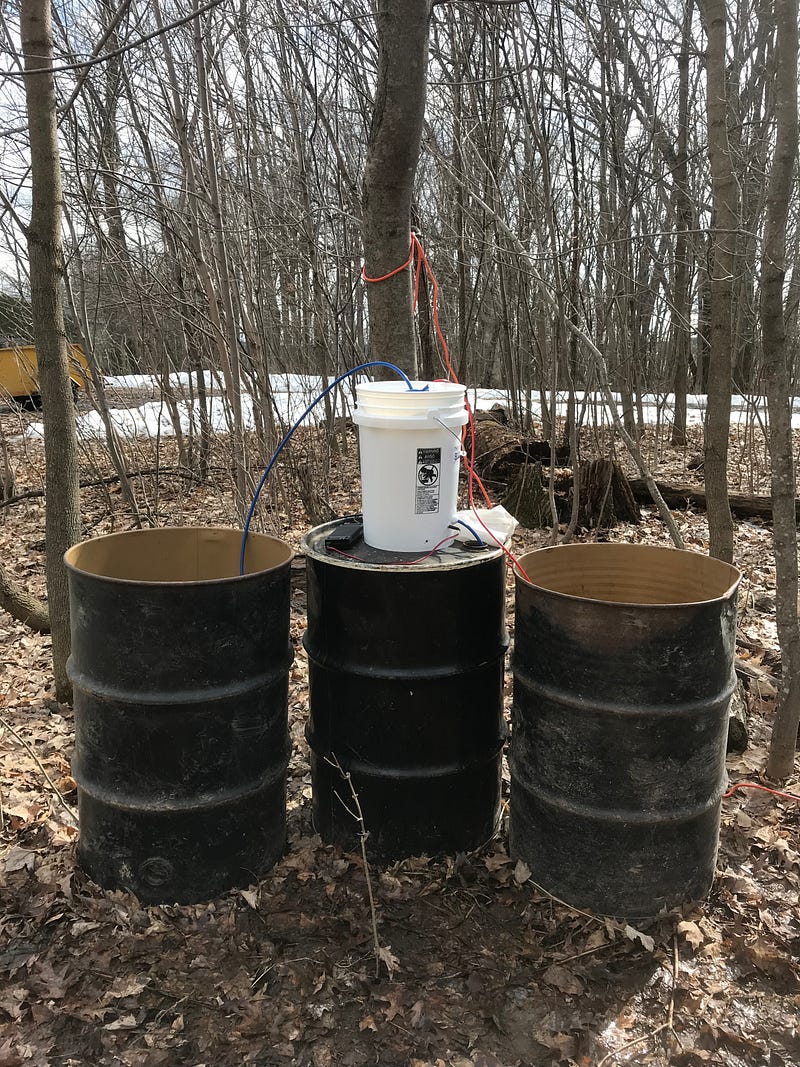
Our mini reverse osmosis system sucking sap out of the middle barrel and dumping pure water out the blue hose and concentrate out the red hose

Our small operation of 100 taps uses bags to collect sap, buckets and barrels to haul sap to the evaporator, a small RO to filter the sap, and a wood-fired boiler to turn it into syrup.
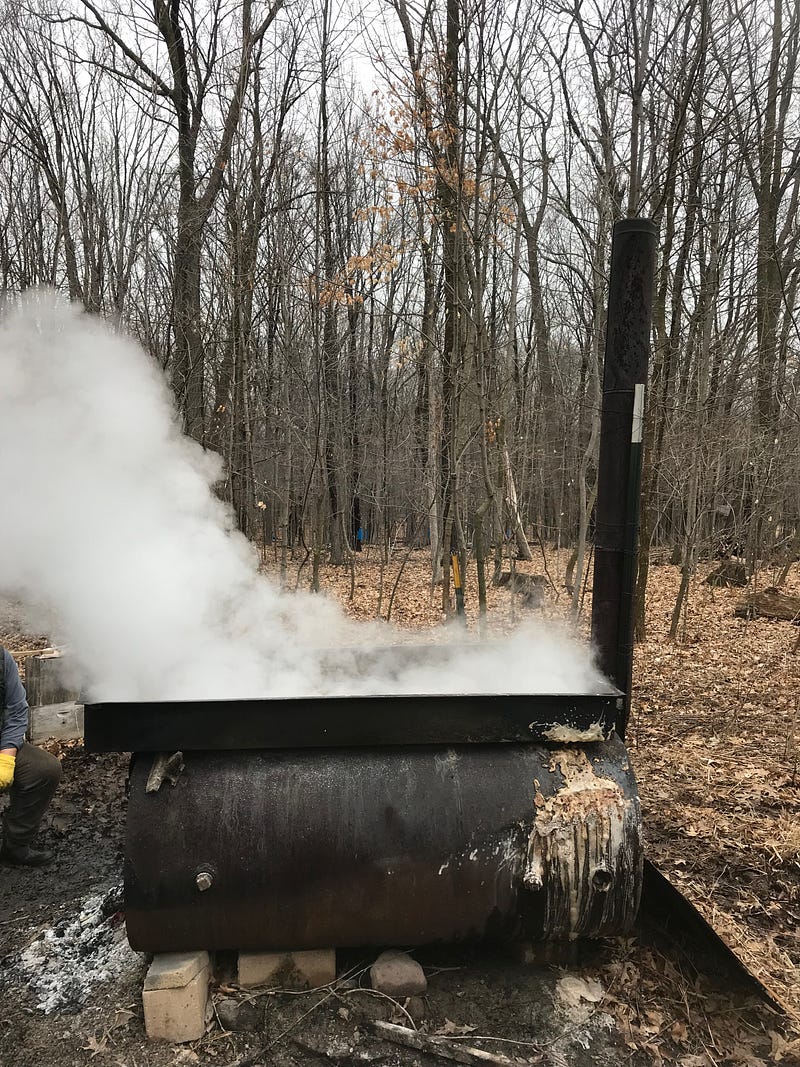
The evaporator we use was made from an old oil barrel turned on its side. Notice the mud from the later part of the season. Once the trees bud out, we have to stop collecting, but there is a little time after the snow melts before the trees bud.

On a good day during the peak season, we can collect over 300 gallons of sap. We can process it into syrup at a rate of about 15–20 gallons per hour. This means at least twenty hours of boiling per sap run, and 5 to 10 of those sap runs in a typical season. That is a lot of boiling!

We have children from the school who help drill the holes in the trees and hang the bags from the spouts. Other children come to help carry buckets and keep the fire going. We involve the whole community. We roast marshmallows and hot dogs over the fire and tell stories. It is the first big event of the year where we need people to help us on the farm, and people like to be of use, especially children.

Sap extraction doesn’t harm the tree when done in a sustainable manner, and the product is much healthier than cane or beet sugar.

Why do I love maple sap season?

  1. I love being in the woods on a warm late winter day. It could be 40 degrees (Fahrenheit) and it feels much warmer.
  2. I love the bird sounds. The chickadees and the sandhill cranes especially.
  3. I love drinking fresh sap straight from the tree.
  4. I love sitting around a fire with friends.
  5. I love using functional ways to build my muscles and endurance.
  6. I love being grateful for food from a tree. I love publicly expressing my gratitude and showing children how to give thanks to the trees.
  7. I love coming back to the same trees year after year. They are friends.
  8. I love that there is a distinct beginning and end to maple sap season. It ends just as greenhouse season starts to get busy.
  9. I love that maple sap flow is unpredictable.
  10. I love how we can teach about science while doing practical work that is fun.

Please check out these other writers’ responses to the seasons prompt.

Angie Mangino writes about spring:

Aarti Tailor writes about seasons in Canada:

Thank you to Sahil Patel and the others on the editorial team at Reciprocal.

Changing Seasons

Which season is your favorite and what it teaches you about life? When you think of the changing seasons, what feelings come to mind? Share your thoughts, experiences, and tales about the seasons.

Reciprocal
Nature Prompt
Maple Syrup
Winter
Seasons
Recommended from ReadMedium