
I Believe I’m Healing The World By Talking Openly About Sex
I know that at a minimum, I’m healing myself
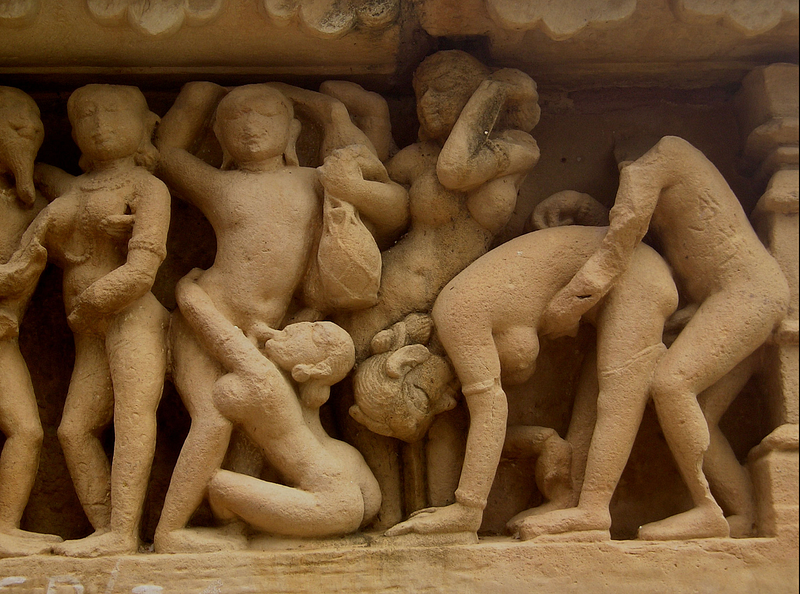
Throughout history and from cultures all around the world, sex has been described and depicted as an important part of life, including at times as a part of worship. The Khajuraho Group of Monuments are Hindu temples and Jain temples in Madhya Pradesh, India that are famous for their erotic sculptures.
The primary deity of ancient Sumeria and Mesopotamia was the Queen of Heaven, the goddess who brought not just sexual love and procreation, but the gift of all life, wisdom, truth, and justice. She went by many names, depending on the culture — Inanna, Nan, Nut, Ishtar, Isis, Au Set, Asherah, Attar, and Hathor, to name just a few and the women who made love in the temples in her name were known as sacred women and the undefiled.
But today in many circles, it’s considered not quite polite to talk about sex even though sex is not only a fundamental instinct, but it’s potentially one of the most beautiful and transcendent experiences that human beings can have. Sexual energy is at its core a vital essence that comes from the same generative source as other forms of creative energy. But even beyond the numinous aspects, it just feels good and is fun. So why is sex considered by some to be something that should not be talked about or described?
There’s nothing wrong with wanting to keep things that you consider to be intimate private, but there’s also nothing wrong with sharing an important part of yourself and your life with others. Treating sex talk as unseemly or lurid just perpetuates the belief that sex is dirty and that talking about it is somehow slutty or transactional.
Sex is the most natural thing in the world, and it was only with the arrival of patriarchy, about 6 thousand years ago that it began to be stigmatized but also controlled. No longer did a woman’s body belong to her. Instead, it became a piece of property to be transferred from her father to her husband for whatever purposes they deemed appropriate. Sex went from something that was an expression of giving and receiving pleasure and a celebration of the vibrancy of life to something that was done by a man to a woman, whether she wanted it or not or experienced any pleasure.
Patriarchy as a social system is based on a dominance hierarchy. Social classes and gross disparity in wealth first came into being when patriarchy arose, and power began to be wielded by a few for their own interests rather than by the larger group for the good of all. Although this new dominator model was about far more than a power differential between men and women, that none-the-less was a central aspect of how women’s bodies and female sexuality came to be viewed — through this lens of ownership and control.
This is why the reconceptualization of the female body from a symbol of sexual and spiritual power to an object under the control of men was integral to the prehistoric shift to a dominator social organization. This reconceptualization of the female body as an object to be controlled by someone outside that body had a number of important results. It certainly justified men’s domination and exploitation of women’s bodies — be it as instruments for procreation and/or recreation, or to render men services and work in their households. It also gradually led women themselves to image their bodies from a male perspective shaped by the dictates of a dominator system.
Eisler, Riane. Sacred Pleasure . HarperOne. Kindle Edition.
A part of my philosophy of life is to challenge everything to see if it actually works for me. I’ve always done this to some extent but even more so in the past 7 years when my husband James and I first started talking about opening up our marriage. Heading down that road together meant that we absolutely had to question everything we’d been told before about what marriage is like and what it means, and although that was sometimes a bumpy road, it ultimately led us to a place where we are both very happy. In questioning the traditional and the expected, we found a deeper relationship for ourselves, as well as a more expanded view of love all around. In opening our sex lives to include other people, we began to feel more at ease in ourselves as human beings — sensual, connected, and empowered in a new and different way.
This was particularly true for me. Going to sex clubs and other sex-positive environments helped me to learn to reclaim my sexuality (which I didn’t even consciously realize needed healing or reclaiming until then). And it also helped me to learn to inhabit my sexual self in an entirely new way.
These were places where I felt encouraged to express my sexual self both mentally/emotionally and in the most literal sense. I have never felt more safe and respected around men in a public space in my life. I was always comfortable with my husband, but that was in our private world, within the confines of our marriage. Out in public from about age 10 on, my body and my sexual self got commented on, groped, leered at, and judged. For the most part, I tried to keep it under wraps in order to avoid that, although there was no getting away from this environment. The club was the complete antithesis of this.
As I wrote in Nearly Naked In The Club, “She is free to be as sexually forward or expressed as she wants with no slut-shaming or entitlement. What she has on isn’t seen as an invitation. There’s no assumption that she is dressing to get male attention. Women dress to have the enjoyment of owning their sexuality in a semi-public venue and she may or may not share that sexuality with anyone else present and that is considered completely acceptable.”
Until that time, I wasn’t conscious of how deeply I had internalized the societal message that my body exists for the pleasure and enjoyment of others, rather than for myself. It’s such a pervasive message for women in our culture that it truly is the ocean we swim in. Even if you seek to consciously step out of that messaging, it’s difficult because it is all around you and has been from before the time that you were old enough to even be aware of it.
Nearly every depiction of women in the public eye is centered around the male gaze. It’s not enough to simply proclaim that you don’t agree with that. That’s not enough to dismantle it. Writing about sex and sexuality has been one of the ways that I disengage from that old paradigm. Of course, there are men (and some women) who read my stories and make the assumption that it’s the same old dynamic, where I am revealing myself for their prurient pleasure rather than for my own purposes.
But just as I used to walk around a sex club half-naked for my own enjoyment and pleasure, dancing for the feel of my body in motion, and enjoying the connections that I made under my own terms, so too is my sexual writing. I enjoy expressing that primal part of myself that was previously so suppressed and appropriated by others. I enjoy the connections I make with those who feel the same way and I love hearing that I am inspiring other people of all genders and sexualities to find and express their true sexual selves as well.
I can’t even count the number of personal messages I’ve received thanking me for being so open and honest, for sharing my journey, and for helping someone else to claim their own sexuality. If instead, you view what I write as a commodity that I’m hawking for a buck, for the gawking pleasure of men, to gain their attention and affirmation, you’ve completely misunderstood.
There is a wide range of people, from conservative politicians and religious leaders to some feminists, who think that any public expression of female sexuality is intended to be enticing to men, and is therefore unacceptable. This outlook is disempowering to women no matter where it comes from because it strips away women’s agency and reduces them once again to nothing more than a commodity to be consumed with no other possible options.
As E. L. Byrne said in her marvelous story, My Sexual Liberation Doesn’t Belong To You, “Once I accepted who I am and how I want to express myself sexually, I could show myself to other people and be truly seen for the first time.” I have some friends, strong, feminist women, who enjoy posting pictures of their body in various states of undress on the internet. That’s not the way that I express and claim my sexual self in the world, but I totally respect and honor that it is theirs.
There can be no equality without freedom — and the freedom to inhabit and share this very fundamental aspect of humanness in the way that any woman wishes to without censure and without entitlement is a cornerstone of that. To boldly affirm this out in the world is one of the ways that I support bringing change to our culture. As far as we’ve come since the 1970s, women’s sexuality is still policed and shamed at the same time that it is also exploited and commodified. I write as I do to further challenge and dismantle that, for myself and for others as well.
I consider how and what I write to be a large part of my work in the world. It’s my contribution to healing old narratives about shamefulness and entitlement, both in the culture and within my own life. Other people should honor their own level of comfort but may wish to ask themselves what that discomfort is actually about. Have you unconsciously internalized Victorian mores or patriarchal narratives? Are you engaging with your sexual self in the way that you want to be, or simply in the way that you believe that you should?
I’ve done the work to uncover my true sexual being and I am comfortable with the way that I express that. It’s OK if you aren’t, but that’s really about you and not about me. I firmly believe that I am helping to heal the world, and I know that I am continuing to heal myself and for me, that’s what really matters.
© Copyright Elle Beau 2022