
How Women Reclaim Their Bodies
From a world that has a lot to say about them
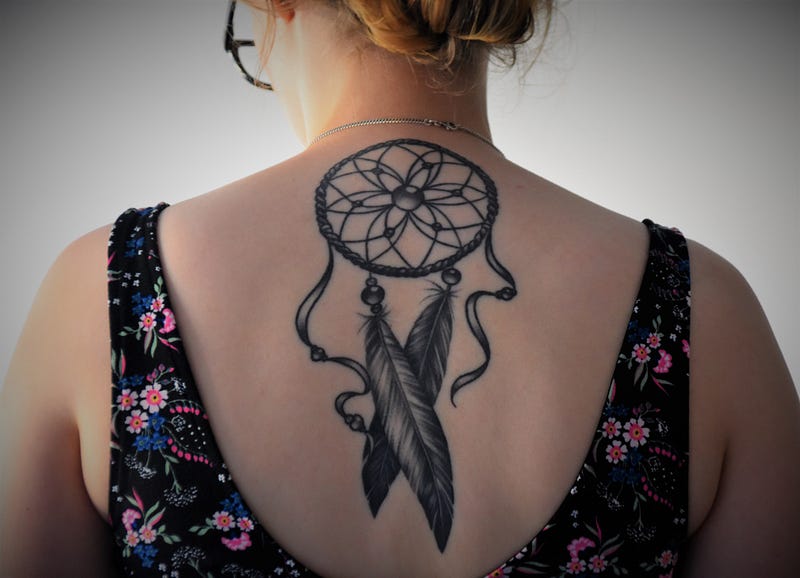
My lover Tamera is covered in tattoos. She has two full sleeves, an elaborate mural on her back, and a bunch of different images and symbols on her legs. They look great on her and she recently appeared in a national tattoo magazine. What Tamara has to say about getting ink is that it gives her confidence. She has decorated her body in a way that she has chosen and it makes her very happy because it makes her feel like herself.
I feel the same way about tattoos, although I only have 5. Each one means something to me and expresses something about who I am. They are a part of the way that I have reclaimed my body from a world that tells me that it belongs to them. I didn’t realize that was what I was doing at first, but it does a lot to explain why tattoos are so addictive.
From the time I was about 10 years old, my body was publicly commented on, whistled at, and gawked at. The pervasive message was that my body was for public consumption. At times I was groped by men who thought that because I was in a public place, my body was also available to them to touch — on the subway, in a bar, on the street. This is a common thing that most women have experienced, where even if their body has never been inappropriately touched by a stranger, it has been virtually appropriated in other ways.
I know this because particularly since #MeToo, we’ve started to talk about it more, and even women my mother’s age have stories. I’ve heard hers as well as those of some of her contemporaries. In fact, often theirs are the worst because they grew up in a time where it was just considered a part of being female to have to deal with this kind of thing. It is a disempowering experience, which I guess is the point and the fact that there is little you can do to stop it only compounds that.
Decorating her body in a personalized manner is one of the few ways that a woman can begin to reclaim her bodily autonomy. Even women who aren’t consciously aware that this is what they are doing may still be claiming their bodies without even realizing it. Simple and widely available personal decoration such as jewelry choices or fingernail art doesn’t just say, “This is me,” they also affirm the right to adorn the body as the woman herself sees fit and that is a bid to reclaim it, not just from men who feel entitled to it, but from society more generally, which always has a lot to say about women’s bodies.
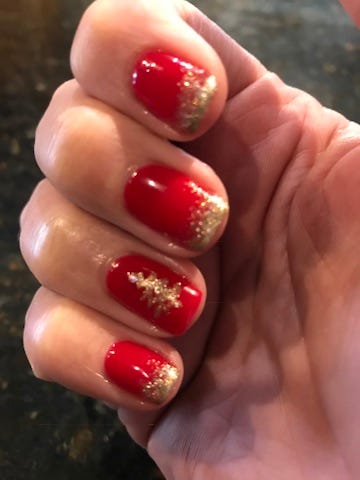
I don’t typically do a lot with fingernails, preferring to keep them natural most of the time, but it was fun one December to have my nail tech apply a design that I had chosen. This kind of personalized nail art is very popular and I think that it’s because it isn’t so much saying, “Hey, look at me,” as it is saying “Since I fully expect that you will be looking at me, consuming me and judging me, I’m at least going to have control over what is on my body.”
Another thing that has gotten increasingly more individual is hair color. I have pink highlights in mine most of the time and many of my friends make a statement with their hair, even if not in quite that bold a manner. I think that many people assume this is to be attractive to men, or at least to conform to standards of attractiveness for other women.
For young women, this may well be the case, but it’s no secret that women in mid-life often experience a kind of awakening where they are no longer so concerned with societal expectations and norms and begin to truly find themselves in new ways. The middle-aged women I know don’t dress in one uniform fashion-of-the-moment manner. They dress to be self-expressed, often giving up high-heeled shoes and other uncomfortable clothing that they used to force themselves into for show in favor of whatever works for them. I absolutely love seeing this kind of confidence in action.
One of my favorite transformations of this type was the principal of my son’s elementary school. When Hugh started there in kindergarten, she had long, straight, brown hair and wore corduroys and blouses with little flower prints. By the time he left for middle school, she had cut her hair short, dyed it blond, and frequently wore skirts and red shoes. She went from someone who was a bit mousy, perhaps not wanting to be noticed, to someone who claimed her physical appearance for herself in a way that she really enjoyed.
I know what that’s like, trying to melt into the background with bland attire. Until about 15 years ago, I only wore single-color clothing without any patterns. Bluejeans or grey pants with a white shirt was almost a uniform. I was hoping not to be noticed, but at 6 feet tall, that was never going to happen, no matter what. Still, I hoped to mitigate some of the unwanted attention that I’d gotten from a young age by not dressing in a way that stood out.
I finally stopped trying to disappear and instead began buying things that made me happy because they helped me to feel like me. I’d never wanted tattoos and then suddenly at age 47, I did. I painted my toenails a shiny teal and started playing with hair color. I stopped worrying about what the world might have to say about how I dress and adorn myself and instead just started doing it to suit myself. I don’t care if I’m “too old” for short skirts or pink hair. I’m not trying to dress young; I’m dressing to be myself.
I feel more at home in my body now than I did when I was in my physical prime in my 20s and people would ask me if I were a model. Tamara is still in her mid-30s, but she feels more confident and at home in her body as well, even though she’s still in great shape. It’s not about being able to satisfy the societal metrics — it’s about feeling like your body belongs to you, the woman who lives in it.
Personal decoration and adornment is one of the ways that many women reclaim their bodily autonomy from a world that wants to tell them that it doesn’t really belong to them. It doesn’t stop the leering or the street harassment or the judgement, but it does help women stand up straighter in the face of that, and that in itself is hugely important.
Most men have no concept of what it’s like to be constantly told from a young age that your own body doesn’t really belong to you and that other people, including strangers, have rights to it. After a while, it’s very easy to begin viewing your body through the lens of how you believe other people are viewing it and whether or not it is pleasing to them, rather than what you think or feel.
This kind of self-objectification is all too common in our culture, particularly for young women, although men can also self-objectify. Finding ways to move away from that is important for healthy self-esteem and confidence. Reclaiming your bodily autonomy in whatever way is personally meaningful helps to create a boundary between the world and you.
© Copyright Elle Beau 2020 Elle Beau writes on Medium about sex, life, relationships, society, anthropology, spirituality, and love. If this story is appearing anywhere other than Medium.com, it appears without my consent and has been stolen.


