
In Praise of Hedonism
The necessity of living life with passion
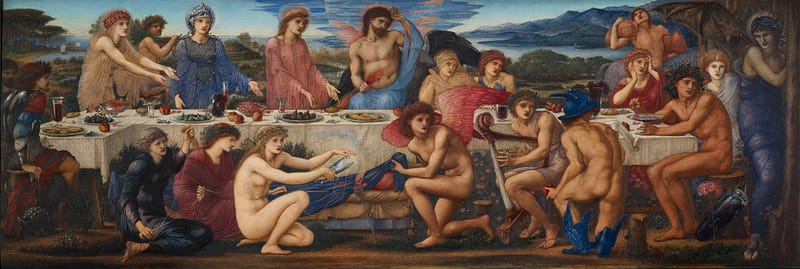
Aristippus of Cyrene, a student of Socrates, believed that pleasure is the highest form of truth. His philosophy of ethical hedonism said that the pursuit of pleasure and the reduction of suffering were the only intrinsic good, although the Cyrenaics, as his school of philosophy came to be known, also believed that pleasure could be obtained through altruism and social good.
“In the original Old Babylonian version of the Epic of Gilgamesh, which was written soon after the invention of writing, Siduri gave the following advice: ‘Fill your belly. Day and night make merry. Let days be full of joy. Dance and make music day and night […] These things alone are the concern of men.’ This may represent the first recorded advocacy of a hedonistic philosophy.”
In the modern Western world, the term hedonist is a bit of a pejorative. It implies self-indulgence and egotism and consequently the hedonist is someone not to be taken too seriously. He is much like the character from Shakespeare, John Falstaff, who is fat and vain and likes to spend his time drinking with libertines, and petty criminals. Falstaff is morally weak although he is one of Shakespeare’s most enduring and beloved characters.
And yet, by contrast, in the ancient world, pleasure and the sacred were inherently linked and female sexuality, in particular, was associated with the divine. This ended as more domination-oriented forms of religion came to the fore in which asceticism and even physical pain became associated with spiritual uprightness. The difference between supplicants to the Goddess communing with her via sex with the sacred intimates of her temple and monks who self-flagellate and wake up in the middle of the night to pray is significant.
In traditions that go back to the dawn of civilization, the female vulva was revered as the magical portal of life, possessed of the power of both physical regeneration and spiritual illumination and transformation.
During Western prehistory there was, as we have seen, a fundamental shift in how sex was conceptualized. From an act associated with the sacred, with religious rites, with the Goddess herself, sex became associated with male power over women. Then religious authorities taught men that the bodily or carnal is, like woman, of a lower order. So it became man’s duty to control and subdue not only woman (who was viewed by some medieval Christian theologians as so base that they even debated whether she had a soul) but all that is bodily or carnal. All this put men at war with their own bodies. And it also put them at war with women — hence the term “war of the sexes.”
Eisler, Riane. Sacred Pleasure . HarperOne. Kindle Edition.
Denial of the body and of bodily pleasures was a central element of Christianity as well as other religious and spiritual traditions, where the focus is on transcending the physical in order to reach enlightenment rather than interfacing with the divine through the sensations of the body. But, if the body is viewed as inherently base, it completely discounts the very real potential to experience the most exalted expressions of our humanity, of all that is most fulfilling and ennobling, through bodily sensations.
In reality, fully experiencing pleasure entails being present, sentient, and aware. And being sentient and aware makes it possible to also feel empathy, and thus at least to a certain degree to feel what another is feeling.
This sexual ethic would teach that there is nothing wrong with sexual passion, that on the contrary, our human capacity for sustained intense sensation, for feeling deeply through all our senses — be it through beautiful music, art, poetry, dancing, or making love — is part of what makes us uniquely human.
Eisler, Riane. Sacred Pleasure . HarperOne. Kindle Edition.
For me, hedonism is not just about the physical sensation of enjoying good food, beautiful art, moving music, pleasurable sex, etc. It is the feeling of being entirely human and connecting deeply with the human experience of others through the senses. From my perspective, this is one of the finest things that hedonism has to offer.
The other day I kissed a woman whom I had never met before. Our mouths explored each other’s as our hands caressed each other’s faces and hair and we became consumed with the experience of it. It didn’t just feel physically sensual and enjoyable, it also felt emotionally satisfying, even though it was a casual encounter. The essence of our humanity was being expressed through our physical selves, which is the most accessible way to energetically connect.
It wasn’t just about me feeling good and then her over there feeling good in our own separate bodily experiences of pleasure. In coming together in our kissing, we found connection in something that transcended both of our individual experiences and that too was enjoyable. She said to me, “I hope this doesn’t sound too weird, but I don’t want this moment to ever end.” It wasn’t about love or possession. It was about the complete and utter beauty of being hedonistically immersed in that moment together. And in truth, what could be better?
Our inner selves are encased in a physical housing. It is the simplest and most straightforward way to interface with each other and our world, through the experiences of our senses. Passion, ardor, sensuality, these are all indications of aliveness and as long as I inhabit this earthly plane, I damned-sure want to be alive and not to merely exist.
And in that place, this is where we have the most inner resources to devote to helping other people experience less pain and more pleasure as well. It is the best of all possible worlds — not one where we selfishly grasp at what pleases us at the expense of others — but one where we all pursue what connects us to each other and to the numinous through pleasure.
Think for a moment about the last time you had a celebratory meal with people you love — how the taste of the special dishes mixed with the laughter and the good feeling of just being together to create an experience that is greater than the sum of its parts. That is hedonism in a nutshell. I don’t know about you, but I don’t want to live in a world where that doesn’t exist or is frowned upon as immoral. I believe that hedonism is both moral and necessary. It is the place where we can most naturally connect as human beings and that is something that the world is desperately in need of.
© Copyright, Elle Beau 2020 Elle Beau writes on Medium about sex, life, relationships, society, anthropology, spirituality, and love.


