
How Much Like Bonobos Are We?
Primate females seek sexual novelty. Why wouldn’t humans also?
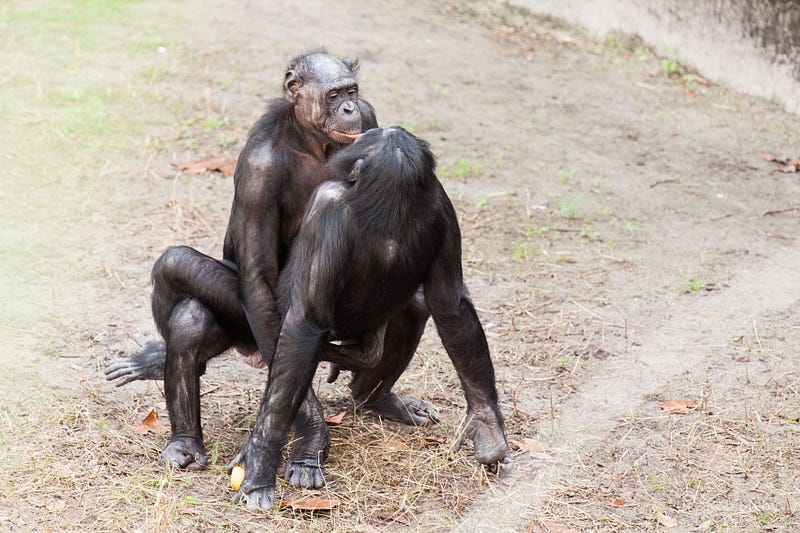
Bonobo muscles have changed the least [from our common ancestor], which means they are the closest we can get to having a ‘living’ ancestor,” according to the research head of the George Washington University Center for the Advanced Study of Human Paleobiology.
Most people have been taught as a scientific fact that human males are naturally randy and promiscuous, seeking to sow their genetic seed as widely as possible while females are reticent and choosy, prioritizing a provider and intimacy over sexual adventure. This is an important aspect of the Standard Model of Evolution, as was first developed by Charles Darwin. The problem is, no other primates actually behave in this way, and it therefore seems completely unlikely that humans would do so naturally rather than as a part of patriarchal expectations.
Primatologist, Meredith Small notes that seeking novelty is the single most observable trait among all the sexual behaviors, preferences, and drivers of female primates. Female primates are actually the complete opposite of how we’ve been taught to imagine them — as reluctant breeders or seekers of “intimacy” with a single “best” mate or only seeking to mate with the alpha.
“Indeed, Small suggests that it is difficult for us humans to wrap our minds around ‘just how little importance nonhuman female primates attach to knowing a male before they mate with him.’ Au contraire, our primate sisters are sexual adventuresses, driven by the thrill of the unknown and unfamiliar.”
Primates also aren’t focused on sex for procreation alone. Nor are they even particular about the gender of their partners. Female macaques, langurs, and bonobos frequently mount each other or rub genitals and males are just as unchoosy about sex partners as well.
“Adult male bonobos copulate with any number of females every day but are just as happy to massage the penises of other adult males in their troop or another troop, or stand rump to rump and rub their scrotal sacs together. Younger bonobos, both male and female, are fond of French kissing and fellatio. Adult female bonobos, for their part, enjoy being mounted by males and not infrequently mount them as well. Females equally or even more eagerly practice what primatologists term (rather uninspiredly) “G-to-G contact,” which is just an easier way of saying “genito-genital contact.”
Lying on top of each other, or facing each other while lying on their sides, the females press and grind their vulvas together in pursuit of pleasure. Which they find. Their clitorides — which are larger than a human female’s and more externalized — become engorged, and they often shriek as they rub against each other. It feels good enough that they do it roughly every two hours on average. In fact, field scientists have documented many instances when female bonobos ignored the overtures of males in order to indulge in this type of girl-on-girl action.
In a research study spanning several months, primatologist Zanna Clay and colleagues noted that ‘females engaged in significantly more sexual interactions with other females than with males.’ And why not? As Parish has observed, the bonobo female’s clitoris is large enough that it is easily stimulated. It can even be used for intromission. That is, a female bonobo can penetrate another female bonobo’s vagina with her excited, engorged, and not tiny clitoris. This is not a frequent occurrence, but it happens. Leave it to female bonobos to invent a dildo that’s always there for you.”
But primates aren’t just having a lot of sex because it feels good. For bonobos, in particular, it is also part of a bonding strategy that creates a kind of female cabal— one that keeps male aggression in check and establishes connection and cooperation.
Bonobos don’t just reduce tension with sex. Females are grinding and G-to-G-ing their way to establishing goodwill and connectedness, or reinforcing goodwill and connectedness already in place, using sex to build a sisterhood of sorts. And bonobo sisterhood is powerful. “We don’t see infanticide or females being sexually coerced, and we don’t see males being aggressive to females in any way,” (primatologist Amy) Parish explained.
We have long believed that humans, like chimps, are naturally prone to (mostly male) conflict and violence, and that male dominance, including infanticide and sexual coercion of females, is an inherent part of our evolutionary legacy. But humans are just as genetically close to bonobos as they are to chimps. What if we are naturally more like them? It would certainly be a different world if that were true and allowed to be expressed.
It all begged a number of questions about our world and the bonobo world, which we might think of as the original hookup culture. If human females lived under these conditions — a world that was female bonded, female affiliative, and female dominant, and where females had the freedom to be blatantly pleasure focused — then sex on college campuses would look very different indeed.
“Bonobos do not form permanent monogamous sexual relationships with individual partners. They also do not seem to discriminate in their sexual behavior by sex or age, with the possible exception of abstaining from sexual activity between mothers and their adult sons. When bonobos come upon a new food source or feeding ground, the increased excitement will usually lead to communal sexual activity, presumably decreasing tension and encouraging peaceful feeding.”
I’m not suggesting that we should try to create a female-dominated culture where it is the males who are often sexually harassed and everyone is going at it around the clock indiscriminately. However, it is an interesting thing to note that bonobos use sex to help create social cohesion and bonding. Females, in particular, sexually engage with each other as a means to cultivate and evaluate their intrasocial relationships. This is the way that they band together to keep the males from the kinds of aggression often seen in other primate societies and encourage peacefulness and fun.
What if women are in fact “wired” at some level to be sexually dominant and promiscuous, and to use sex for pleasure and building social bonds with other women — and it is primarily environment that has resulted in our behaving otherwise?
Skirt Club is a private members-only group that puts on sex parties for confident, successful bisexual and bicurious straight women to network and explore. What started as just a couple of clubs in New York and London is now a vast network of 47 in pretty much every major city all around the globe. Interest in Skirt Club keeps growing and when I first wrote about it, I had several inquiries wanting to know if I were a member.
This doesn’t mean the answer to the question above is definitively yes, or that human females are naturally wired exactly like bonobos, but it also speaks volumes about how social conventions have kept many women from the kinds of sexual lives that they might be more inclined to if they could choose for themselves.
What if rather than adhering to norms imposed on them by the relatively recent context of patriarchy, which is only about 6–9 thousand years old, women (and men) had the freedom to fully explore their sexuality? Would we have a more peaceful and socially cohesive world? I don’t know, but maybe.
Unless otherwise noted, all quotes are from Martin, Wednesday. Untrue. Little, Brown and Company. Kindle Edition.


