
How to Use Negative Thoughts to Improve Your Life
A healthy way to understand and overcome negative thinking

Intensive, intrusive, and repetitive negative thoughts are well known for causing fear, sadness, anger, anxiety, and even panic attacks.
For these reasons, we’ve always been advised to avoid them and pay zero to no attention to them, since they are ‘not real’.
But such a thing is pointless and difficult to achieve, in other words: a waste of time.
Guideline
- Where do negative thoughts come from?
- Why negative thoughts are key to grow
- Scientific explanation
- Our dearest friend Tom
- Exercise: using negative thoughts to speed up your self-improvement journey
Where do negative thoughts come from?
Repetitive negative thoughts are strongly linked to beliefs we built when we were kids. You must already know this better than I do, so let’s repeat it together this time:
Until the age of 8, our prefrontal cortex, the part of our brain responsible for logic and reason is not developed yet. This means we take the beliefs and behaviors of our mentors and build our thoughts from them.
A huge percentage of negative thoughts come from beliefs we built around that age, beliefs that are what I like to call: limiting.
Limiting belief — a judgment about yourself, that you believe to be true, and restricts you from living your life to the fullest.
Examples:
- I am not smart/pretty/tall/good/whatever enough
- I will never achieve success
- I will never be able to speak in public
- I am not worthy of being loved
Note that those things didn’t necessarily have to be told to you, per se.
Sometimes, actions speak louder than words, and you may have built these beliefs based on how you were treated by the people you looked up to when you were a kid.
Why negative thoughts are the key to grow
Those limiting beliefs were built when we were kids, and yet no matter how much time goes by, we never seem to leave them behind.
We outgrew the person who created those beliefs in the first place but did not outgrow the beliefs themselves.
These negative thoughts are slowing you down, or even stopping you, but read/listen closely: you can use them to your advantage.
They are giving you direction by telling you what to start working on so that you can improve your quality of life for good.
Negative thoughts are nothing to be ashamed of, much less ignored. They must be paid attention to, understood, and carefully replaced.
Allow me to use an example to explain this better:
Imagine the way to achieving your dreams is a road trip. You get a new car, pack your things, and get going. But after some time, the tires (beliefs) wear off, and if you don’t change them you’re in danger of getting in an accident.
Does it really make sense to ignore this as if it didn’t exist? I mean, you could for some time but it would slow you down tremendously, and even put you at risk.
What you should do is carefully change them, so you can continue with your road trip, safely.
Those tires/beliefs served you for many km/years, but it’s time to get new, updated, and safer ones.
Our dearest friend Tom
Those of you who read my articles often may already be familiar with our friend Tom.
Tom is that voice in our heads that is constantly talking, commenting, and narrating everything we see. By now, you should be thinking: what voice? I don’t have such a thing.
Well, there he is! Hi Tom! How is it going?
Negative thoughts are narrated by the voice in your head, and the voice in your head is not you, it’s Tom.
Separate yourself from him, you are you and he is Tom. You are not your thoughts.
Easier said than done right?
Here’s how you can do it:
Pay close attention to that voice from the outside, see how little sense it makes most of the time, how it describes and comments on everything, how quickly he changes his mind, how unstable he is… He has taken over you so strongly that you identify yourself with him.
Listen to everything he has to say, you’ll convince yourself Tom is a toxic friend.
(I’ll leave the link at the end of this article to the articleS where I introduce you to him, explain better how you can identify him, and how you can unfriend him).
Scientific explanation
It is very easy to think you are your thoughts because most of the time, they seem to control you and influence your emotions.
Our prefrontal cortex, PFC, (in charge of our thoughts) is connected with the amygdala, A, (responsible for emotions, mostly negative* such as fear, sadness, and anger), and they should regulate each other.
*Two-thirds of the neurons of the amygdala are used to detect negative thoughts and store them in long-term memory, says Neuropsychologist Rick Hanson, PhD, University of California, Berkeley.
When the amygdala — the part of the brain believed to play a key role in emotions — becomes aroused, it remains in that state for a long time. At the same time, a memory of the situation becomes imprinted in the brain. The more emotional the situation, the stronger the memory will be. — By Psychcentral
The PFC is responsible for reducing the emotional reactions to stress of the A, but it is also the PFC the one that stores your limiting beliefs.
If the A by itself stays in that state for a long time, and the PFC which is supposed to regulate the A doesn’t, imagine how strong those memories are after years of having negative thoughts.
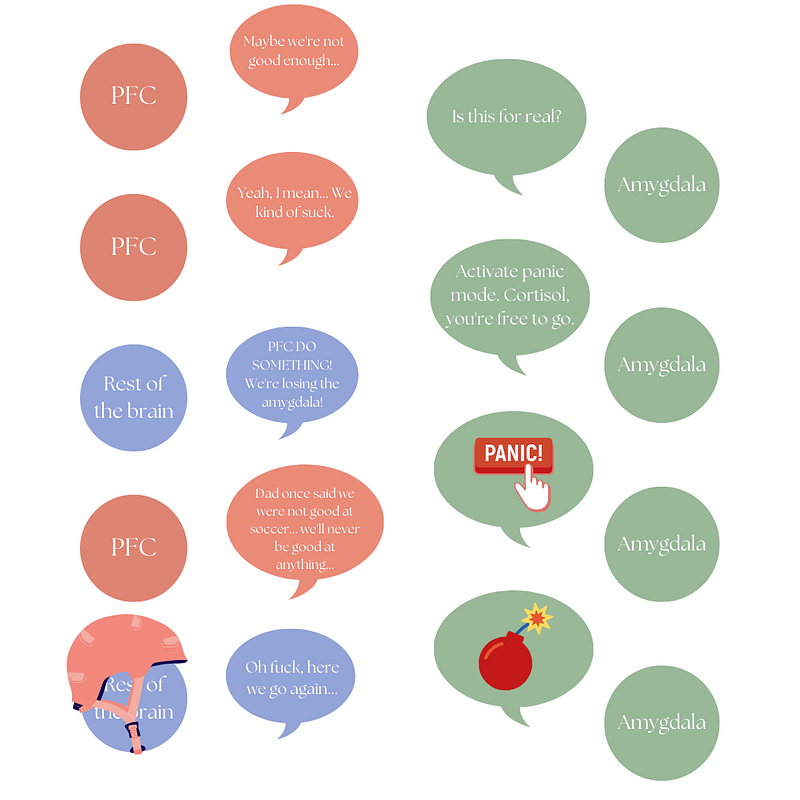
That is why we believe them to be true, we have glued them in our memory. But we are the ones forcing them to stay, even if we don’t need them anymore. So it’s time to let them go.
Let’s see how.
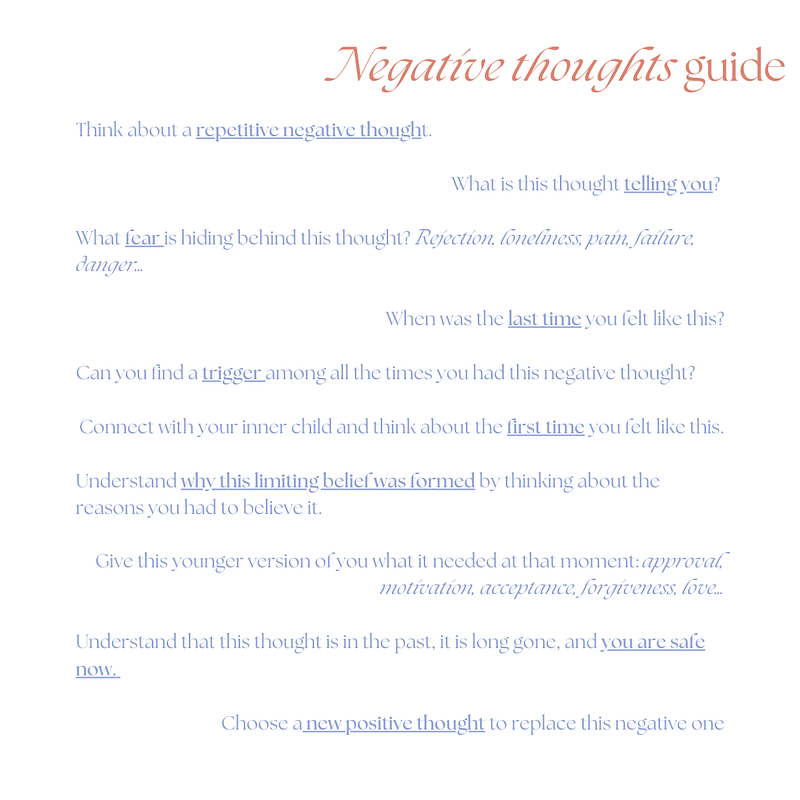
Exercise
Take some time alone and go through these questions carefully. I recommend you write your answers down, but it is completely up to you.
I’ll leave you the exercise in a downloadable image so you can save it, use it any time you want without having to come back to this article, and even share it.
Article mentioned: